Why Are Pearl Necklaces Knotted Between Pearls?
The tiny knots between pearls do two useful jobs: they help limit how many pearls can slip off if the string breaks, and they separate neighboring pearls so their surfaces do not rub directly against each other. They are a practical part of a pearl necklace’s construction, even when they almost disappear into the strand.
Knots do not make a necklace unbreakable, and they cannot keep worn thread strong forever. Understanding what they protect—and what still needs attention—makes it easier to recognize when a strand is ready for professional restringing.
In this guide
Why are pearl necklaces knotted between pearls?
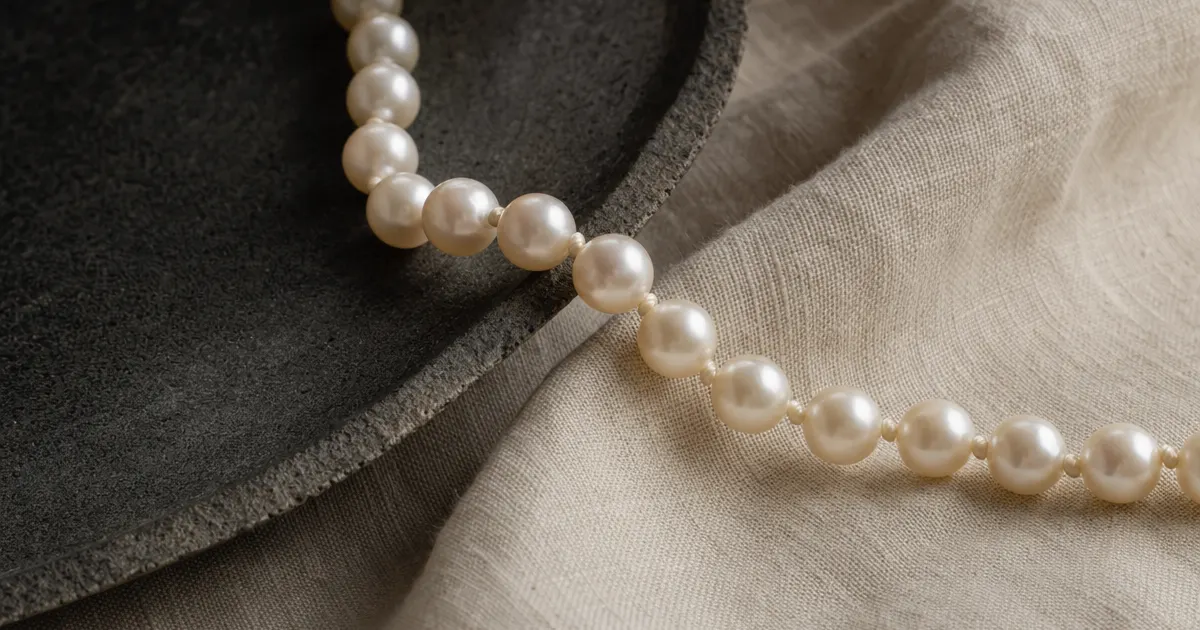
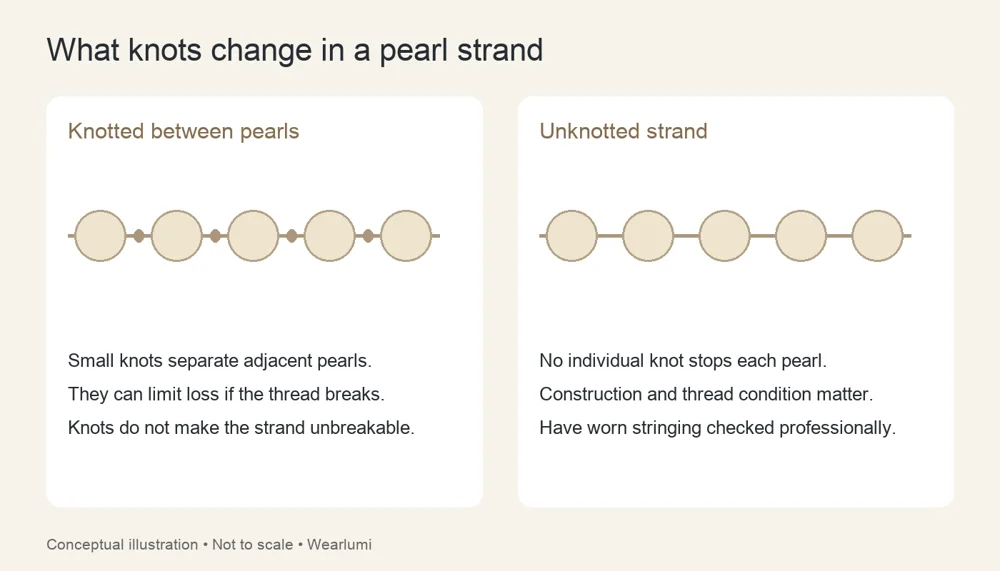
Think of a knotted strand as a series of small, separated units. The thread passes through a pearl’s drill hole, then a knot sits between that pearl and the next. Repeating that arrangement along the necklace provides both spacing and a barrier to pearls sliding freely along the string.
GIA’s pearl buyer’s guide gives these two reasons directly: knots help prevent the loss of an entire strand when the string breaks, and knots between individual pearls prevent them from rubbing against one another. The protection comes from the necklace’s construction, rather than anything applied to the pearl’s surface.
It helps to consider the pearls and their string separately. A necklace can have beautiful pearls while its thread needs replacement. Likewise, the presence of knots tells you something about how a strand is assembled; it does not, by itself, establish the pearls’ identity, quality, or value.
Why Are Pearl Necklaces Knotted Between Pearls to Prevent Strand Loss?
On a strand without individual knots, a break can leave an open end through which multiple pearls may slide. Knots interrupt that route. If a section of thread fails, neighboring knots can help contain the loss instead of leaving the whole strand free to scatter.
That is why knotting is especially useful in a necklace made from many separate pearls. GIA’s pearl-care FAQ describes the familiar benefit as only one pearl coming loose when a knotted necklace breaks. For everyday care, treat that as an explanation of the intended protection, rather than a promise about every possible failure.
The outcome depends on the condition of the strand and where it fails. A necklace with compromised thread or knots needs attention even if every pearl originally had a knot beside it. Knotting helps manage a break; it does not remove the need to inspect the string.
If your necklace breaks, stop handling it over an open floor or sink. Set the strand and any loose pearls in a small container, keep the clasp and other components together, and take everything to a jeweler. These are practical recovery steps, not a substitute for repairing the strand before wearing it again.
Why separating pearl surfaces matters
A necklace moves as you move. A core reason why are pearl necklaces knotted between pearls is that without individual barriers, their delicate nacre surfaces grind directly against each other. Each knot creates an isolated buffer that prevents continuous surface friction.
That matters because pearls are vulnerable to scratching and abrasion. GIA’s Pearl Care and Cleaning Guide describes pearl as very soft and easily scratched or abraded. Its buyer’s guide specifically recommends knots to prevent neighboring pearls from rubbing together.
The spacing has a limited job. It does not protect the exposed sides of the pearls from a rough surface, a sharp object, or harder jewelry stored alongside them. A knotted necklace still needs gentle handling and separate, soft storage.
Do not pull neighboring pearls apart to see how securely they are knotted. Look at the strand while it rests on a soft, light-colored cloth instead. If the spacing seems different from how you remember it, note the change and ask a jeweler to examine it. A visual check is more useful than putting extra tension on thread you already suspect may be worn.
The string can wear out while the pearls still look beautiful
It is easy to focus on luster and overlook the thread carrying the piece. Even when knowing why are pearl necklaces knotted between pearls, remember that knots are tied from the same silk string, meaning the knotting material will naturally stretch and degrade over years of wear.
GIA’s buyer’s guide notes that pearl string stretches and weakens over the years. Its care FAQ adds that silk string can darken, stretch, or wear thin, and that pearl necklaces may need periodic restringing. Those changes can matter even when the pearls themselves look much as they always have.
Silk is specifically discussed in GIA’s guidance, but do not assume you know your necklace’s stringing material from a quick glance. If you are unsure, ask the jeweler inspecting it. The useful question is whether the existing material and construction are still suitable for continued wear.
A change in color alone does not tell you exactly how much strength remains. Neither does a necklace’s age. Instead of trying to calculate a replacement date from appearance or a calendar, consider visible changes together and have concerns assessed professionally.
Signs to ask a jeweler about professional restringing
When reviewing why are pearl necklaces knotted between pearls, monitoring overall string health is critical. The clearest reason to arrange an inspection is a noticeable change in the string or spacing, as stretching and weakening naturally occur over time.
Use the following as prompts for an assessment, rather than a home pass-or-fail test:
- More exposed thread than before: new or larger gaps between pearls may be a reason to discuss stretching.
- Thinning, fraying, or damaged-looking thread: put the necklace aside until a jeweler can examine it.
- Darkened silk: ask about its condition, particularly if the change appears alongside looseness or thinning.
- Knots or end attachments that look different: have loose-looking knots, exposed ends, or an insecure clasp connection checked.
The first three prompts follow GIA’s descriptions of string deterioration. Checking the knots and end connections is a practical extension of inspecting the complete necklace, rather than a separate GIA diagnostic rule.
Bring the whole strand to the appointment and describe what changed. Ask the jeweler to assess the thread, knots, clasp, and connections, explain whether restringing is appropriate, and discuss the intended spacing and finished length before work begins. Avoid tightening questionable knots yourself or adding glue as a temporary repair.
There is no single useful restringing deadline for every necklace. The cited GIA guidance calls for periodic restringing without setting a universal interval. Let the strand’s condition and professional advice guide the decision instead of treating an annual date as either mandatory or a guarantee of safety.
Care for the pearls and the string together
Good care supports the whole necklace. For routine cleaning, GIA recommends wiping cultured pearls with a very soft, clean cloth after each wearing. Put pearls on after applying perfume or cosmetics, and store them in a soft pouch or case away from sharp or rough objects.
Keep pearl necklaces out of ultrasonic and steam cleaners. That instruction comes directly from GIA’s care and cleaning guide. For broader context when sorting other jewelry, see Wearlumi’s ultrasonic cleaner gemstone safety guide.
GIA also allows warm, soapy water for occasional, thorough pearl cleaning and says the string must be completely dry before the necklace is worn. If the strand looks worn, its construction is unfamiliar, or other components need special care, ask a jeweler how to clean that particular necklace before proceeding.
Our perfume and sunscreen jewelry care guide offers practical ways to separate jewelry from freshly applied products. For pearls, the useful habit is straightforward: finish your beauty routine before putting on the necklace, then wipe it gently after wear.
Ultimately, knowing why are pearl necklaces knotted between pearls confirms that knots provide essential surface protection, but remain only one part of a sound strand. Notice changes in spacing and thread, avoid unnecessary pulling, and seek professional restringing when wear appears.
Explore more jewelry at Wearlumi.
Sources
- GIA: Pearl Buyer’s Guide — knotting, pearl separation, string stretching, and restringing advice.
- GIA: How should I care for my pearls? — silk deterioration, periodic restringing, storage, and care.
- GIA: Pearl Care and Cleaning Guide — abrasion sensitivity, cleaning precautions, and drying the string.