Can Diamonds Chip? Why Hardness Isn’t Toughness
Can diamonds chip? Yes, diamonds can chip despite their exceptional mineral hardness. While diamonds resist surface scratches effortlessly, high hardness does not make them immune to impact damage. A hard knock at an exposed edge can remove a piece of stone, even after years of daily wear. GIA explains how diamond chipping happens.
That distinction matters when choosing a ring, comparing settings, or deciding what to do after an accidental knock. Understanding how diamonds respond to scratches and impacts lets you enjoy your jewelry with sensible care, without expecting any gemstone to be indestructible.
In this guide
Can Diamonds Chip? Hardness Resists Scratches While Toughness Resists Breaking
Gemstone durability has three parts. Hardness describes resistance to scratches and abrasion. Toughness describes resistance to chipping, cracking, and breaking. Stability describes resistance to chemicals and temperature changes. A stone can perform exceptionally well in one category while still needing care in another. GIA’s diamond care guide defines these durability properties.
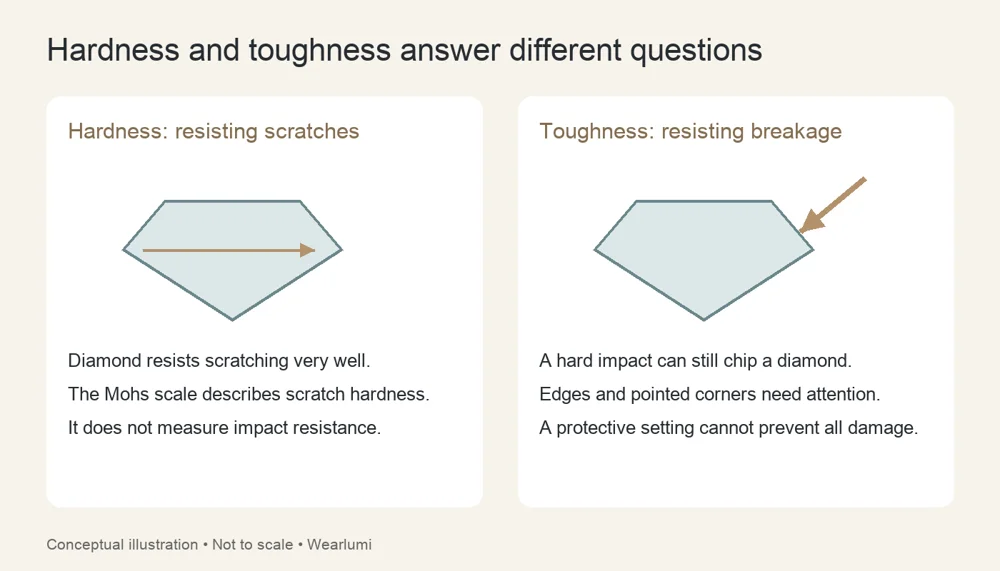
Diamond ranks 10 on the Mohs hardness scale, the highest position on that scale. But Mohs measures relative scratch resistance; it does not assign an impact rating. Its steps are also uneven, so the difference between 9 and 10 is not equivalent to the difference between 8 and 9. GIA explains diamond hardness and the Mohs scale.
A scratch marks a surface; a chip means material has broken away. Something does not need to be capable of scratching a diamond to damage it through impact. GIA identifies hard countertops as a potential source of chips when a diamond’s edge or point strikes them. See GIA’s examples of chipping risks.
For more context on what a hardness number can tell you, read our Mohs hardness scale jewelry guide. Treat hardness as one part of a durability assessment, alongside the stone’s condition and how it will be worn.
Cleavage explains why the direction of a blow matters
Diamond’s crystal structure has directions along which it separates more easily. Gemologists call this property cleavage. Diamond has four perfect cleavage directions, and its resistance to breaking varies with direction. A sufficiently hard blow in an unfavorable direction can therefore chip or split a diamond despite its high scratch resistance. GIA describes diamond’s cleavage directions.
Cleavage is a structural property, not a synonym for a crack already inside a particular stone. It helps explain how damage can occur; it does not mean every diamond is about to split. GIA also notes that actual chips often have a stepped appearance rather than the smooth, flat surface people might imagine from the word “cleavage.” GIA discusses the appearance of diamond chips.
For an owner, the practical lesson is to consider impact separately from scratching. Whether a particular knock causes damage depends on where and how the force reaches the stone. A ring surviving one accidental collision does not establish that it will survive the next. There is no useful home experiment that turns an individual diamond into a reliably “chip-proof” stone.
Pointed corners and thin girdles deserve extra attention
The girdle is the edge around a cut diamond, between its upper crown and lower pavilion. Chips commonly occur when that edge or a point strikes something hard. Girdles with very thin sections are more vulnerable, particularly at corners and tips. A thicker edge can be harder to chip, but a strong blow can still damage it. GIA identifies girdle thickness as a durability consideration.
Shape influences where exposed points occur. Princess cuts have pointed corners; pear and marquise shapes have pointed ends. Those areas need thoughtful protection. Round, oval, and rounded-corner cushion shapes avoid that particular point exposure, although their edges remain susceptible to damage. GIA explains the vulnerability of points and sharp corners.
Condition matters alongside outline. Certain inclusions near the girdle or a point, including feathers, can increase vulnerability depending on their location and the direction of an impact. An open cavity at the girdle also warrants attention. These are reasons to have a professional assess the individual stone, rather than deciding durability from its shape or clarity grade alone. GIA discusses inclusions and cavities near vulnerable edges.
When evaluating a diamond, ask the jeweler to identify its most exposed areas and explain any condition concerns. The useful question is specific: “What should I understand about this stone’s girdle, points, and existing features?”
Settings can reduce exposure, but cannot guarantee protection
Metal placed around a vulnerable area can help shield it from direct contact. GIA recommends considering bezels, partial bezels, or V-shaped prongs for exposed points and corners. The appropriate choice depends on the diamond’s geometry and how the mounting supports it. GIA outlines setting options that help protect vulnerable areas.
Protection has limits. GIA documents that a hard blow to a prong at a princess-cut corner can still cause a chip. Bent or broken prongs also compromise the support and protection a setting provides, and a loose diamond is at greater risk of chipping. No setting makes a diamond immune to impact damage. GIA explains prong damage and remaining chip risks.
For a broader comparison, our guide to prong, bezel, and pavé gemstone settings can help frame the conversation. Ask how the proposed design covers the actual vulnerable areas of your stone, and have the finished mounting inspected by a qualified jeweler.
Reduce chip risk with a few everyday habits
The most useful care routine addresses situations where jewelry could strike a hard surface. Jewelers Mutual recommends removing diamond rings for workouts, DIY projects, and gardening, where equipment, tools, or rocks can create impact risks. Store the ring securely before starting, rather than leaving it on a nearby counter. Jewelers Mutual explains when to remove a diamond ring.
- Plan for hands-on activities. Make putting the ring away part of preparing for a workout or project.
- Keep neighboring jewelry in mind. GIA identifies contact between diamond jewelry worn next to each other as a possible cause of chips. See GIA’s common impact examples.
- Arrange professional inspections. Ask a jeweler to check the mounting and recommend an inspection schedule suited to its condition and your wear habits. GIA emphasizes checking prongs regularly for damage. GIA explains why prong condition matters.
These habits reduce avoidable exposure; they cannot eliminate every accident. The goal is to make care easy enough to follow consistently, especially for a ring you wear often.
If you suspect a chip, stop wearing it and get an inspection
A newly noticed edge irregularity after a knock deserves professional attention. If you suspect a chip, loose stone, or damaged prong, remove the jewelry and arrange a prompt inspection. Jewelers Mutual recommends seeing a jeweler for suspected damage, and GIA warns that an already chipped area can be especially vulnerable to further chipping. Read Jewelers Mutual’s inspection advice; see GIA’s warning about continued wear.
Put the piece in a secure jewelry box until the appointment. Do not scratch it against another material, tap it, press on the suspected chip, or try to move the stone to check its security. Skip DIY durability tests and attempts to tighten the setting. An inspection is the appropriate next step.
Ask the jeweler to assess both the stone and the mounting, explain what they find, and discuss suitable options. Recutting or moving a diamond into another piece may be possible in some cases, but the choice requires an individual assessment. Jewelers Mutual discusses potential options after chipping.
Diamond’s remarkable scratch resistance makes it appealing for jewelry, but asking can diamonds chip helps you respect physical limits: stone shape, setting condition, and daily wear routines. When you are ready to explore durable jewelry, visit Wearlumi with those practical protection questions in mind.