Why Is My Gold Jewelry Stamped 925?
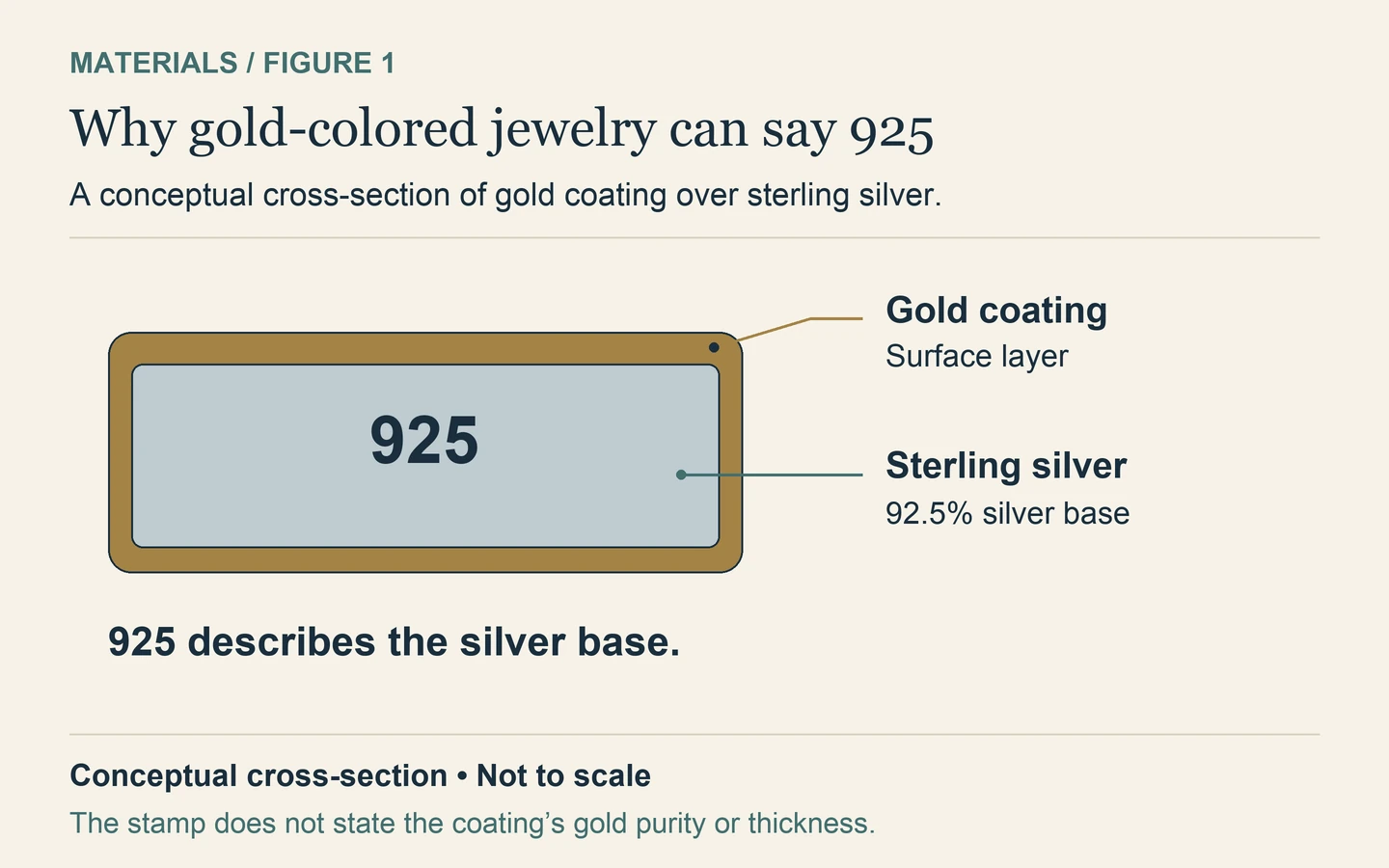
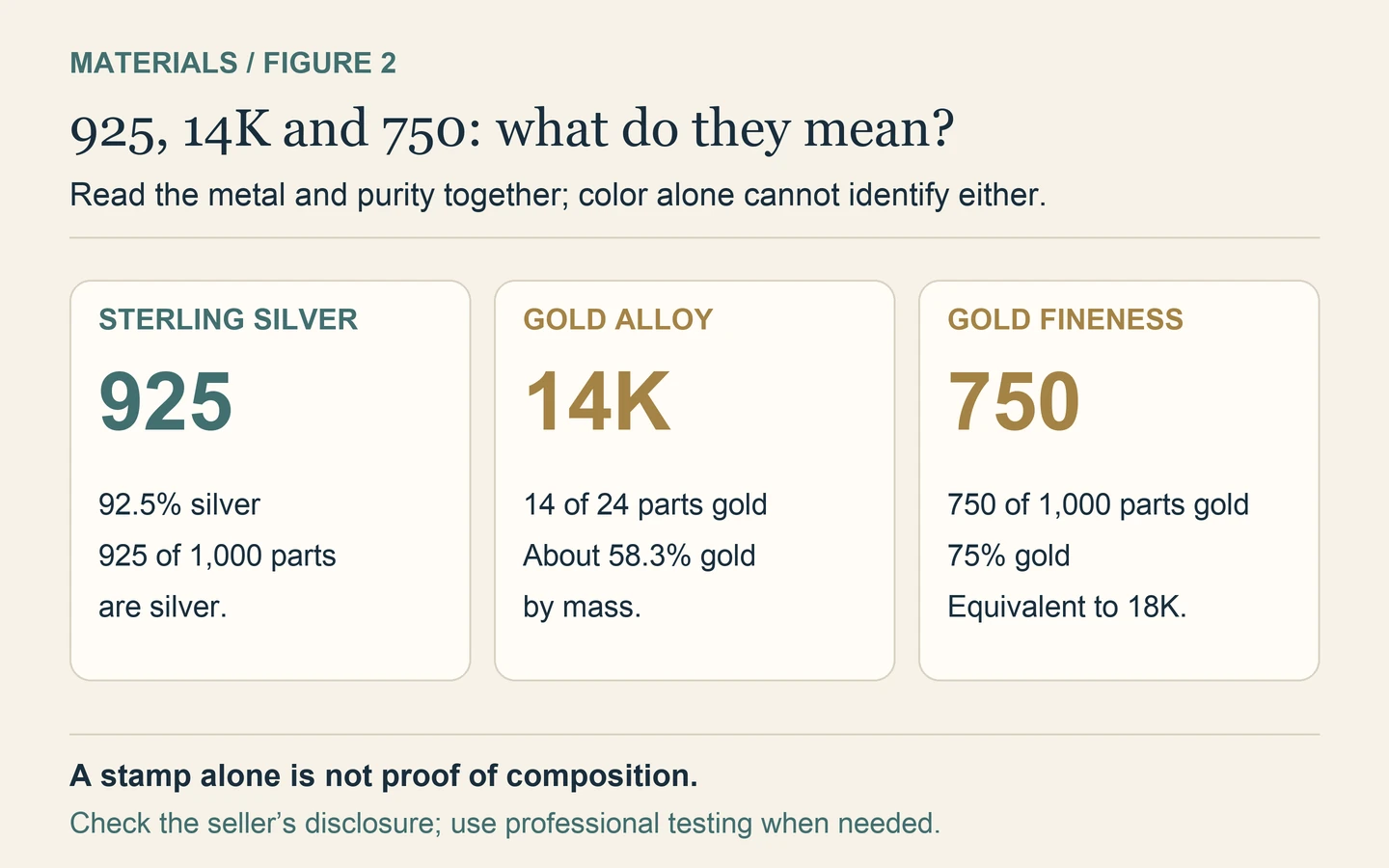
A 925 stamp on gold-colored jewelry usually points to a sterling silver base with a gold coating. The number refers to silver fineness: 925 parts per thousand, or 92.5% silver. It does not mean 92.5% gold, and it does not establish the coating’s karat or thickness. The FTC Jewelry Guides’ silver standard sets that sterling threshold.
Finding 925 on gold jewelry is therefore a reason to check its description, not an automatic sign that you bought a fake. The useful question is whether the silver base and gold surface match what the seller promised. Here is how to read that distinction without treating a tiny stamp as a laboratory report.
On this page
What does 925 on gold jewelry actually tell you?
The stamp is a claim about the silver component, not a complete description of the finished piece. If the marking is accurate and the item is gold plated over sterling silver, 925 describes the silver beneath the gold. The coating needs its own description.
Think of the item as two separate questions: what is the body made from, and what covers it? “925 sterling silver, 18K gold plated” answers both. “925 gold” leaves the relationship unclear. Under FTC gold guidance, descriptions of coated products should make their surface-plated construction clear.
Placement matters, too. If you find the mark on a clasp or small tag, ask whether the seller’s material statement covers the chain, pendant, and findings as well. Treat that as a verification question rather than assuming every component has the same composition.
Is gold-colored 925 jewelry real gold or fake?
Gold-plated sterling silver can have genuine gold in its surface layer while having silver as its base. That is different from a piece made throughout of a gold alloy. “Real gold” is an incomplete answer unless you know which part it describes.
A correctly described plated piece can be exactly what its buyer wanted. The problem arises when plating is presented as through-body gold, or the material differs from the description. If your receipt says “solid 14K gold” but the only mark you can find is 925, ask the seller to explain the discrepancy before reaching a conclusion.
A number alone cannot settle authenticity. Nor does a gold color establish composition. For the broader construction comparison, our guide to solid gold versus gold-plated jewelry explains why separating the body from the surface is useful.
Does 925 mean the piece is gold vermeil?
No. Gold vermeil is a more specific description than gold plating over silver. A 925 stamp supplies no evidence of the gold layer’s thickness or fineness, so it cannot establish that the finished piece meets the US vermeil conditions.
Under the current FTC Jewelry Guides, Section 23.4, a product may be described as vermeil when it has:
- A sterling silver base.
- Gold or gold alloy of at least 10K on all significant surfaces.
- A coating of reasonable durability.
- A minimum thickness throughout equivalent to 2.5 microns of fine gold.
That last phrase matters. The FTC specifies a fine-gold-equivalent thickness, not simply any gold-alloy coating advertised as “2.5 microns.” Ask the seller how its stated thickness and karat meet that condition. A high karat number by itself does not answer the thickness question.
The Guides also call for disclosure when a base-metal layer, such as nickel, lies between the sterling silver and gold. These are US marketing guidelines; they do not certify an individual item or guarantee a fixed number of years of wear.
Is a 925 quality stamp the same as a hallmark?
A standalone 925 quality stamp is not the same as an independently verified hallmark. It states a fineness claim; it does not, by itself, identify an independent testing authority.
The UK system illustrates the difference. Birmingham Assay Office explains that a UK hallmark includes three compulsory elements: a sponsor’s mark, a fineness mark, and an assay office mark. The office mark connects the item to independent testing and verification.
Those are UK hallmarking arrangements, not a checklist that every US purchase must satisfy. When researching an imported or older piece, read the whole group of marks and identify the relevant country’s system. Calling any isolated number a “hallmark” can give it more evidentiary weight than it deserves.
Can an authenticity test prove what is underneath?
Professional testing can help, but the method must suit a layered object. A surface result and a conclusion about the whole item are different things.
X-ray fluorescence, or XRF, is useful for metal analysis, yet plating can complicate its interpretation. In GIA’s 2025 report on gold-plated gold, a higher-karat surface could make the underlying gold alloy appear purer than it was. That example concerns gold over gold; it demonstrates a testing limitation rather than proving anything about your silver-based piece.
A separate GIA bracelet examination found that thick plating and electroforming could escape detection by XRF alone. Microscopic inspection and further investigation changed the conclusion. Our explanation of electroformed gold jewelry gives context for that construction.
For a meaningful assessment, tell the jeweler you suspect gold over sterling silver. Ask what was tested, whether the result describes the surface or base, and what remains uncertain. Discuss any proposed filing or sampling before authorizing it. A home observation of color, weight, or a stamp is not equivalent to an analysis of both layers.
What should you ask the seller next?
Ask for a written material description that separates the base, coating, and evidence. You do not need a metallurgy vocabulary to request a clear answer.
- Confirm the base. Does “925” describe the body of the piece, or a particular component?
- Identify the coating. Is it gold or gold alloy, and what karat is stated?
- Clarify any vermeil claim. What minimum thickness is supported, and how is the fine-gold-equivalent condition addressed?
- Ask about other layers. Are there intermediate metals or an additional finish?
- Keep the records. Save the listing, receipt, stamp photographs, and seller’s response. If they conflict, request an explanation and review the return terms before commissioning testing.
The goal is to resolve what you own and what was promised. Testing may be worthwhile for an expensive purchase or an unresolved discrepancy; a clear, consistent description may answer a simpler question.
What does this mean for your jewelry?
Read 925 as a starting point: a silver-fineness claim that needs the rest of the material description. It does not establish solid gold, vermeil compliance, independent verification, or a particular resale value. You can appreciate a gold-plated silver piece while still expecting precise disclosure about both layers.
For your next purchase, bring those same questions to the Wearlumi shop.