From Ancient Egypt to Modern Gold: Why Big Jewelry Feels Light
Electroforming gold jewelry creates a metal shell by electrodepositing gold or a gold alloy onto a conductive form, then removing that temporary core. The finished piece can keep a generous, sculptural outline while using much less metal than a solid object of the same size. Its lightness comes from the hollow interior; the gold itself has not become less dense.
Pick up a rounded pendant that looks substantial, and that difference can be surprising. The shape suggests weight. Your hand tells a different story. Electroforming helps explain how those two impressions can coexist—and why a light piece still needs thoughtful engineering.
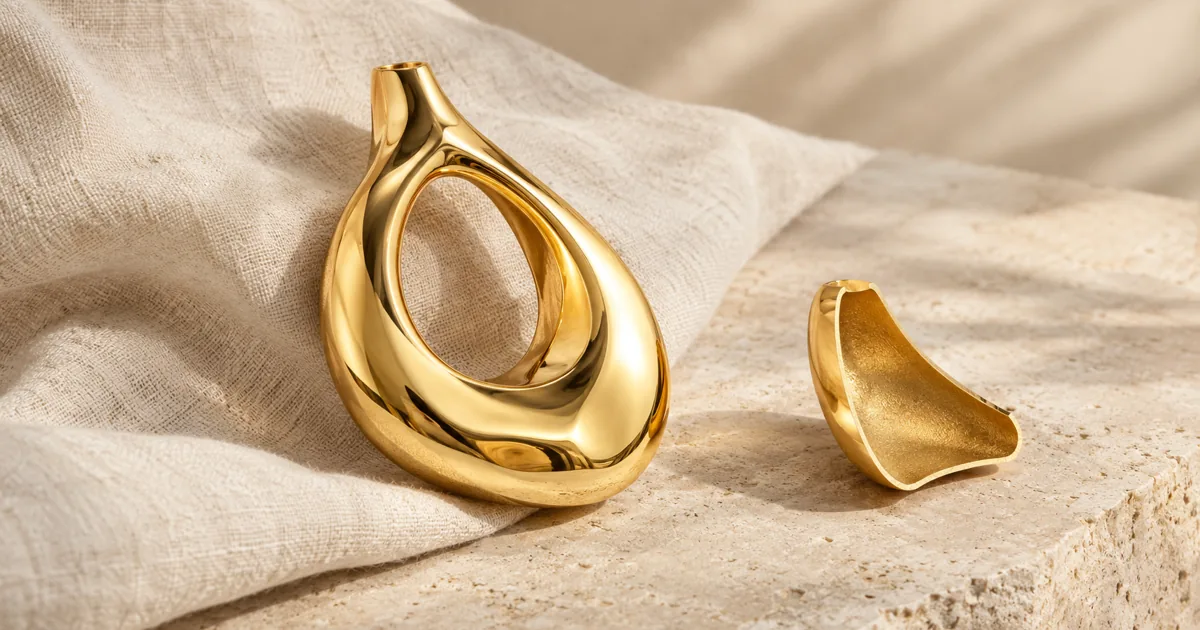
The cover is an AI-generated editorial illustration, not a Wearlumi product photograph. Process diagrams below are simplified illustrations.
In this guide
- From ancient Egyptian goldwork to modern electroforming
- How electroforming gold jewelry works
- From wax mandrel to hollow jewelry
- Why a large shape can weigh so little
- What keeps a thin shell in shape?
- Electroforming versus gold plating
- The manufacturing breakthrough behind the shell
- What to ask before buying lightweight gold jewelry
From ancient Egyptian goldwork to modern electroforming
Ancient Egypt belongs in this story as part of gold jewelry’s long history. Modern electroforming belongs to a much later chapter in manufacturing.
The Metropolitan Museum of Art’s Gold Necklace of the Child Myt dates to approximately 2051–2030 BCE. Made of gold with an ancient linen cord, it is a surviving example of fine Egyptian jewelry from more than four thousand years ago.
That artifact does not establish an ancient origin for electroforming. The electrical process came much later. Encyclopaedia Britannica records that Jacobi announced electrotyping, an electroforming method for copying printing plates, in 1838. A metal shell was deposited onto a mold and then separated from it.
The connection across these eras is the desire to give gold a shape people can wear. The manufacturing method changed: electrodeposition made it possible to build that shape through controlled chemical reactions.
How electroforming gold jewelry works
Electroforming uses an external electrical supply to drive the formation of solid metal on a conductive surface.
In a gold electroforming bath, gold is present as dissolved chemical species, commonly complexes, rather than tiny flakes floating in the liquid. A conductive mandrel—the temporary form that defines the piece—is connected to the negative side of a direct-current supply. It serves as the cathode. An anode connected to the positive side completes the electrode arrangement.
At the cathode surface, gold-containing species undergo reduction: gold gains electrons and becomes part of a solid metal deposit. As deposition continues, the layer builds thickness. Bath chemistry and operating conditions vary between processes. Withey’s technical article in Gold Bulletin describes gold bath selection, conductive surface preparation, and control of deposit growth.
“Atom by atom” is a useful way to picture this transformation. It describes reactions happening at an atomic scale, with many reactions occurring across the surface at once. The deposit forms through nucleation and crystal growth; equipment does not place individual atoms into a predetermined arrangement.
Making metal stick is only the beginning. A usable shell needs enough thickness, suitable material properties, and controlled internal stress to remain intact after its supporting core is gone. Those demands make electroforming more challenging than simply adding a decorative coating. Kuhn and Lewis’s review of gold electroforming explains why current distribution and internal stress become especially important when the deposit must stand on its own.
From wax mandrel to hollow jewelry
A wax-based route typically involves shaping a core, making its surface conductive, depositing metal, removing the core, and finishing the shell. This sequence is an introduction to one route; industrial processes can use different mandrels and intermediate layers.
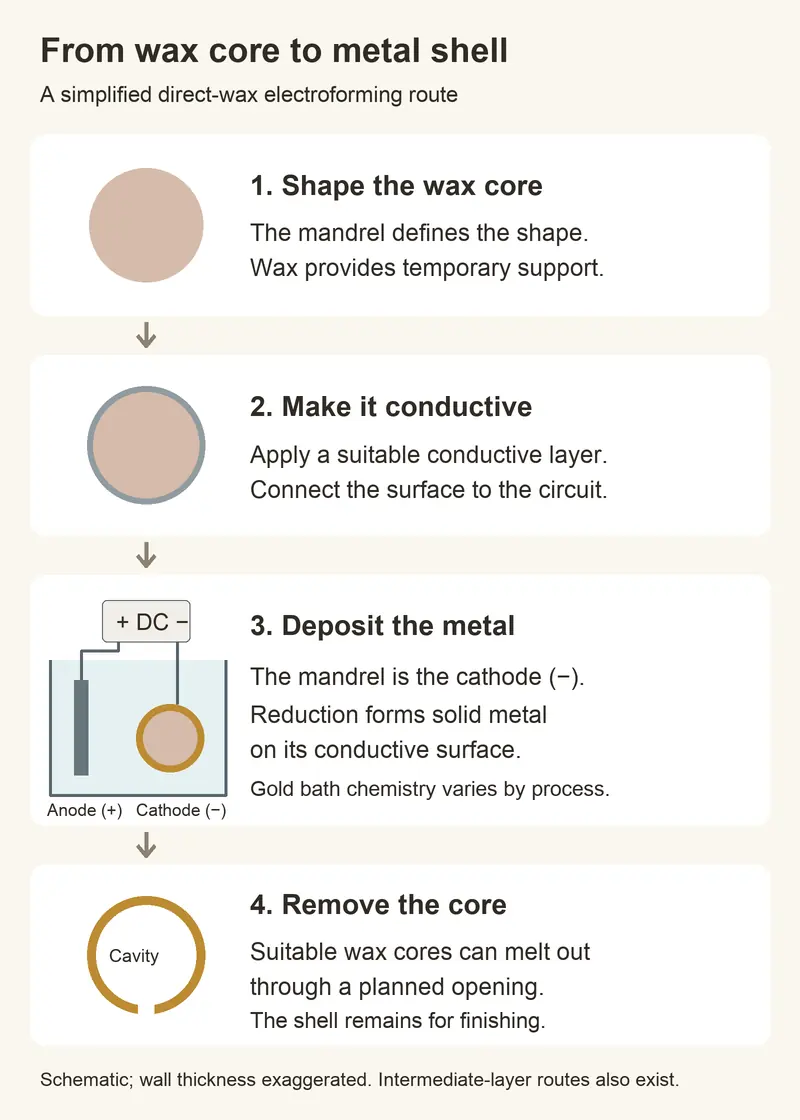
- Shape the mandrel. A wax form provides the intended geometry and surface detail. Its shape establishes the starting surface for deposition.
- Make the surface conductive. Wax cannot function directly as the required electrode surface. A suitable metallization treatment connects that surface to the electrical circuit.
- Build the metal shell. The conductive form enters the bath. Deposition builds the metal layer to the design’s required thickness while the manufacturer controls bath chemistry, current density, temperature, and solution maintenance.
- Remove the temporary core. In suitable wax processes, heat allows the wax to melt out through a planned opening. Other routes may use soluble or fusible mandrels.
- Finish and inspect. The piece receives the required opening treatment, attachments, and surface finishing. Deposit integrity, wall thickness, and connection points all matter to the finished result.
The shorthand “grow gold on wax, then melt out the wax” leaves out some real manufacturing variations. A patent describing electroformed hollow jewelry, for example, discusses wax routes in which a copper shell is formed first, the wax is removed, gold is deposited onto that shell, and the copper is subsequently removed. A patent documents a particular route; it does not show that every modern factory follows it.
More time in the tank is not automatically better. Unsuitable deposition conditions can produce roughness, nodules, uneven distribution, or cracking. The process must balance thickness with deposit quality.
Why a large shape can weigh so little
The outside dimensions determine how large a piece looks. The volume of actual metal determines how much its metal body weighs.
For the same material, mass equals density multiplied by metal volume. Replacing an interior volume of metal with an empty cavity reduces mass without changing the material’s density.
A spherical example makes the difference easy to calculate. The dimensions below are hypothetical geometry, not typical electroforming specifications or a Wearlumi product claim.
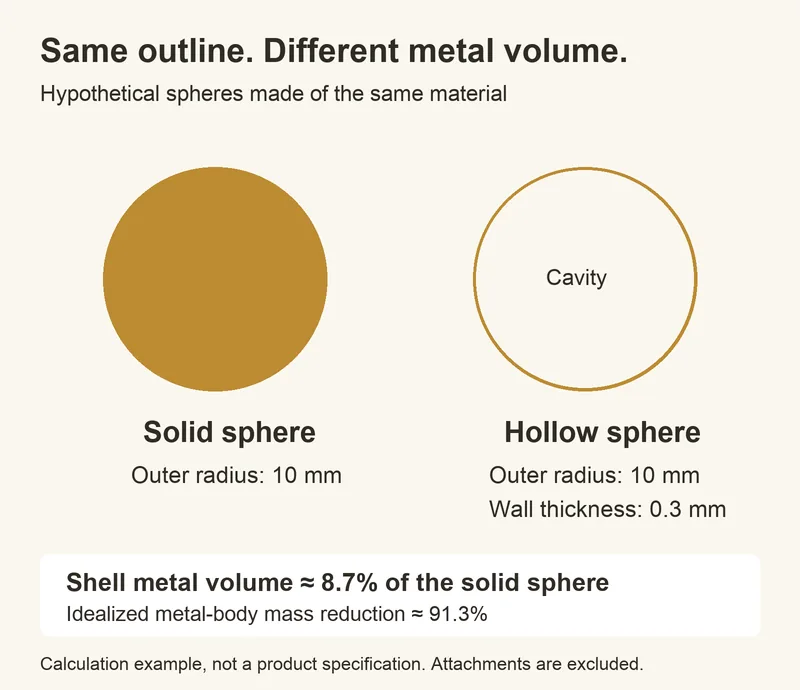
Imagine two objects made of the same metal, each with an outer radius of 10 mm. One is solid. The other is a hollow sphere with a 0.3 mm wall, giving it an inner radius of 9.7 mm.
The shell’s metal volume, divided by the solid sphere’s volume, is:
1 − (9.7 ÷ 10)3 ≈ 8.7%.
In that idealized model, the hollow sphere uses about 8.7% as much metal as the solid sphere. Its metal body therefore weighs about 91.3% less, even though the outside dimensions match.
A real pendant has attachment points, local thickness variations, and possibly other components. Those change the total weight. The example explains the physical principle, rather than predicting a finished piece’s weight.
For a broader comparison of wear and structure, see our guide to hollow versus solid gold jewelry.
What keeps a thin shell in shape?
A shell’s ability to hold its shape depends on its material, thickness, geometry, and manufacturing quality. The word “electroformed” cannot establish those properties by itself.
Controlled electrodeposition can create a different grain structure from casting or rolling. Withey’s Gold Bulletin article discusses fine-grained gold deposits that are harder than conventionally processed gold of the same purity under the conditions described. This is evidence that processing can change material behavior, rather than a hardness guarantee for every electroformed item.
Geometry matters too. A curved shell responds to loads differently from a flat sheet, and local reinforcement can change where deformation begins. One hollow-jewelry patent describes integral internal ribs intended to support a thin shell against crushing. That is a specific design option, not a feature shared by all electroformed jewelry.
Hardness and resistance to crushing are different properties. A harder metal can still form a thin shell that dents under concentrated pressure. Wall thickness, curvature, openings, and attachments affect the behavior of the whole piece.
“Featherlight” is best understood as a description of the contrast between size and weight. It is neither a literal weight specification nor evidence that a piece can withstand any squeeze or impact.
Electroforming versus gold plating
Both processes can use electrodeposition. The practical distinction is the role the deposited layer plays in the finished object.
| Question | Gold plating | Gold-shell electroforming |
|---|---|---|
| What is being made? | A gold surface layer on an existing object | A shell designed to retain its shape independently |
| What happens to the supporting form? | The underlying object usually remains | The temporary mandrel is removed |
| What does the deposited gold do? | Provides a surface covering | Forms the structural body of the shell |
| What should buyers check? | Base material and coating details | Shell composition, weight, construction, and care instructions |
In Kuhn and Lewis’s definition, removing the mandrel leaves the electrodeposit as an object in its own right. That is the central distinction.
The process name does not tell you which metal forms the shell. An electroformed copper body with gold plating differs from a gold or gold-alloy electroform. Hollow construction also describes geometry, rather than karat purity. Always read the material disclosure alongside the manufacturing description.
Our comparison of gold and gold-plated jewelry explains why that distinction matters when shopping.
The manufacturing breakthrough behind the shell
The key advance was making thick gold deposits sufficiently stable and consistent to survive as independent objects.
The 1988 Gold Bulletin review describes early difficulties with thick gold layers that were prone to cracking, followed by developments in suitable electrolytes that supported more reliable deposition and commercial activity. It is a historical account of the technology’s development, rather than a survey of every current manufacturer.
For jewelry design, the useful outcome is a route to thin hollow structures, detailed surface reproduction, and a more deliberate relationship between metal use and outer volume. Bath chemistry, stress control, and structural design all contribute to making those possibilities usable.
A process label still needs to be backed by information about the actual item: its composition, weight, construction, and quality control.
What to ask before buying lightweight gold jewelry
Start with the shell material, the weight of the complete piece, and the maker’s guidance about durability and repair.
- What is the structural metal? Ask whether the item has a gold or gold-alloy shell, or a different electroformed metal with gold plating.
- What does the stated weight include? For earrings, confirm whether a measurement refers to one earring or the pair, and whether backs are included.
- Is the piece hollow? Ask where it may be vulnerable to squeezing, bending, or impact.
- Can it be repaired? Check what the maker recommends if the shell dents or an attachment fails.
A lower mass reduces the weight load, but comfort also depends on dimensions, balance, and attachment design. For a hollow piece, avoiding forceful squeezing or twisting and preventing heavy objects from pressing on it in storage are sensible structural precautions. Follow the maker’s specific care instructions.
From an ancient Egyptian necklace to a modern electroformed shell, gold can carry a striking shape. Electroforming adds a precise way to create that shape with a hollow interior. Once you understand the deposition process and the missing internal metal, the surprising lightness in your hand becomes much easier to explain.
Sources
- The Metropolitan Museum of Art. Gold Necklace of the Child Myt. Artifact dating and material record.
- Encyclopaedia Britannica. Electrotyping. History and process description.
- Dirk Withey. Gold electroforms and heavy electrodeposits: Decorative and industrial applications. Gold Bulletin, 1983. Full-text PDF.
- Anselm Kuhn and Leslie V. Lewis. The electroforming of gold and its alloys. Gold Bulletin, 1988.
- US5891317A: Electroformed hollow jewelry. Evidence of particular manufacturing routes.
- WO1990002828A1: Hollow jewellery objects and method. A specific internal-reinforcement design.