Why Layered Necklaces Tangle—and How to Reduce It
Many wearers wonder why layered necklaces tangle when their moving chains cross, wrap around one another, or catch at a clasp or pendant. Giving each necklace a distinct resting position, testing the stack in motion, and storing pieces separately can help stop necklaces from tangling and reduce the hassle. These are practical strategies, not a promise that any combination will stay tangle-free. [1][2][3]
If two necklaces look perfectly separated in the mirror but become a layered necklaces tangle by lunch, the missing variable is movement. A still photograph shows where the layers start; daily wear reveals where they travel. Understanding that difference helps you adjust the stack without buying a whole new set.
On this page
Why layered necklaces tangle
The useful everyday explanation is repeated overlap: adjacent necklaces have opportunities to cross as you move. Jewelers Mutual recommends different lengths, contrasting chain styles, and layering clasps to help manage this problem. Those recommendations are jewelry guidance, not controlled measurements of tangle prevention. [2]
It helps to separate three things you might call a tangle. Two chains may simply cross at the front. They may wind around each other along their sides. Or one chain may develop a compact knot that remains after you remove it. These problems can look similar while requiring different adjustments.
A crossing may need only a gentle repositioning. Repeated winding suggests that the necklaces keep traveling through the same space. A tight layered necklaces tangle deserves a slower approach on a flat surface. Jewelers Mutual’s untangling guidance starts with opening the clasp and spreading out the necklace. [3]
Our necklace-specific inference is that reducing repeated overlap gives the chains fewer opportunities to wind together. That is a useful working explanation, but it does not establish which chain style will perform best for every wearer. Start by noticing where the problem begins: the front, the sides, or the clasps behind your neck.
What string experiments actually show
Laboratory string experiments show that knotting and why layered necklaces tangle depend on the setup, including length, flexibility, confinement, and agitation. They do not provide a necklace layering formula. In a 2007 PNAS study, physicists Dorian Raymer and Douglas Smith tumbled an open-ended string inside a rotating box and analyzed the resulting knots. [1]
In the main setup, the researchers used a 3.2-millimeter-diameter string in a box 0.30 meters wide, usually rotating it for 10 seconds. Knotting probability rose over part of the tested length range, then leveled off. Longer agitation increased knotting in additional tests, but faster rotation could reduce it by pressing the string against the walls and limiting tumbling. “More movement” was not a simple, universal rule. [1]
The researchers also proposed a simplified model in which a string end weaves among neighboring segments. That model offers a way to understand how motion can produce knots; it is not a direct demonstration of why layered necklaces tangle on a person. [1]
A worn necklace has linked metal construction, a clasp, support from the body, and sometimes a pendant. A layered stack also involves more than one necklace. These differences limit the comparison. Do not turn the study’s experimental length threshold into a “safe” necklace length, or its knotting percentages into your chance of getting tangled. Its value here is explaining why geometry and freedom to move deserve attention. [1]
Choose chain lengths by where they rest
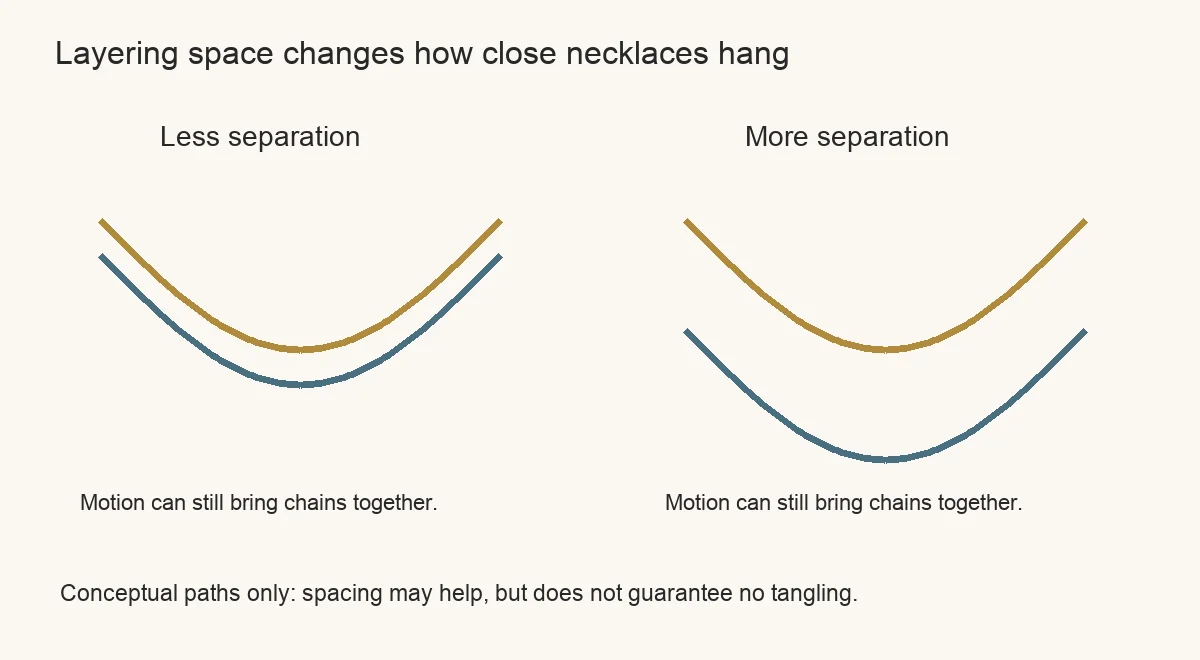
Choose lengths that create visible separation when worn to prevent a layered necklaces tangle, then check whether that separation survives ordinary movement. Jewelers Mutual suggests approximately two inches between necklace lengths. Treat that as a styling starting point rather than a scientifically established minimum. [2]
For example, you could try 16-, 18-, and 20-inch chains if those lengths fit comfortably. The numbers describe total necklace length, not a guaranteed two-inch vertical gap between layers. Judge the actual result on your body, with your chosen neckline and any pendants attached.
Begin with two necklaces before adding a third. Fasten each one at its intended setting, let it settle, and check the lowest point of each layer. If both occupy nearly the same band across your chest, try an extender on one or choose a different pairing. Adjusting lengths with extenders is also part of Jewelers Mutual’s layering guidance. [2]
Then turn your head, reach forward, and walk around briefly. This is an informal fit check, not a validated test. Look for the shorter necklace sliding into the longer one or for both pendants meeting. Change one variable at a time so you can tell whether the new arrangement is easier to wear.
More length is not automatically better. The goal is a stack with distinct resting positions that suits your movements, rather than the largest possible gap.
Watch motion, pendants, and chain design
Evaluate the complete necklace combination, including its pendants and the clothes you wear with it, to see why your layered necklaces tangle. Jewelers Mutual recommends mixing chain textures, weights, and styles, and notes that the neckline affects a layered look. It does not provide a tested ranking of chain designs by tangling resistance. [2]
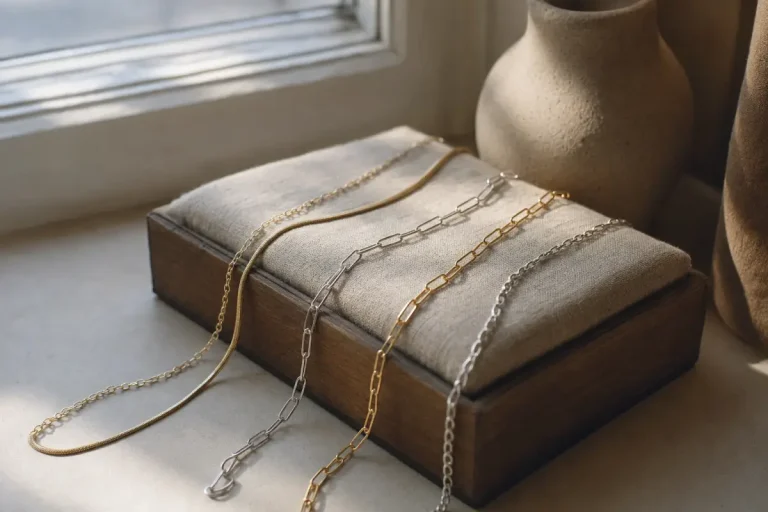
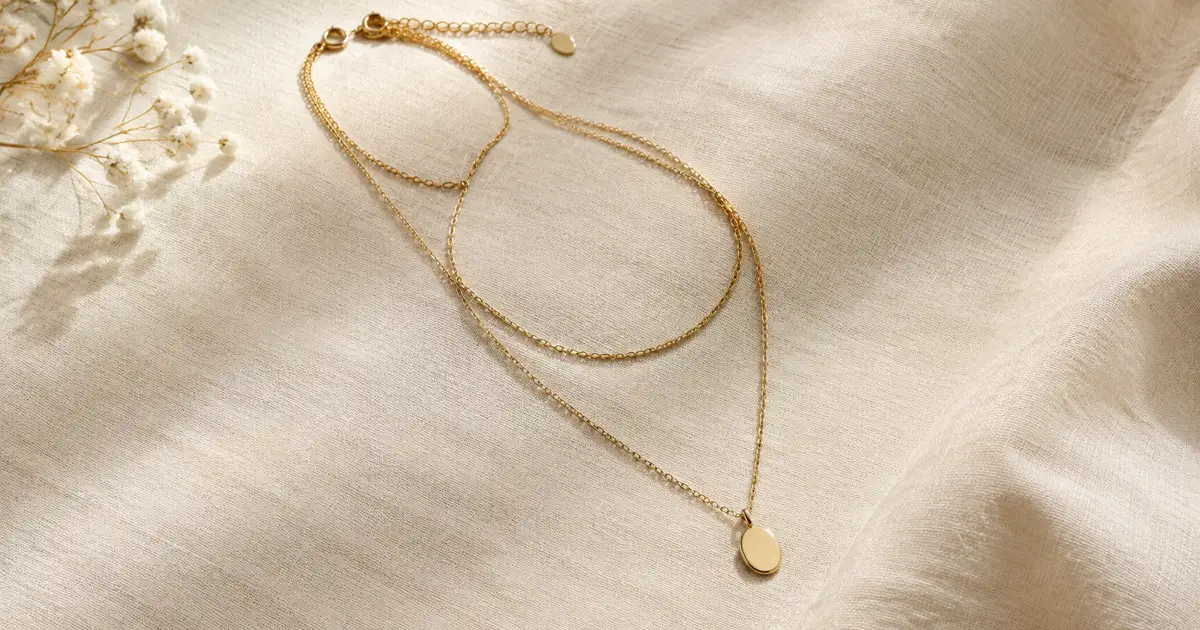
A practical starting arrangement is one plain shorter chain and one longer pendant necklace. Watch whether the pendant stays below the other layer during your normal movements. If it repeatedly passes across the shorter chain, try a different length or wear the pendant alone.
Pendant weight is not an automatic fix. Our mechanical inference is that a pendant can change how a chain hangs and moves, while its bail or projecting details can create additional places for another chain to catch. The sources reviewed here do not establish an ideal pendant weight or prove that heavier pendants prevent tangles. Avoid adding weight solely to solve this problem. [1][2]
Likewise, try contrasting chain widths or textures if two similar fine chains repeatedly wind together. That follows the practical layering guidance, but “different” does not mean guaranteed to work. A combination still needs to suit the individual pieces. [2]
For related background, read WearLumi’s guide to necklace chain construction. Keep strength and tangling as separate questions: a chain’s ability to withstand a pull does not, by itself, tell you how it will behave beside another necklace.
Consider the day’s activity, too. If a stack needs constant resetting during a commute or an active afternoon, wearing fewer layers is a reasonable adjustment. The aim is less maintenance, not a rule that you must keep every necklace on.
What a necklace separator can—and cannot—do
A separator is worth considering when the clasps repeatedly bunch together, but it cannot promise separation along the entire stack. Jewelers Mutual includes layering clasps among its suggestions for organizing necklaces; its article does not report controlled effectiveness testing. [2]
A typical layering clasp connects several necklaces to separate attachment points behind the neck. Our design-based inference is that this can organize their starting positions while leaving the chains free to cross farther forward. The connector itself may also shift or rotate during wear. Its effect depends on the particular device and necklace combination. [2]
Before trying one, check that your clasps fit the attachment points without forcing them and that the hardware rests comfortably. Recheck the lengths with the separator attached rather than assuming the original arrangement still looks the same. Test it with two necklaces first.
If the necklaces still cross near the pendants, focus on their lengths or pairing. If the connector becomes awkward or the stack needs frequent correction, simpler layering may be more useful. A separator is an optional tool for a specific problem, not a substitute for a workable arrangement if your layered necklaces tangle constantly.
Store separately and untangle gently
Store each necklace in its own supported space rather than dropping several chains into one loose pile. Jewelers Mutual recommends necklace hooks, original boxes with retaining loops or slits, and padded necklace carriers. These are practical storage options, not guarantees against every knot. [3]
For travel, choose a holder that keeps each chain arranged separately. Check that the pieces cannot slip together when the case closes, and keep pendants from piling onto neighboring chains. Closing a clasp can be part of your routine, but it does not make an unsupported necklace knot-proof.
WearLumi’s jewelry storage guide covers related storage considerations. Here, the immediate goal is physical organization: fewer loose chains sharing the same compartment.
If a tangle forms, give yourself time to work on it:
- Remove the necklaces and place them on a plain, well-lit surface.
- Open the clasps and spread the loose sections away from the knot.
- Gently loosen the crossing rather than pulling the ends against each other.
- Stop if you need force, see a damaged link, or cannot make progress; ask a jeweler for help.
The unclasping, flat-surface approach, and professional fallback follow Jewelers Mutual’s guidance. This article does not adopt its oil, powder, or soaking methods as universal advice for necklaces with unknown finishes or stones. [3]
Conclusion: build a stack that works in motion
The most useful necklace stack is one that remains comfortable and manageable after you leave the mirror. Start with two distinct lengths, observe where crossings begin, and adjust the pairing before adding more layers. Consider a separator for clasp crowding, and give each piece its own place in storage.
String experiments explain why moving flexible objects can knot, but they do not certify a necklace as tangle-free. A little trial and adjustment is more honest—and more useful—than a universal formula. When you are ready to explore your next combination, visit WearLumi.
Sources
[1] Raymer, D. M., and Smith, D. E. (2007). “Spontaneous knotting of an agitated string.” Proceedings of the National Academy of Sciences, 104(42), 16432–16437. Full paper hosted by UC San Diego. Original experiments on strings in rotating boxes; not a study of worn layered necklaces.
[2] Dosh, T. (2023). “How to Layer Necklaces Without Tangling.” Jewelers Mutual. Jewelry-specific styling guidance on lengths, textures, and layering clasps; not a controlled trial.
[3] Jewelers Mutual (2022). “How to Untangle a Necklace Chain: 5 Easy Tips.” Practical guidance on storage, unclasping, flat-surface untangling, and consulting a jeweler.