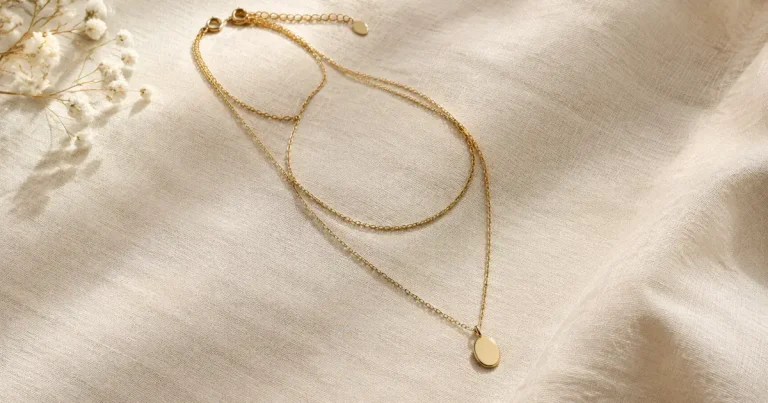
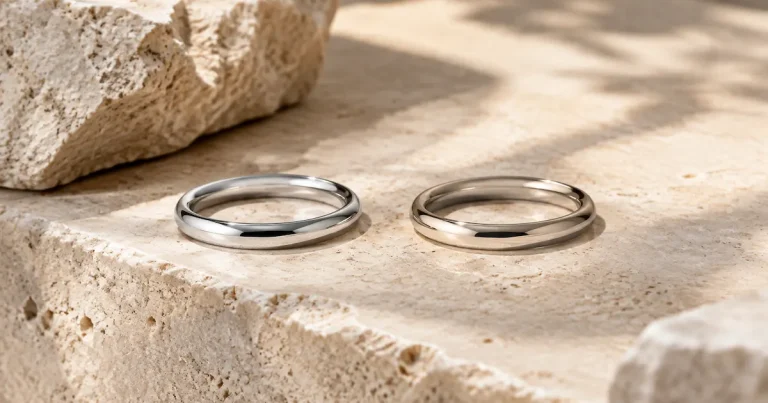
Dainty Necklace Durability: Solid vs. Hollow Chains
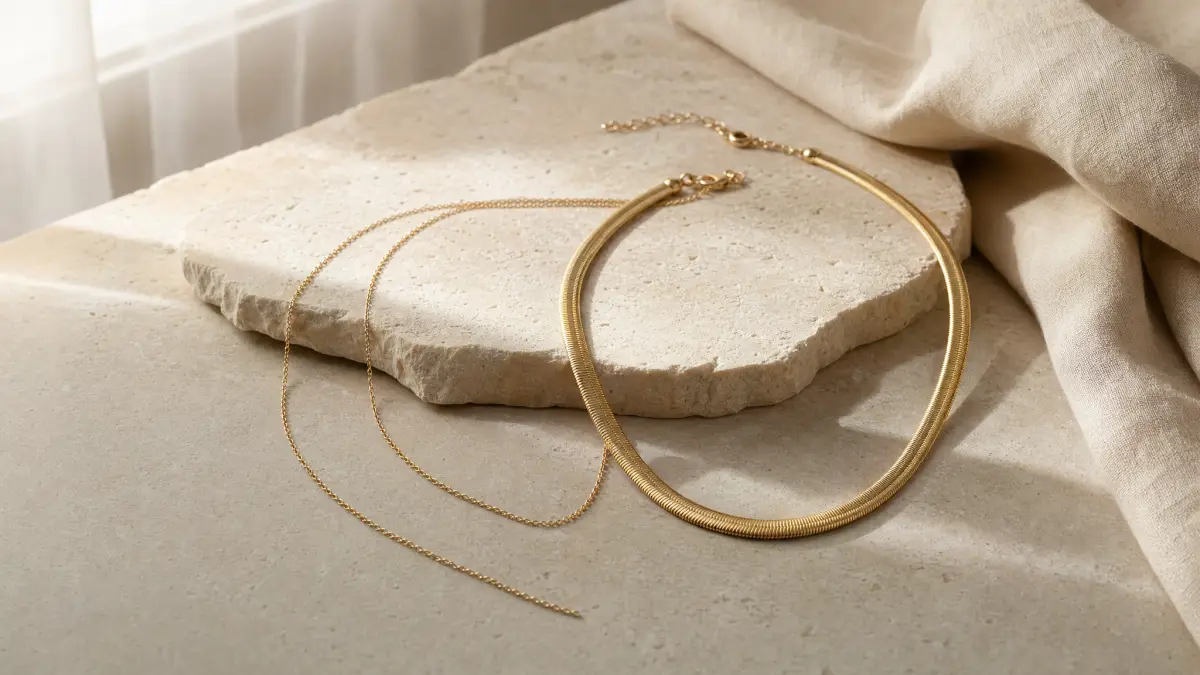
Dainty necklace durability depends on construction, connections, and daily use—not visual width alone. A thin necklace chain is not automatically fragile. Learn why solid construction, cable links, connection points, and daily pulling habits matter more than visual width.
What Shapes Dainty Necklace Durability?
A dainty necklace’s durability is the ability of its finished parts to handle normal movement, occasional contact, and the small pulls of daily life without permanent distortion or breakage. It depends on construction and use—not simply on how delicate the necklace looks.
In practical terms, the chain is a system. Links, clasp, jump rings, end tabs, soldered areas, and the pendant connection all share the job of carrying force. A slender-looking design can wear well when those elements are proportioned and finished thoughtfully; a visibly heavier design can still have a vulnerable join.
Solid vs. Hollow Chain Construction
“Solid” and “hollow” describe how much material makes up a link or tube. A solid link has metal throughout its cross-section. A hollow link has an interior space, which can reduce weight and change how the piece responds to bending, denting, and localized pressure.
For comparable dimensions and the same general alloy, a solid link often has greater resistance to crushing or denting than a hollow one. That is a useful design tendency, not a universal ranking. Wall thickness, shape, temper, joints, and finishing can change the result.
| Construction or feature | What it can help with | What it cannot prove |
|---|---|---|
| Solid link | More material can support resistance to local deformation. | That every solid chain has a higher finished breaking load. |
| Hollow link | Lower weight and a light, airy look. | That it is unsuitable for all everyday wear. |
| Cable link pattern | Multi-directional movement and a familiar flexible profile. | That cable is the strongest chain in every size or build. |
| Heavier visual width | May indicate more material or a larger profile. | The quality of hidden joins, clasp, or soldering. |
Think of construction as one part of a decision, not a shortcut to certainty. If a necklace will carry a substantial pendant or face frequent snagging, ask about the finished design and its intended use rather than choosing by appearance alone.
Tensile Strength Is Not the Same as Chain Breaking Load
Tensile strength is a material property measured under defined conditions. It describes the stress a material can withstand while being pulled in a specified test. It is useful engineering information, but it does not describe every necklace made from that material.
A finished chain has geometry and discontinuities. Each link has a shape, cross-section, opening, and orientation. A clasp or jump ring adds a connection. Soldering, forming, polishing, and heat history may influence the final behavior. The direction and speed of a pull also matter.
That is why a material datasheet cannot be turned into a promise that one dainty necklace is “several times stronger” than another. A finished-chain breaking-load test would need a defined sample, attachment method, force direction, and failure criterion. Without those details, precision would be misleading.
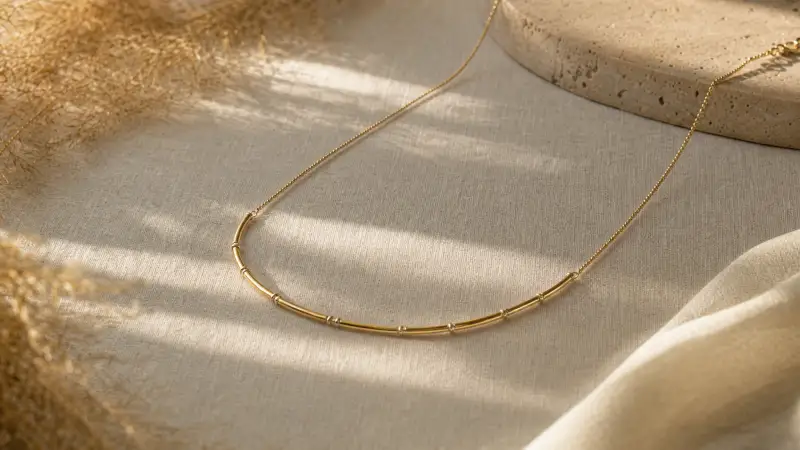
Where Dainty Necklaces Usually Take the Stress
Clasp and end tab: The clasp is opened and closed repeatedly, and the end tab can twist as the necklace is handled. A small distortion here may make the piece feel “broken” even when the chain links remain intact.
Jump rings and soldered joins: A ring that is not fully closed, or a seam that has been poorly finished, can become a high-risk transition. Solder can support a connection when used correctly, but it does not make a design immune to pulling.
Pendant connection: A pendant adds mass and momentum. If it catches on a sweater or pillowcase, the force may focus at the bail or ring carrying it, rather than distributing smoothly along the necklace.
Repeated bends: A gentle curve is normal. A sharp crease, trapped twist, or repeated bend in the same location can produce fatigue and visible distortion over time, especially in a hollow or very lightly built part.
Why Cable Chains Are a Practical Choice—Not a Universal Winner
Cable chains use connected round or near-round links. Their linked structure allows movement in more than one direction, which can feel forgiving as the necklace follows the wearer. That makes cable a sensible option for many dainty, everyday designs.
But “cable” is a pattern name, not a complete quality specification. Wire gauge, link proportion, closure, soldering, alloy, and finishing all influence the finished result. A paperclip, snake, or herringbone chain may be right for a different look and use case; compare the construction rather than treating any style as an absolute champion.
For a deeper look at how cable, paperclip, snake, and herringbone structures respond to bending and snagging, read our guide to necklace chain strength and weak points.
Daily Habits That Protect a Dainty Necklace
- Dress first, necklace second. Put it on after sweaters, coats, and scarves are in place. Remove it before pulling clothing over your head.
- Give it a break during high-pull activities. Take it off for workouts, contact sports, sleep, showers, swimming, and situations where straps or hair can catch it.
- Keep the chain untangled. Lay it flat or coil it loosely in a soft pouch. Do not knot it tightly around other jewelry.
- Check the transitions. Look at the clasp, end tab, jump rings, and pendant connection in good light. Stop wearing it if a ring is opening or a link is visibly bent.
- Use gentle cleaning. Follow the metal and gemstone care instructions. Avoid pulling the chain through fabric or using a stiff brush on delicate connections.

A Simple Buying Checklist
Use this checklist when a dainty necklace will be worn often. It focuses on questions that reveal construction without pretending that a product label can predict every failure.
- Is the chain solid, hollow, or a combination of constructions?
- What pendant weight and wear conditions is the finished design intended to handle?
- Are the clasp, jump rings, and pendant connections proportionate to the chain?
- Is the chain flexible in several directions without sharp kinks?
- Does the seller provide care guidance and a repair or warranty process?
- Can the necklace be inspected easily before and after periods of frequent wear?
How Different Forces Damage a Fine Chain
“Breaking” is not one single event. A necklace can fail through tension, bending, fatigue, or a snag impact, and each failure mode points to a different prevention habit. A chain that survives a steady pull may still kink, wear through, or open at a connection after many small cycles.
Tension: a straight pull
Tension is the force people usually imagine when they ask about chain strength. It stretches a necklace along its length, such as when a pendant catches on a drawer handle and your body keeps moving. The load is shared imperfectly: the smallest link, thinnest section, or least secure connection starts to deform first.
Bending: a kink or sharp fold
Bending concentrates stress on one side of a link or tube instead of distributing it through a straight pull. Hollow tubing has less material behind its outer wall, so a sharp fold can create a dent even when the chain still looks connected. Snake and herringbone styles can be especially unforgiving because their smooth, close-set surfaces are designed to lie flat rather than articulate like separate round links.
Do not repeatedly straighten a kinked area with your fingers or pliers. Each correction can work-harden or crack a thin section, and a jeweler may need to inspect the piece before deciding whether reshaping is safe.
Fatigue: many ordinary cycles
Fatigue is cumulative damage from repeated movement. A visible break can appear suddenly even though the initiating damage developed gradually at the same bend, clasp, or end tab.
Fatigue is why “I never pulled it hard” does not necessarily rule out wear. Look for a link that no longer closes cleanly, a seam that catches on fabric, thinning near the clasp, or a pendant that hangs at an unusual angle. Early inspection is less expensive than rebuilding a chain after a lost pendant.
Snag impact: a short, sharp shock
A snag impact is a rapid load from a sleeve, towel, hairbrush, backpack strap, or bedding. The peak force can be much higher than the force felt during ordinary wear, and the force may arrive at one jump ring or clasp instead of traveling evenly through the chain. A connection that opens cleanly can sometimes protect your neck and save the chain from a more destructive tear.
Practical limit: No construction is a promise against every snag. Never use a dainty necklace as a tether, handle, or attachment point for a heavy object, and do not test it by pulling harder.
Why Hollow Links Dent, and When Repair Has Limits
Hollow chain is made with a cavity or reduced interior volume, which can lower weight while preserving an attractive outside profile. That design is not automatically poor quality. It does mean that the outer wall has less reserve material when a localized force presses sideways or folds the link.
Follow the Load Path from Pendant to Clasp
A necklace is a connected load path, not just a row of decorative links. When a pendant snags, force can travel from the pendant loop into its bail, through the chain, into the end rings, and finally to the clasp and opposite end tab. Every transition can change direction and concentrate stress.
- Pendant loop and bail: A narrow or partly closed loop can twist when the pendant catches, especially if the pendant is much heavier than the chain.
- Chain links: Round, articulated links can change angle; flat or tightly packed styles may resist the twist that a snag creates.
- End rings and tabs: These small parts join components and can open, crack, or pull away before a central link fails.
- Clasp: A well-made clasp should close fully and match the necklace’s scale, but its spring, gate, soldered joint, and attachment ring still deserve inspection.
Choosing Weak Points for Your Actual Routine
- Match pendant weight to chain scale. Check the bail and pendant loop for sharp edges, tight clearance, or a mismatch that forces the chain to carry a twisting load.
- Examine the clasp closed. The gate should return fully, the end ring should not have a visible gap, and the clasp should not feel disproportionately delicate.
- Check movement. Flex the necklace gently in your hands without pulling. Stiff spots, gritty movement, flattened links, or a kink are reasons to pause before wearing it.
- Choose for interruption. If a snag could happen often, a necklace that can release at a connection may limit damage. That is a safety behavior, not proof that the component is stronger.
What to Do After a Snag
After a necklace catches, stop and inspect it before putting it back on. Check the clasp gate, both end rings, the pendant loop, and the section that took the bend. Run a soft cloth lightly over the chain; a rough catch can reveal a lifted seam or a partially open link without forcing the metal.
Use a jeweler when you see a dent in hollow tubing, a cracked seam, a loose stone in the pendant, repeated clasp opening, or a link that will not return to its normal shape. Keep the piece off until it is checked. Store it flat or loosely coiled, and record any repair so recurring damage can be traced to a clasp, pendant, layering friction, or a particular daily habit.
Frequently Asked Questions
Does a thin necklace chain break easily?
A thin necklace can be durable when it is solidly constructed and properly finished, but visual width alone cannot predict breaking load. Clasps, jump rings, soldered joins, and repeated snags may fail before the chain itself.
Is solid or hollow chain better for dainty necklace durability?
Solid construction generally gives a link more material to resist deformation than a comparable hollow design. It is not an automatic guarantee: alloy, link geometry, welds, finish, and the way the necklace is worn also matter.
Are cable chains durable for everyday wear?
Cable chains are one practical durability choice because their connected round links can move in several directions and distribute ordinary motion. A cable chain is not universally the strongest chain, and finished construction still matters.
What is the weakest part of a dainty necklace?
The weakest point is often a connection rather than a link: a clasp, jump ring, end tab, soldered seam, or transition where parts meet. These areas experience concentrated loads when a necklace catches on clothing or bedding.
How can I prevent my dainty necklace from breaking?
Reduce sudden pulls: put it on after dressing, remove it before sleep, workouts, showers, and swimming, store it flat or loosely coiled, and inspect the clasp and end connections regularly.
Can tensile strength predict whether my necklace will snap?
No. Material tensile strength describes a material property under a defined test. A finished chain’s breaking load depends on link size, cross-section, joints, heat treatment, workmanship, and test direction, so the numbers are not interchangeable.
Choose Jewelry for Real Life
Wearlumi designs demi-fine jewelry with everyday styling in mind. Explore the collection and choose the pieces that fit your routine.
Sources: Ganoksin chain strength and quality evaluation; GIA fine-chain soldering technique; FTC Jewelry Guides; Engineering Library stress reference.