Materials College · Metallurgy
Base Metals Exposed: Brass, Stainless Steel, and Titanium in Real Life
Shoppers often judge jewelry by its shiny surface plating, but seasoned wearers evaluate the underlying jewelry base metals first. Whether it is brass, steel, or titanium, the core metal dictates weight, tarnish resistance, longevity, and everyday comfort.
Comparing Core Jewelry Base Metals: Brass, Stainless Steel, and Titanium
Base metal is the structural metal that sits underneath any surface plating, and it quietly sets the weight, the detail, and the durability of every piece of jewelry you wear.
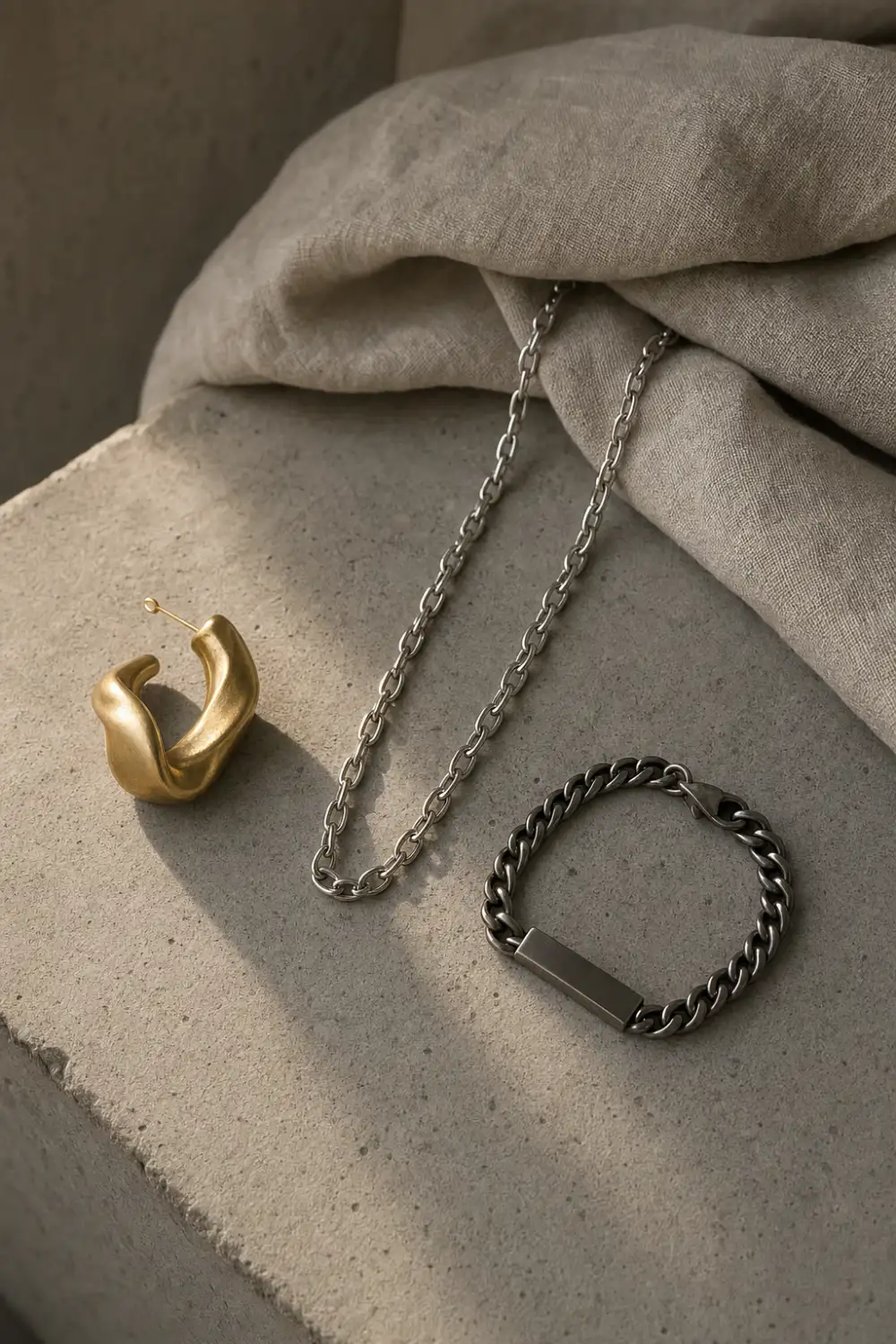
Brass is an alloy of copper and zinc, and jewelers have worked it for centuries for one practical reason: it is soft and highly malleable. That softness lets a casting pick up crisp, sculptural, fine details that harder metals blur. When you see a gold-tone earring with sharp ridges and deep geometric cuts, a brass core is usually doing the detail work underneath the finish.
Brass also brings real heft — it feels substantial in the hand and substantial on the ear, and many shoppers read that weight as a sign of quality. That instinct is not wrong: dense, weighty pieces have signaled fine jewelry for generations. The flip side arrives at the end of a long evening, when a heavy statement earring starts to tug at the lobe.
Brass is also the reason gold-tone fashion jewelry exists at all. Copper and zinc cost a fraction of gold, and casting brass is fast and forgiving, so designers can afford big, sculptural, expressive shapes at a price most people can reach. The look is gold-tone; the economics are brass.
The honest trade-off with brass is tarnish: left unplated, it dulls quickly, eventually grows a green patina called verdigris, and can react with sweat and skin oils. The green layer is the same chemistry that colors the Statue of Liberty — charming on a statue, less charming on your wrist. That is why brass jewelry is always plated: a thin layer of gold, rhodium, or another finish stands between the copper-zinc core and your skin, protecting you from the metal and the metal from you.
Living with plated brass is mostly a water discipline, because water and perfume accelerate wear on any plating. Take brass pieces off before the gym, the pool, or a long shower, and wipe them with a soft dry cloth before they go back in the box. Treated that way, a well-plated brass piece can look rich for years.
If you are curious what hides under your finish, a fridge magnet offers a quick clue. Brass is not magnetic, so a magnet that sticks suggests a steel core, while a magnet that falls away points to brass or another non-magnetic base. It is not a purity test, but it is a fun ten-second science check.
The Zero-Maintenance Warrior: PVD Stainless Steel That Survives the Shower
Stainless steel is iron alloyed with at least 10.5 percent chromium, and that chromium changes everything. Exposed to air, the chromium forms a transparent, self-healing oxide layer in a process called passivation. Scratch the surface and the layer quietly rebuilds itself, which is why steel does not rust in daily life.
That chemistry makes stainless steel the zero-maintenance option. It is shower-safe, gym-safe, and pool-safe; soap, shampoo, hand sanitizer, and salt air all slide off without a mark. If you want jewelry you never have to think about — the chain you sleep in, the bracelet you wear to spin class — steel is the metal that keeps up.
The trade-off is detail. Steel is very hard and tough, which makes it difficult to shape into micro-fine lines and fragile filigree, so steel designs stay simpler by nature: clean curves, smooth hoops, bold minimal forms. Grades 304 and 316L are the skin-friendly standards, and 316L belongs to the same family as the surgical steel used in body jewelry.
In the hand, steel sits between the other two: heavier than titanium, lighter than the heftiest brass. It feels solid and cool, and it stays that way for years, because the surface has no coating to rub through — the protection is built into the metal itself.
Add a PVD finish and steel gains color without losing toughness: metal is vaporized inside a vacuum chamber and deposited onto the surface as a thin, tightly bonded film. The color will not peel like paint, and it adds extra hardness on top of the passivated steel. The result is a shower-proof piece in nearly any tone you want.
Everyday steel care is almost embarrassingly simple.
- Wear it in the shower, the pool, and the gym — the oxide layer does not care.
- Pat it dry once in a while to prevent water spots; they are cosmetic, not damage.
- Wash it with mild soap and warm water if lotion builds up, then dry it with a soft cloth.
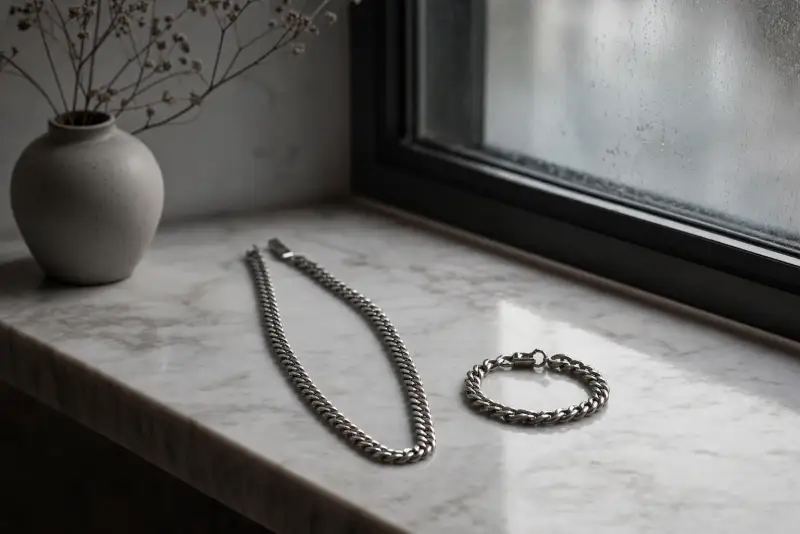
The Sensitive-Skin Savior: Aerospace-Grade Titanium’s Featherlight Barrier
Titanium comes from aerospace, where every gram counts. It is roughly half the weight of steel, yet its strength-to-weight ratio beats most other metals, which is why it ends up in aircraft frames and engine parts. On your ear, that translates to almost nothing — titanium studs and hoops are so light you can forget you are wearing them.
That featherlight feel matters most where weight hurts: in earrings, because heavy earrings tug at lobes all day and can stretch a piercing over the years. Titanium lets you wear a bigger, bolder shape without the drag, and people who gave up on statement earrings for comfort reasons usually get along with titanium.
Titanium earns its sensitive-skin reputation the hard way: inside the body. It is biocompatible enough for medical implants, from hip joints to bone screws to dental posts, and it contains no nickel. If most metals leave your skin itching and red by lunchtime, titanium is the closest thing to a safe default.
Colors on titanium come from anodizing, not paint. An electric current grows a thin oxide layer on the surface, and the thickness of that layer bends light into color — blues, purples, teals, golds. There is no coating to wear off, because the color is the metal itself.
Titanium also skips the first cold-metal shock. It conducts heat slowly, so it does not feel icy against your skin on a winter morning the way steel sometimes does. Small thing, but you notice it every day.
The honest cost is the price. Titanium is harder to cast and machine than brass or steel, which pushes prices toward the premium end of the demi-fine range. What you pay for is the combination: featherlight weight, near-zero reaction risk, and colors that cannot flake — a metal that behaves like a medical device and wears like a whisper.
Titanium is worth the upgrade if:
- Your skin reacts to nickel or mystery metals.
- You have a healing or stretched piercing that needs zero drag.
- You want bold shapes you forget you are wearing.
- You shower, swim, and sleep in your jewelry.
Set these three jewelry base metals side by side and the trade-offs become easy to read. Water tolerance is the sharpest divide, and weight is the one you will feel every single time you put the piece on.
| Quality | Brass (Plated) | Stainless Steel | Titanium |
|---|---|---|---|
| Weight | Substantial; feels heavy in hand | Mid-weight; heavier than titanium | Featherlight; about half the weight of steel |
| Tarnish Resistance | Low without plating; patinas over time | High; self-healing oxide layer | Very high; naturally inert |
| Skin Sensitivity | Can react with sweat; plating protects | Skin-friendly in 304 and 316L | Excellent; nickel-free, implant-grade |
| Detail Capability | Excellent; crisp sculptural detail | Moderate; designs stay simpler | Moderate; costly to cast fine detail |
| Water Tolerance | Low; keep it dry | High; shower-safe | High; shower-safe |
| Price Band | Most affordable | Mid-range | Premium |
In the hand, the three metals introduce themselves before you ever look at the label. Brass sits heavy and dense, steel feels solid and cool, and titanium feels almost suspiciously light. Your fingers know the difference instantly.
Check what is inside before you judge the price tag. Gold-plated or gold vermeil always means a base metal underneath, usually brass or sterling silver. The finish is real, but the core decides the weight, the durability, and what happens when the plating eventually wears.
There is no single winner among all jewelry base metals. Brass wins when you want intricate sculptural gold looks at an accessible price, as long as you keep it dry. Steel wins when you want one piece that survives showers, workouts, and road trips without a second thought, and titanium wins when your skin reacts to everything and you want to forget your earrings are there.
So choose the metal the way you would choose a car: by how you actually live. A bold brass statement earring for dinner, a steel chain for every ordinary day, and a titanium stud for a healing piercing or a sensitive lobe. When you know the base metal, you know exactly how the piece will age.
The plating is the first impression; the base metal is the long-term relationship. Either way, the metal underneath is doing the quiet work every single day — so it deserves the same scrutiny as the shine on top.
Keep reading
Brass, Stainless Steel, and Titanium Jewelry: FAQ
Common questions about jewelry base metals come up at the counter and in the shower. Here are the ones people ask most, answered straight.
Does brass jewelry turn your skin green?
Unplated brass can, because the copper in brass reacts with sweat and skin oils to form green copper salts that rub off onto skin and leave the classic green stain. Plated brass seals the copper away, so marks are rare — but if the plating wears thin, green marks can return. Keep plated brass dry and clean, and the color stays put.
Is stainless steel jewelry shower-safe?
Yes, and it is one of the few jewelry metals you can say that about without caveats. The chromium in steel forms a transparent oxide layer that self-heals whenever it gets scratched, so water, soap, and shampoo slide right off. Pat the piece dry occasionally to avoid water spots — those are cosmetic, not damage.
Is titanium really hypoallergenic?
Titanium is one of the most biocompatible metals in existence. The same material sits in hip implants and dental posts, it contains no nickel, and it rarely triggers a reaction even on highly sensitive skin. No metal is universally safe for every single person, but titanium is the closest thing to a safe default.
Which base metal lasts longest for daily wear?
Stainless steel and titanium outlast brass in everyday conditions, because neither tarnishes and both tolerate water, sweat, and soap. Titanium adds featherlight weight to that same durability. Brass can last for years too, but only while its plating stays intact — which means keeping it away from water, perfume, and workouts.
Why is gold-plated brass cheaper than solid gold?
Because the metal underneath does most of the pricing. A gold-plated piece is brass with a thin layer of gold on the surface, so its material cost is a small fraction of solid gold, where the gold goes all the way through. Plated and solid pieces can look identical in photos, but they feel and wear very differently in hand.
Know what your jewelry is made of.