
Materials College · Mechanical Physics
Why Cable Chains Bend and Snake Chains Kink: Necklace Chain Physics
For necklace chain strength, A broken necklace is not always bad quality. Most of the time, it is just physics. Some chain geometries shrug off a hard pull; others can never un-kink.

Necklace Chain Strength: How Link Geometry Handles Pulls
Chain strength is a matter of geometry: chains built from many independent links, such as cable and paperclip, spread a pull across dozens of moving parts, while tightly interlocked styles like snake and herringbone trap stress inside links that cannot move.
Think of a chain as a series of decisions made on a jeweler’s bench: how each link moves, where the load goes, and what happens when one link gives up. Those decisions, not the metal alone, decide whether your necklace comes home in one piece.
A cable chain is the simplest necklace there is: round or oval links interlocked in a repeating pattern. Because every link moves independently, a pull is shared across dozens of links at once instead of landing on a single weak point. If one link does open, a jeweler can solder or replace it in minutes, which makes cable the most repairable chain you can wear.
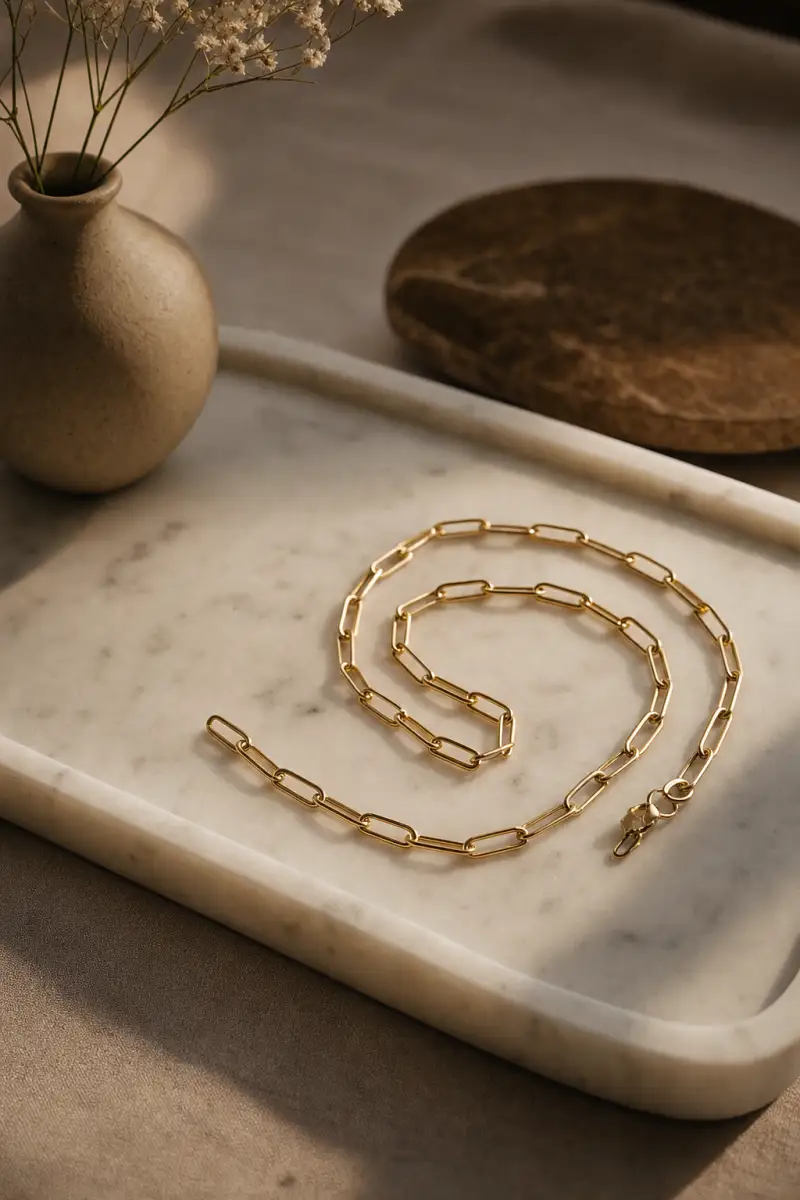
A paperclip chain runs on the same idea. Its elongated open links, shaped like office paperclips, are joined end to end, and each one flexes on its own. The chain takes tension well, resists tangling, and carries the clean, modern look that made it a layering favorite.
Both styles share one more survival trick: they fail gradually. Yank a cable or paperclip chain hard and it stretches and elongates before it gives way. That visible warning buys you time to spot a weakened link and have it soldered before the whole chain comes apart.
That is what makes them the pull champions of the chain family. Their failure point is a single link, and a single link is cheap to fix. Gauge matters too: a thicker cable chain will always out-pull a finer one, because style sets the baseline and thickness sets the ceiling.
No chain is unbreakable. A sharp yank, like a chain snagged on a bag strap or a door handle, can exceed any force limit in a fraction of a second. The difference is what happens before failure: cable and paperclip warn you, while stiffer styles snap or kink without one.
Layering adds one more vote for these two. Stacked necklaces rub against each other all day, and chains with free-moving links shed that friction easily. Smooth, rigid tubes take the same rubbing as concentrated wear on a fixed surface, another quiet argument for linked styles on a daily stack.
For an everyday chain, pick the thickest gauge your style allows. Two cable chains with the same geometry can have very different force limits when one is a fine gauge and the other a heavy one, and a slightly heavier gauge buys a lot of peace of mind.
The Price of Fluid Shine: Why Snake and Herringbone Chains Kink Permanently
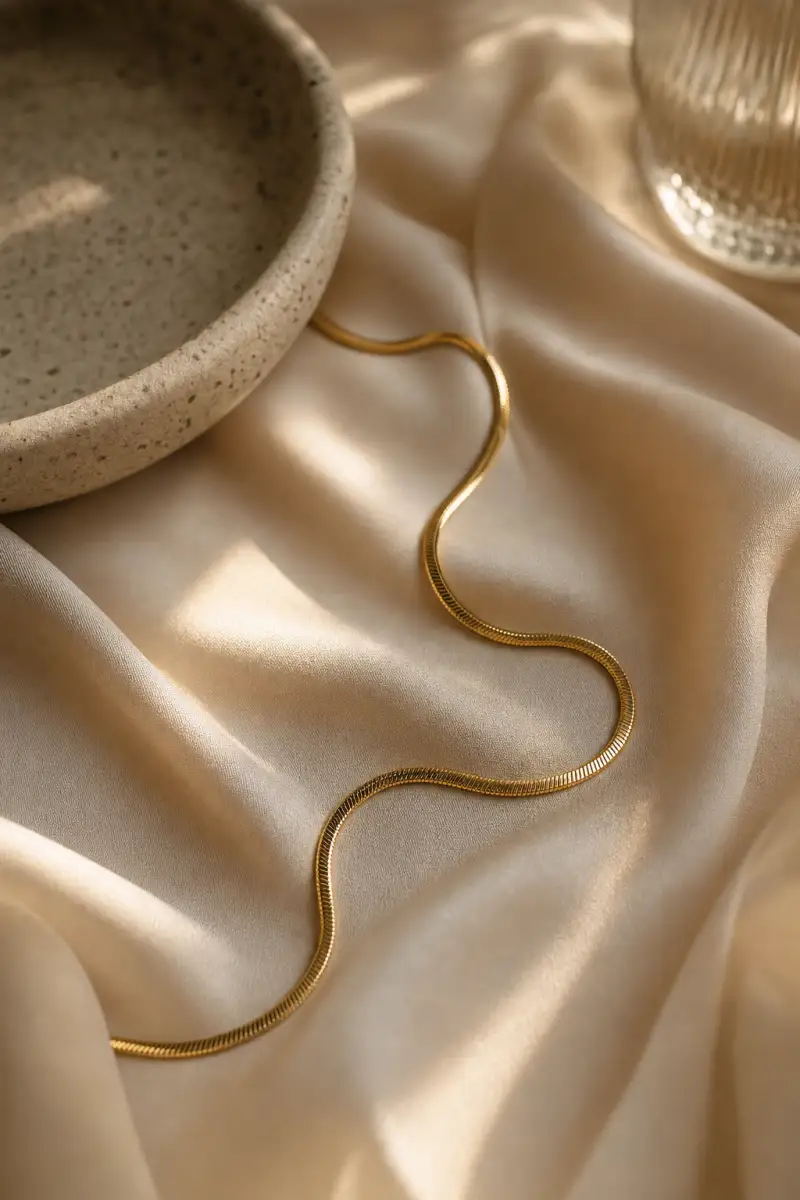
A snake chain is a different animal. Tightly interlocked, scale-like plates form a smooth round tube, and that fluid, silky look comes from plates that have almost no independent movement. The surface is beautiful precisely because nothing inside can shift.
That beauty has a price. Every material has a yield point, the bend beyond which it will not spring back. Bend a snake chain past its yield point and the plates slide out of alignment. The tube holds a hard angle from then on, and no polishing cloth or squeeze can put the plates back.
The physics is unforgiving. A kink is not a dent in the surface; it is the internal structure permanently displaced. Since the plates cannot move freely, they cannot move back. Repairs are usually impossible, and the ones a jeweler attempts are almost always visible.
Herringbone chains share that fragility and add an annoyance. Their flat, V-shaped links are woven so tightly that they grab fine hair and threads at the back of the neck. The weave kinks just as permanently as snake, and the flat links make it the most hair-catching style in the case.
Care for both styles follows the same rules. Never sleep or exercise in them, store them flat or hanging so the chain cannot fold on itself, and never pull or twist hard to undo a tangle. A snake or herringbone chain can survive decades of gentle wear, and kink in one careless second.
You can catch trouble early. Run the chain slowly through your fingers and feel for a stiff spot where the tube refuses to curve smoothly, because that is a kink forming. Catch it before it sets and you may save the chain; leave it folded in a drawer and the kink becomes permanent.
If you already own a snake or herringbone chain and love it, the fix is habits, not hardware. Reserve it for days without gym bags, fasten it last and unfasten it first, and lay it flat the moment it leaves your neck. A chain that never gets yanked never gets kinked.
Here is how the major styles compare on the points that decide whether a chain survives daily life:
| Chain Style | Strength Under Pull | Kink Risk | Tangling | Repair Ease | Best For |
|---|---|---|---|---|---|
| Cable | Excellent, links move independently | Very low | Low | Excellent, single links solder easily | Everyday wear, pendants, layering |
| Paperclip | Excellent, stretches before failing | Very low | Very low | Good, open links solder or reshape | Modern looks, pendants, everyday wear |
| Curb and box | Good to very good, interlocking links share the load | Low | Low | Good, clean breaks solder quickly | Everyday and casual wear |
| Snake | Low under a yank, plates cannot move | High, kinks are permanent | Low, smooth tube | Poor, kinked section usually means replacement | Dressy occasions, worn alone |
| Herringbone | Low under a yank, tight flat weave | High, kinks are permanent | High, catches fine hair | Poor, reweaving is rarely invisible | Dressy occasions, careful wear |
If you want a middle ground, curb and box chains sit between the two camps: interlocked links that still move, solid strength under a pull, and no permanent-kink drama.
None of this makes snake or herringbone bad chains. Worn alone on quiet occasions, they are among the most beautiful chains made. The trouble only appears when they are asked to do what they were never designed to do: fold, tug, and bounce through everyday life.
Jewelers see the difference every day. Someone arrives with a cable chain that broke at one link and leaves with a five-minute repair; someone else arrives with a kinked snake chain and leaves with a decision. The styles are not equally forgiving, and the repair desk is where the geometry shows its true colors.
Chain Repair, Explained: What Can Be Re-Welded and What Cannot
Whether a broken necklace can be saved comes down to the chain style, and a quick inspection tells you which case you are in.
- Find the break. A clean opening at one link is a simple repair; a flattened, kinked, or twisted section is a complicated one.
- Clean break at a link. Cable, paperclip, curb, and box chains with one open link can be soldered quickly, and the repair is usually inexpensive and invisible.
- Kinked snake or herringbone. A jeweler can rarely restore the tube or the weave, because the kink lives inside the structure. The standard answer is replacing the damaged section, or the whole chain.
- Stretched link. A link that elongated but did not open can sometimes be re-tightened or re-shaped. If the metal is too thin, the jeweler replaces the link instead.
- Tangled, not broken. Do not yank. Work the knot loose gently, because patience repairs what force destroys.
Never yank a knot out of a fine chain. Pulling hard turns a loose tangle into a bent or snapped link within seconds. Work the knot open gently between your fingertips, or tease it apart with two straight pins. If it will not give, a jeweler can untangle it in a few minutes of bench time.
Cost follows the same logic. A broken link in a cable, curb, or box chain is a routine bench repair, cheap and quick. A kinked snake or herringbone section usually means replacing the chain, because rebuilding the weave costs more than most chains are worth.
One more thing worth knowing: a chain that breaks under a sharp yank is not necessarily defective. Snagged on a bag strap, a chain can be loaded far past any reasonable force limit, and every chain, whether gold, silver, or steel, has one. Quality shows up in gentle, everyday wear: a well-made chain should survive years of that without drama.
Clasps deserve a look too. A sturdy lobster clasp fails less often than a spring-ring clasp on a heavier chain, and the clasp is usually the cheapest part to replace. When a chain keeps breaking in the same spot near the clasp, the clasp, not the chain, is often the real culprit.
If the repair quote approaches the price of a new chain, retire the old one without guilt. Chains are consumables over decades, not forever. A chain that served you for years and died in a door handle did its job; the smarter money goes to the next chain, chosen with these geometry lessons in mind.
Keep reading
Necklace Chain Strength: FAQ
What is the strongest necklace chain?
For everyday pull resistance, cable and paperclip chains are the strongest popular styles, because every link moves independently and shares the load. Real-world strength also depends on link thickness and the metal, so a thicker cable chain in solid gold or sterling silver outlasts a thin chain of any style. Choose cable or paperclip when you want a chain that takes daily wear and warns you before it fails.
Can a kinked snake chain be fixed?
Usually not. A kink is not a surface dent; it is the internal plates permanently slid out of alignment, and there is no way to squeeze or polish them back into place. A jeweler may be able to replace the damaged section, but for most snake chains the honest repair is a new chain. A soft, minor bend can sometimes be worked out gently, while a sharp kink is permanent.
Which chain is best for pendants?
A cable chain is the classic choice: a pendant bail slides smoothly along the links, and if the chain ever breaks, any link can be soldered. Paperclip chains carry chunkier pendants well and add a modern line. Snake chains are a poor pendant match, because the bail cannot slide over the smooth tube and the hanging weight stresses the fixed plates at one point.
Why did my chain break, quality or physics?
If it snapped at a single link during a sharp yank, snagged on a bag strap, a door handle, or a seatbelt, you probably witnessed physics rather than a defect. Every chain has a force limit, and a sudden jerk can exceed it in a fraction of a second. The quality question applies to gentle wear: a chain that opens while you fasten the clasp, or after weeks of careful use, has a real problem.
Which chains catch hair?
Herringbone is the worst offender: its flat, tightly woven V-shaped links grab fine hair and threads at the back of the neck. Snake chains are smooth tubes and rarely snag anything. Cable and paperclip chains occasionally catch long hair near the clasp, but far less than herringbone. If hair-catching is a daily frustration, choose a smooth tube or a cable chain.
Chains built to be lived in.



2 Comments