Why White Gold Turns Yellow: Rhodium Plating Explained
White gold turns yellow-looking most often because its bright rhodium plating has worn thin, revealing the warmer white gold alloy underneath. The coating changes the surface appearance; it does not change the metal throughout the piece. GIA confirms that white gold is often rhodium plated and that the coating gradually wears away. GIA: White Metal Options
A cream-colored patch on a ring can therefore be a maintenance issue rather than evidence that the gold is fake. Still, color alone cannot identify the alloy or rule out damage. Understanding which layer you are seeing helps you choose between gentle cleaning, professional inspection, and replating.
On this page
Why white gold turns yellow
White gold is a gold alloy, and its underlying color depends on the other metals mixed into it. Pure gold is yellow. Adding whitening metals creates a paler alloy, but different formulas produce different degrees of whiteness. Assay Assured’s explanation, based on Birmingham Assay Office expertise, distinguishes naturally whiter alloys from off-white alloys that need rhodium for a white finished appearance. Assay Assured: White Gold, Explained
This means white gold does not have one universal unplated color. Some pieces show a noticeable cream or yellow cast when the coating wears; others reveal a subtler difference. Avoid the assumption that every white gold ring must become strongly yellow, or that every unplated alloy looks identical.
Karat measures gold content, not the whiteness of the finished surface. GIA describes common U.S. white gold as 14K or 18K and notes that rhodium can make the two difficult to distinguish visually. The same karat can still accommodate different alloy recipes. A karat mark cannot tell you the complete formulation or plating history. GIA: White Metal Options
For background on purity terminology, see WearLumi’s guide to gold karats. When evaluating a white gold piece, ask two separate questions: what is the alloy, and what finish covers it?
What rhodium plating actually does
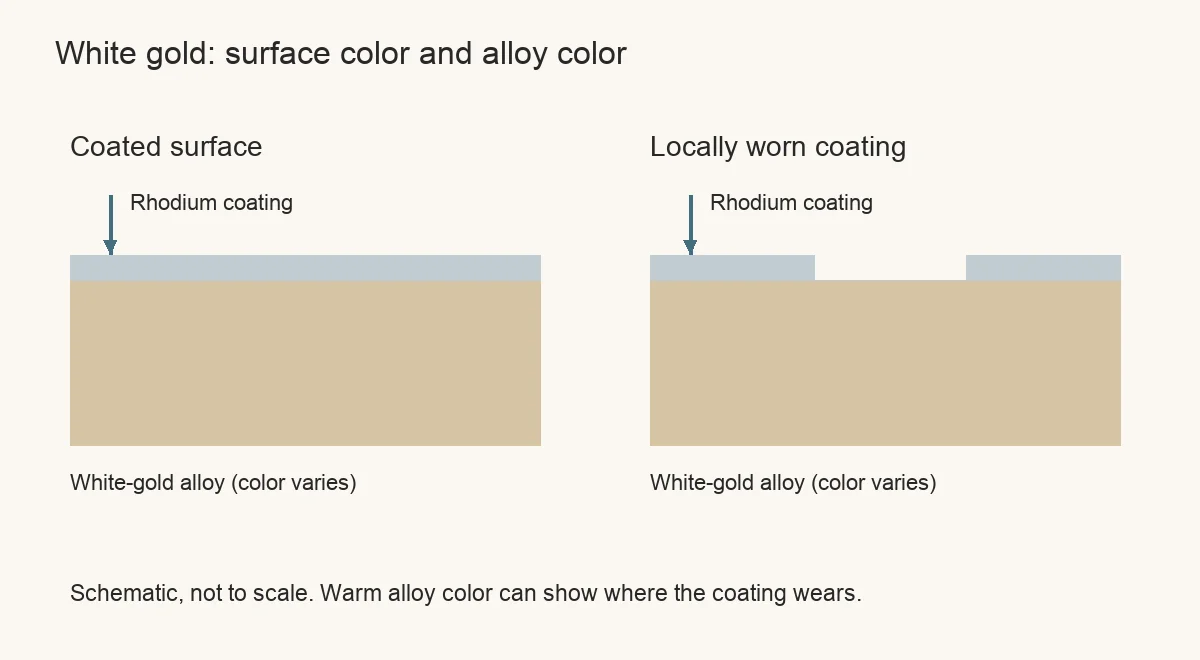
Rhodium plating puts a bright, reflective metal layer over the jewelry’s surface. It creates a different appearance without becoming part of the gold alloy beneath it. Assay Assured explicitly describes rhodium as a surface treatment and explains that wear reveals the alloy’s true color. Assay Assured: White Gold, Explained
A useful way to picture the structure is a white gold body with a separate bright outer layer. A rhodium-plated white gold ring still has a gold-alloy body. That is different from jewelry whose body is a base metal covered by a gold-colored coating. The word “plated” needs the name of both the coating and the material underneath to be meaningful.
Jewelers apply rhodium through electroplating, using an electrical process and a prepared solution. Stuller’s bench guidance emphasizes surface polishing and thorough cleaning before deposition; it also discusses contamination, voltage-related finish defects, ventilation, and solution disposal. The finish depends on preparation and process control, not simply dipping a dirty ring into liquid. Stuller: Rhodium Plating—Your Questions Answered
Plating does not rebuild a worn prong, straighten a damaged setting, or fill a deep dent. Ask the jeweler to separate structural repair from cosmetic finishing. A ring can look brighter after plating while still needing attention elsewhere.
How to recognize plating wear
Plating wear may show as a persistent warmer area where the jewelry receives repeated contact. Assay Assured identifies frequent wear, especially on rings and bracelets, as a challenge to rhodium longevity. Thickness and plating quality also affect how long the finish lasts. Assay Assured: White Gold, Explained
On a ring, compare the palm-facing band with less exposed areas. A localized color difference is consistent with uneven wear, though it is not a definitive test. Look in neutral daylight: warm room lighting can make an otherwise white surface appear yellow. If you take a comparison photo, use the same light and background each time.
Dullness and yellowing also deserve separate questions. A cloudy film may call for cleaning; a clean surface that remains warmer may call for an assessment of the finish. GIA warns that chemical exposure can discolor precious metals and that chlorine bleach can damage gold alloys. Do not assume every change is harmless coating wear. GIA: Tips on Caring for Jewelry
If the change follows a chemical accident, or you notice roughness, a bent band, snagging, or a loose stone, have the jewelry inspected. WearLumi’s guide to prong, bezel, and pavé settings explains the support points worth watching. Finish restoration and stone security are different maintenance needs.
When to replate white gold
There is no universal replating schedule for all white gold jewelry. GIA calls for occasional replating as rhodium wears; Assay Assured identifies everyday wear, thickness, and finish quality as relevant factors. Neither supports treating a fixed calendar interval as a guarantee for every piece. GIA: White Metal Options Assay Assured: White Gold, Explained
Use condition and preference to guide the decision. If the jewelry is structurally sound and the warmer tone does not bother you, an immediate cosmetic refresh may be unnecessary. If you want the original bright appearance, ask a qualified jeweler whether replating is appropriate. A daily ring and an occasionally worn pendant should not automatically share a service timetable.
Before authorizing the work, ask what the service includes: inspection, cleaning, repairs, polishing, and plating are separate operations. Ask whether polishing will affect engraving, textured surfaces, or fine details. Request a quote for your specific piece instead of relying on a generic price found online.
It is also reasonable to ask whether the piece can be worn without rhodium. Naturally whiter alloys can make that an attractive option, but the decision depends on the actual alloy and the appearance you want. Ask to see an unplated sample when available. Do not have the coating stripped at home to find out.
Care without DIY chemicals
Gentle care can remove buildup and reduce avoidable wear, but cleaning cannot replace missing rhodium. If the coating has worn through, scrubbing harder will not restore its original bright color.
Start with instructions for the complete piece, including its gemstones and treatments. GIA recommends warm water, mild dish soap, and a soft brush for most colored gems, while warning that some materials and treatments need different care. If you do not know what stones or treatments you have, ask a jeweler before soaking or using equipment. GIA: Tips on Caring for Jewelry
For compatible jewelry, keep cleaning gentle, rinse in a container rather than over an open drain, and dry with a soft, lint-free cloth. Store pieces separately so they do not rub together. Remove fine jewelry before chlorinated swimming and household cleaning; GIA specifically warns about chemical damage to metals and gems. GIA: Tips on Caring for Jewelry
Avoid abrasive whitening tricks, toothpaste scrubs, household acid mixtures, and metal-polishing products chosen without checking their suitability for the finish. These are unnecessary experiments on a thin surface layer. Do not attempt chemical stripping or home rhodium plating. Stuller’s professional guidance requires controlled preparation, electrical settings, ventilation, and waste handling. Leave that work to an equipped jeweler. Stuller: Rhodium Plating—Your Questions Answered
A home ultrasonic cleaner is not a universal shortcut either. GIA warns that some gemstones and treatments cannot safely undergo ultrasonic cleaning. The stone and setting matter alongside the metal.
White gold vs. platinum: choosing your maintenance
Platinum maintains its natural white color, while rhodium-plated white gold may need its bright surface renewed. GIA identifies platinum’s natural white color as a lasting property; its white-metal guide describes the gradual loss of rhodium on white gold. GIA: Platinum—A Metal Fit for Kings GIA: White Metal Options
For color maintenance, that is the useful distinction. Platinum does not need a coating to make its underlying metal white. White gold’s maintenance depends partly on the natural alloy color and whether you want to preserve a rhodium-bright finish.
Natural whiteness does not eliminate cleaning or inspection. GIA’s jewelry-care guidance applies to platinum as well as gold and warns against chemical exposure and careless storage. Choose either metal with realistic expectations about the whole piece, especially its stones and setting. GIA: Tips on Caring for Jewelry
Before buying, ask about alloy composition, surface finish, future servicing, and any written service terms. For a piece you already own, start with its present condition. A warmer white gold surface often reflects a coating wearing away; a jeweler can confirm whether cleaning, repair, or replating is the sensible next step.
Choose the appearance you enjoy and the upkeep you are comfortable with. When you are ready to explore jewelry, visit WearLumi with those material and maintenance questions in mind.
Sources
- GIA: White Metal Options for Your Engagement Ring — white gold alloys, karat marks, rhodium wear, and metal comparisons.
- Assay Assured: White Gold, Explained — Birmingham Assay Office expertise on alloy whiteness, surface treatment, and plating longevity.
- Stuller: Rhodium Plating—Your Questions Answered — professional preparation, electroplating, ventilation, and disposal considerations.
- GIA: Tips on Caring for Jewelry — chemical precautions, gentle cleaning, ultrasonic limitations, and storage.
- GIA: Platinum—A Metal Fit for Kings — platinum’s natural white color.