Materials College · Stacking Guides
Can You Wear White Gold and Yellow Gold Together? The Physics of Mixed-Metal Stacking
White gold and yellow gold can share the same stack when you account for where metals touch. Gold and white gold on the same wrist used to be styled as a mistake. Today it’s the whole point of the look. Here’s the honest physics of what happens when the two metals actually touch — and the formula for stacking them without the scratches.
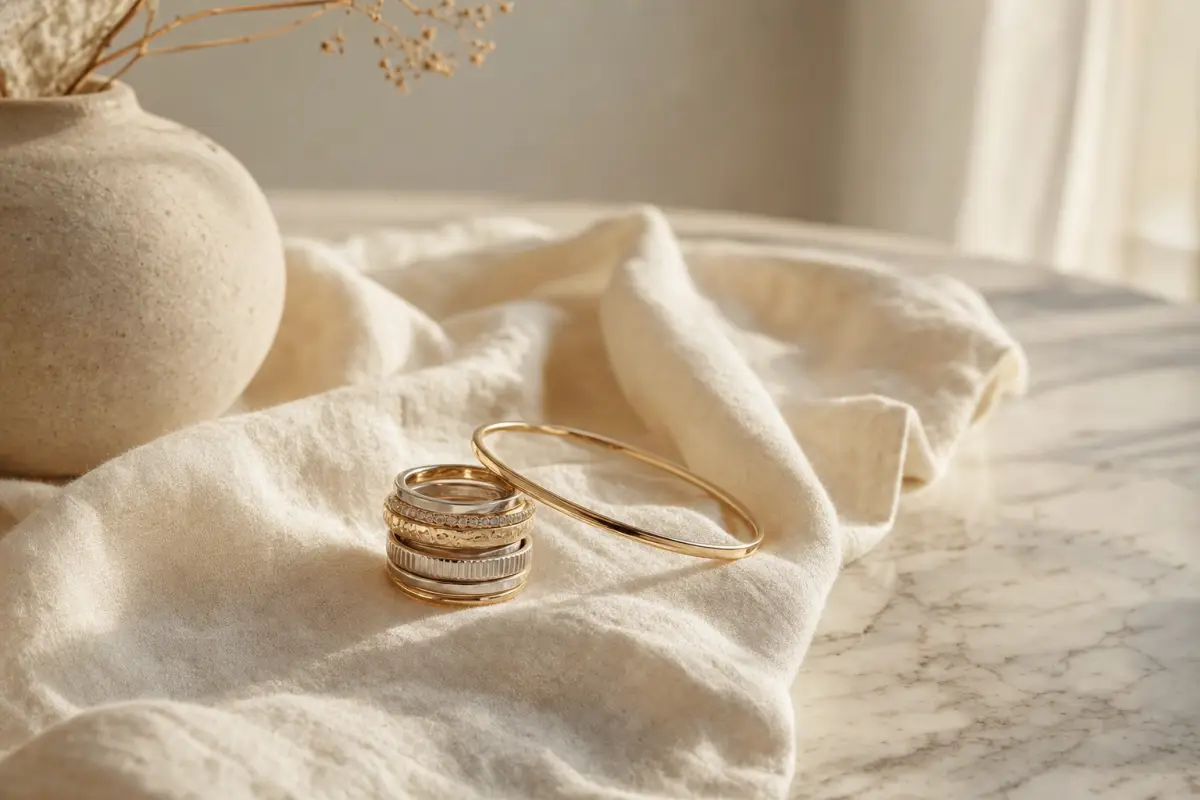
White Gold and Yellow Gold
Mixed-metal jewelry is the practice of pairing two or more metal tones — typically yellow gold, white gold, platinum, or silver — in a single outfit. The metals are chemically stable together, so the only real question is surface wear, and that comes down to hardness and placement.
The old rule — match your metals, wear one tone head to toe — governed weddings, job interviews, and every “proper” jewelry purchase for decades. It’s officially retired. DTC jewelry brands now publish dedicated mixed-metal styling guides: Ana Luisa documents how to blend yellow and white tones in one look, and Missoma built its stacking strategy around gold-and-silver combinations. They are not tolerating mixed metals; they are teaching them.
Why now? Three things converged. First, the demi-fine price tier lets one person own a real gold stack and a rhodium-white stack without choosing sides. Second, today’s signature styles — double necklaces, ear-curated stacks, three rings per hand, bracelet layers — are multi-piece by design, and multi-piece looks read better in two tones than one. Third, the capsule-wardrobe mindset finally reached jewelry: mixing tones turns one set of pieces into four different moods, and on the wrist it reads as personality rather than polish.
In 2026, stacked metal tones are a fashion language: gold for warmth and heirloom feeling, white (or silver) for contrast and edge. Wearing both says you curate your pieces instead of inheriting a rulebook — which is exactly why the question “will they damage each other?” deserves a straight answer.
The Hardness Matchup: What Happens When Karat Gold Rubs Sterling Silver
Metal-on-metal wear is governed by hardness, measured on the Mohs scale (1 = softest, 10 = hardest). The bigger the gap between two metals, the more the softer one gives up surface material when they rub. Here is where every stacking metal actually sits:
| Metal | Mohs hardness | Why it matters for stacking |
|---|---|---|
| 24K gold (pure) | ≈2.5 | Softest jewelry gold; bends and scratches readily |
| 18K yellow / rose gold | ≈2.7–3.5 | 75% gold; beautiful color, softer alloy |
| 14K yellow / rose gold | ≈3.0–3.5 | 58.3% gold; the everyday-durable sweet spot |
| Sterling silver (925) | ≈2.5–3 | Soft, skin-friendly — picks up the most marks |
| Platinum | ≈4–4.5 | Dense and tough; scratches less, weighs more |
| White gold (base alloy) | ≈4.5–5 | Hardened with nickel or palladium — the stiff sibling |
| Rhodium (plating layer) | ≈6 | The armor on white gold’s surface |
The chemistry first, because it puts the whole debate to bed: yellow gold, white gold, and silver do not react with each other. Gold is chemically inert — it does not oxidize or tarnish, which is why ancient gold still looks new. Silver tarnishes, but through sulfur in the air and sweat, not through contact with gold. Nothing leaches, nothing corrodes, nothing “poisons” the other metal. Mixed-metal stacking is a mechanical question, never a chemical one.
White gold deserves a closer look, because it explains the entire hardness gap. White gold is not a naturally white metal — it is the same gold alloy you know, bleached white with nickel or palladium, then electroplated with a thin layer of rhodium, a platinum-group metal at roughly Mohs 6. That layer is only about 0.5–2 microns thick, yet it is the hardest surface on your wrist, and it doubles as a barrier that keeps nickel away from skin. The trade-off: a plating is a consumable. With daily wear it thins over 6–12 months, and jewelers recommend replating every 1–2 years.
The honest part. In high-friction spots — bangles knocking together, rings on neighboring fingers, anything pressed while you grip a doorknob or a dumbbell — the softer metal (yellow gold, and especially sterling silver) will pick up fine surface scratches. This is physics, not a defect, and not proof of low quality. A five-figure Cartier stack shows the same micro-marks as a demi-fine one. Polishing removes them; placement mostly prevents them.
Silver also does its own thing: it tarnishes where air and sweat reach it, darkening into a thin gray film that wipes off with a polishing cloth. Again — chemistry at work, not damage.
Friction, not chemistry, is the only variable. So the practical answer splits by body zone:
| Where you stack | Friction level | Mixed-metal verdict |
|---|---|---|
| Layered necklaces / collarbone chains | Very low | Mix anything, worry-free |
| Earrings, ear cuffs, cartilage stacks | Very low | Mix anything, worry-free |
| Stacked bracelets / bangles | High | Fine micro-scratches possible; easy to polish — or avoid with the formula below |
| Stacked rings on adjacent fingers | High | Fine micro-scratches possible; easy to polish — or avoid with the formula below |
That split is the whole essay in miniature: 18K and 14K gold stack beautifully with sterling silver for asymmetry’s sake, and on your neck and ears the pairing is effortless. On wrists and fingers, the same pairing wears like honest metal — and that is a solved problem, not a deal-breaker.
Wearlumi’s Scratch-Proof Formula for Mixed-Metal Stacking
Our visual formula has three principles, and they double as scratch prevention:
- Zone your metals. Give each tone its own friction zone. Necklace and ear zones are free-for-alls — mix as loudly as you like. On wrists and fingers, let one metal lead, and use the other tone only as thin, delicate accents (a fine chain, a slim band) that have less surface to bump.
- Separate the layers. When you must stack bracelets in both tones, put a soft layer between them — leather, braided cord, a knotted chain, or a watch strap. The soft layer absorbs the friction so the metals never meet.
- One dominant, one accent. Let about 80% of the visual weight sit in one tone and 20% in the other — gold as the lead, a white-gold signet or thin bangle as the counterpoint. It is the proportion both Missoma and Ana Luisa push in their styling guides, and it reads as intentional instead of accidental.
- Put jewelry on last: after lotion, perfume, and sunscreen dry, so chemical residue never sits against metal.
- Build bracelets soft-first: slip the silver or gold piece closest to your wrist, then the harder white-gold piece outside it, so the harder metal shields the softer one.
- Take rings and bracelets off before the gym, the pool (chlorine is genuinely corrosive to gold alloys), and the sauna.
- Store by metal or in individual pouches when you take the stack off — silver gets its own sealed bag to slow tarnishing.
- Rinse-then-polish monthly: warm water, a drop of mild soap, a soft brush, and a separate cloth per metal; give silver a dedicated polishing cloth pass.
Maintenance cadence, in one breath: gold — a jeweler’s polish every 1–2 years, or whenever the shine asks for it; white gold — replate rhodium every 1–2 years, sooner if it starts looking warm; sterling silver — polish every 3–6 months depending on how often you wear it, and always dry it fully before storing.
One more honest note. Micro-scratches are not a quality verdict. Real gold and silver are soft by nature — that softness is why they age gracefully and polish back to new, and why a solid-metal piece outlives any plated costume jewelry. Wearlumi’s position: stacking freedom comes first, and correct habits handle the rest. Wear the two tones, love the contrast, and treat the scratches as what they are — the patina of a well-worn stack.
Frequently Asked Questions
Can you wear white gold and yellow gold together?
Yes. On low-friction spots — necklaces, earrings, cartilage stacks — the two tones mix freely with no visible wear. On bracelets and stacked rings, the softer metal can pick up fine micro-scratches; that is normal metal physics, polishing removes it, and the stacking formula above prevents most of it.
Does mixing white gold with yellow gold scratch the metal?
Only where they physically rub. White gold alloys sit at roughly 4.5–5 on the Mohs scale, while yellow gold sits around 3–3.5 and sterling silver around 2.5–3 — so in high-friction zones, the softer metal takes fine surface marks. Layered necklaces, ear stacks, and layers with a soft separator between them show essentially no wear.
How long does rhodium plating last on white gold?
The rhodium layer is typically 0.5–2 microns thick. Daily wear thins it noticeably after about 6–12 months, which is when white gold can start to look slightly warm again. Jewelers typically replate every 1–2 years as part of regular maintenance.
Will gold-plated sterling silver tarnish when worn with gold?
The gold plating itself does not tarnish, and gold does not cause silver to tarnish. But plating wears with friction, and once the silver base is exposed, the silver tarnishes through its normal reaction with sulfur in air and sweat. Keep plated pieces in low-friction spots and they hold up much longer.
How should you clean mixed-metal jewelry?
Warm water with a drop of mild dish soap, a soft brush, rinse, then dry each piece with its own soft cloth. Polish silver with a dedicated silver cloth. Skip ultrasonic cleaners for rhodium-plated or gold-plated pieces — the vibration can weaken thin platings.
Keep reading the Wearlumi Materials College