Why Your Ring Spins: Large Knuckles and Sizing Beads
A ring can feel tight going over your knuckle and still spin once it reaches the base of your finger. When the knuckle is larger than the wearing position, a rigid band may leave extra clearance at the base. If the ring’s weight is concentrated toward its stone and setting, gravity can encourage rotation in some hand positions. Sizing beads can improve local fit and contact, but the right adjustment depends on your finger and your ring.
A Wearlumi podcast-style conversation and practical fit guide. Host A and Host B are script roles; this is not an expert interview or a recorded episode.
In this episode
- Why is my ring tight over the knuckle but loose at the base?
- How does a top-heavy setting encourage ring spinning?
- Why does extra clearance make a ring less stable?
- How do sizing beads help keep the stone upright?
- Should I resize, add beads, or consider another structure?
- How can I check whether an adjustment actually helps?
- Common questions about spinning rings
- Questions to bring to your jeweler
Why is my ring tight over the knuckle but loose at the base?
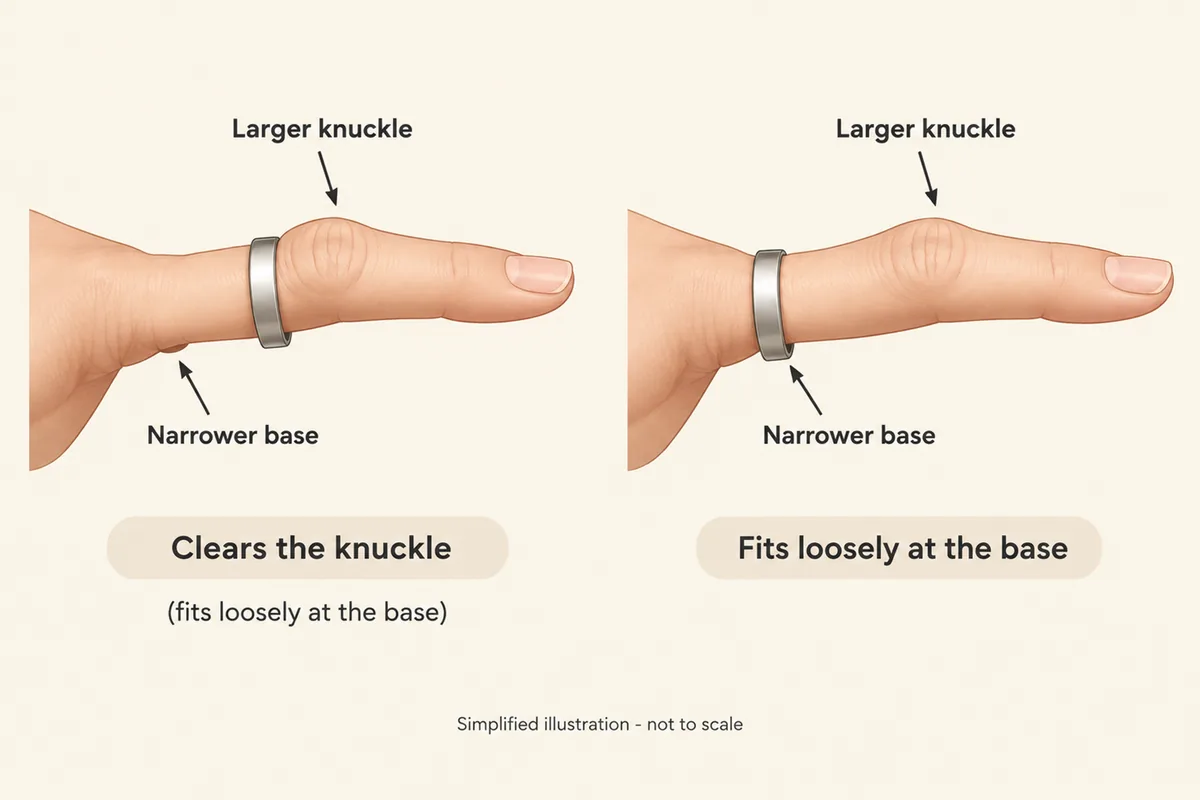
The opening needed to clear your knuckle can be larger than the opening that would fit snugly where the ring rests. One fixed circle has to meet both requirements.
Host A: You straighten the center stone, answer a text, and look down to find it leaning sideways again. The confusing part is that getting this ring over your knuckle already takes a little effort. How could it be too big?
Host B: Because we are talking about two different places. The knuckle is the part the ring has to pass. The finger base is the wearing position closer to your hand. A ring that clears a larger knuckle may have room to move at a narrower base.
That is a question of the finger’s outer shape, not a ring sitting directly against a bone. Skin and soft tissue form the contact surface. The finger also does not behave like a rigid cylinder with the same diameter from end to end.
Host A: So one ring size is trying to solve two fitting problems?
Host B: Exactly. Jewelers Mutual’s ring-fit guidance describes both: a snug, comfortable fit at the base and a little resistance when removing the ring over the knuckle. With a pronounced difference between those two areas, one rigid band may struggle to achieve both.
Host A: Which means that spinning does not automatically tell me to go down half a size.
Host B: Start by having a jeweler assess both locations. The goal is less unwanted rotation, comfortable wear, and normal removal. A smaller band is useful only if it still works with the rest of your finger.
How does a top-heavy setting encourage ring spinning?
A ring with its center of mass displaced toward the setting can experience a turning effect from gravity around the finger. That effect depends on the hand’s orientation as well as the weight distribution.
Host A: Is a larger diamond always going to make a ring lean?
Host B: Stone size is one clue, but carat weight alone cannot explain the whole ring. The setting, shoulders, and band all contribute to its center of mass. Two rings with similarly sized stones can distribute their weight differently.
Host A: And this is where torque comes in?
Host B: Think about opening a door. The same push is more effective at the handle than beside the hinge. Torque describes that turning effect. Its magnitude depends on the force and the perpendicular distance from the rotation axis to the force’s line of action, called the lever arm. OpenStax’s torque chapter explains the underlying relationship.
For this discussion, imagine a simplified ring rotating around an axis along the finger. Treat the ring’s weight as acting at its center of mass. We are applying a general physics principle to an idealized wearing situation, rather than reporting a measured ring-performance test.
Host A: What happens with my hand flat, back of the hand facing up?
Host B: Suppose the finger is horizontal and the center of mass is above its axis, toward the stone. When everything is perfectly centered, gravity’s turning effect about that axis can be zero at that instant. But without enough resistance, that position is easy to disturb. Once the ring shifts slightly to one side, gravity can encourage it to rotate toward a lower position.
Contact friction can hold it in place. It does not have to fall just because the stone is above the finger.
Host A: What if my finger points straight down?
Host B: In that ideal model, gravity runs parallel to the finger’s axis, so it creates no torque about that axis. The ring can still turn because of movement, contact with adjacent fingers, or changes in skin contact. We just cannot explain every turn as gravity pulling the stone underneath.
Host A: That makes sense of why it behaves differently when I type, turn my palm over, or let my hand hang.
Host B: Real rings also shift and tilt, while skin changes shape. The model helps explain a trend; it does not predict a single resting angle for every ring.
When comparing new rings, consider the whole setting and band together. Our guide to gemstone setting design explains other practical trade-offs between prongs, bezels, and pavé. Setting security and rotational fit are related design questions, but one does not prove the other.
Why does extra clearance make a ring less stable?
Extra clearance gives a ring more freedom to move and can make its contact with the finger less consistent. Stability depends on the resistance at those contacts, not simply on whether the band touches skin somewhere.
Host A: Does a loose ring have no friction at all?
Host B: It can still touch your finger at several places. But those contacts may not provide enough resistance to the forces trying to turn it. Contact geometry matters alongside friction.
In the basic dry-friction model, static friction responds to an attempted movement up to a limit. That limit depends on the normal load, or how strongly the surfaces press together. OpenStax’s friction chapter also emphasizes that this is an approximate model.
Host A: Then why not just make the band much tighter?
Host B: Because comfort and removal still matter. Skin is flexible, textured, and changeable. We cannot take a textbook friction coefficient and calculate a universally safe ring size. A fitting adjustment should improve stability within a comfortable range.
Host A: What about the advice that a wider band has more surface area, so it must have more friction?
Host B: That explanation skips a step. Apparent contact area is not a direct factor in the basic dry-friction equation. A wider band may change pressure distribution, fit, and room for tilting, but doubling its width does not establish that it doubles resistance to spinning. It also changes how the ring feels, so try the actual width you intend to wear.
The practical question is how the ring and finger work together: clearance, local contact, setting height, weight distribution, and the movements you make every day.
How do sizing beads help keep the stone upright?
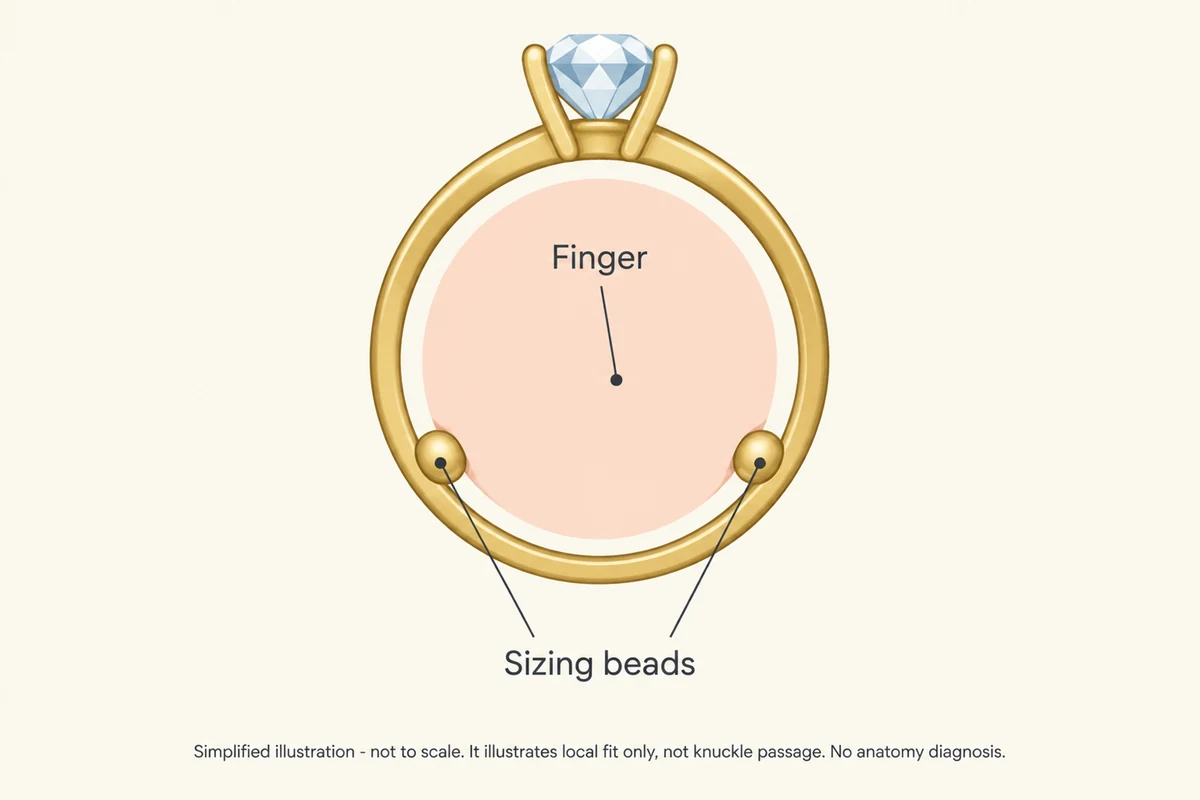
Sizing beads project into the band and reduce local clearance. They change where and how the ring contacts the finger, which can help it resist unwanted rotation.
Host A: What exactly are sizing beads?
Host B: Typically, they are two small metal beads fitted by a jeweler inside the palm-side portion of a band. Jewelers Mutual’s guide to resizing alternatives describes them as an option for a slightly loose ring that can help keep it upright. It also notes that some people find them uncomfortable and recommends trying a sample ring.
Host A: Are the beads counterweights for the stone?
Host B: They have mass, but their fitting effect should not be reduced to a counterweight story. Their inward projection takes up some of the gap. A smooth circular opening becomes an opening with local raised points.
If those points make suitable contact with the soft tissue, the ring has to overcome a changed pattern of friction and geometric resistance to turn. This contact-based explanation is an inference from basic mechanics, not a Wearlumi laboratory finding.
Host A: Is there a standard bead size or a specific clock position I should ask for?
Host B: There is no universal prescription. A jeweler needs to consider the band profile, your finger shape, the stone’s orientation, and how you put the ring on and take it off. A bead diameter mentioned online is not a sizing instruction for your hand.
Host A: Could the beads make it harder to get past my knuckle?
Host B: Yes. They do not shrink the entire circumference in the same way as cutting down a band, which can help some people find a better compromise. But they still reduce space locally. Check removal as carefully as the fit at the base.
Before any modification, ask about the ring’s material, stone settings, finish, service policy, and whether the adjustment can later be changed. Jewelers Mutual’s resizing guide explains why metal and construction affect feasibility. Plated surfaces and intricate settings need individual assessment.
Should I resize, add beads, or consider another structure?
The useful distinction is whether the ring is loose everywhere or mainly loose at the base after clearing a larger knuckle. Then compare comfort and removal with the actual ring.
Host A: Let’s work through a few everyday situations. First: the ring slips easily over the knuckle and stays loose at the base.
Host B: Have a jeweler assess whether the whole ring is oversized. If its material and construction allow it, conventional resizing may be the more direct adjustment.
Host A: Second: there is already resistance at the knuckle, but the stone keeps turning once the ring reaches the base.
Host B: Ask to try a sample with sizing beads or an insert. Compare the feeling while resting your hand, typing, and gently bending your finger. The knuckle-to-base difference is the reason to explore local fit.
Host A: Third: the beads feel like pressure points.
Host B: Ask about a spring insert. This is a flexible metal structure inside the band that yields to help pass the knuckle and then returns toward its fitted shape at the base. Jewelers Mutual describes spring inserts and sizing bars among professional alternatives. Comfort still depends on the individual and the construction.
Host A: Fourth: the knuckle and base are so different that fixed bands never seem comfortable.
Host B: An opening or hinged shank separates passing the knuckle from closing around the base. CLIQ’s hinged-ring technology is one manufacturer example. It establishes that the structure exists; it does not tell us that every existing ring can be converted or that one system is best for everyone.
Host A: What if I want to try something removable first?
Host B: An adjuster made specifically for rings can help you explore whether filling the gap improves stability. It can also move or change how high the ring sits. Treat it as a temporary fit aid and inspect it regularly, rather than assuming it replaces a professional assessment.
Do not glue metal beads into your ring, coat the interior with nail polish, or file it to create a rougher surface. Ask a jeweler which approach suits the material and finish.
Host A: And the squared-off bottom sometimes called a euro shank?
Host B: A different external shape may affect contact with adjacent fingers or weight distribution. That is a design possibility to compare in person. A square-looking exterior alone does not establish that the inner opening fits your finger better or guarantees an upright stone.
How can I check whether an adjustment actually helps?
Compare the fit at both locations, try ordinary hand positions, and confirm that the adjusted ring remains comfortable to put on and remove.
Host A: What should I do at the jewelry counter beyond saying, “It spins”?
Host B: Bring the actual ring and describe when it turns. These four observations make the conversation more useful:
- Check the knuckle and base separately. Note resistance while passing the knuckle and clearance at the wearing position. A single size number does not capture both.
- Compare ordinary positions. Rest your hand with the back facing up, turn your palm up, let your hand hang, and gently simulate typing. Observe how the stone settles. This is a fit check, not a torque measurement.
- Try the proposed structure. A sample with beads can reveal whether local contact feels comfortable. Compare an insert if it does not. Confirm normal removal as well as placement.
- Revisit the fit in daily life. Check at different times rather than treating one fitting as a year-round verdict. Temperature and other factors can change fit, as Jewelers Mutual’s guidance notes.
Host A: How do I know I improved stability rather than just squeezing my finger?
Host B: Look for less unwanted rotation, comfortable movement, and normal removal. A little controlled movement can be acceptable. Stop wearing a ring that causes persistent pain, numbness, or marked color changes. If it becomes stuck, particularly with discoloration or pronounced swelling, seek prompt medical help rather than pulling harder. These are practical comfort boundaries, not a diagnosis.
A useful request is: “This ring is snug over my knuckle but loose at the base. Could I try a sample with sizing beads and compare an insert?” That gives a jeweler something specific to evaluate.
Common questions about spinning rings
Does spinning mean my ring is poorly made?
Host A: Is the movement itself evidence of bad quality?
Host B: No. Fit, finger shape, and weight distribution can explain it. A sudden change, a visibly bent band, or a loose setting deserves inspection, but ordinary spinning alone does not establish workmanship quality or gemstone authenticity.
How much improvement can sizing beads provide?
Host B: There is no percentage that applies to every finger and ring. The professional fit guidance supports beads as a useful option, but does not establish a universal success rate. Wearlumi has not measured a percentage reduction in spinning for this modification. The relevant result is your own comfort and stability after fitting.
Can stacking a plain band hold my stone ring in place?
Host B: Sometimes an adjacent band limits movement, but separate rings can still rotate independently. Contact can also create rubbing, depending on spacing and the setting. Do not buy an uncomfortably tight band just to clamp another ring in place. For material considerations, see our mixed-metal ring stacking guide.
Questions to bring to your jeweler
- Is my ring oversized overall, or does the knuckle-to-base difference explain the loose fit?
- Can I try a sample with sizing beads to check the palm-side contact?
- Does my ring’s metal, finish, and setting allow beads or an insert?
- Will the adjustment allow comfortable finger movement and normal removal?
- If beads are uncomfortable, would a spring insert or an opening shank be feasible?
- What are the cost, maintenance, and service-policy implications? Can the adjustment be changed later?
Host A: One thought to take away?
Host B: Clearing the knuckle and sitting securely at the base are two connected fitting requirements. Ring spinning often comes from their interaction with weight distribution and contact. Identify the mismatch first, then choose a suitable adjustment. A comfortable ring you can wear through ordinary life is a better goal than forcing a stone to stay perfectly still at any cost.
Sources and further reading
- Jewelers Mutual: How do I know if my ring fits? — fit at the base, knuckle resistance, and signs of excessive tightness.
- OpenStax, University Physics Volume 1: Torque — the general principle behind our simplified ring model.
- OpenStax, University Physics Volume 1: Friction — static friction and the limits of an approximate model.
- Jewelers Mutual: When and how to make a ring smaller without resizing — beads, inserts, and temporary fit aids.
- Jewelers Mutual: How to resize a ring — material and construction considerations.
- CLIQ Jewelry — a manufacturer example of an opening shank, rather than independent comparative evidence.