Lab-Grown Rubies and Sapphires: 7 Crucial Facts for Buyers
Lab-grown rubies and sapphires are laboratory-created corundum gems with essentially the same defining chemical, physical, and optical properties as natural ruby and sapphire.[1][3] Their origin is laboratory growth rather than geological formation.[10]
The useful distinction is between what a stone is and how it formed. A properly identified laboratory-grown sapphire is corundum; a blue lookalike may be a different material.[1][2] Laboratory-grown stones still need clear origin labels, and U.S. jewelry marketing has specific guidance on words such as “real” and “genuine.”[3][8]
For a jewelry buyer, understanding those distinctions makes it easier to compare color, craftsmanship, documentation, and care without relying on an ambiguous sales description.
On this page
What are lab-grown rubies and sapphires?
Lab-grown ruby and sapphire belong to the same corundum family as their natural counterparts.[1][2][5] Corundum’s basic chemical composition is aluminum oxide, written as Al₂O₃.[2][5]
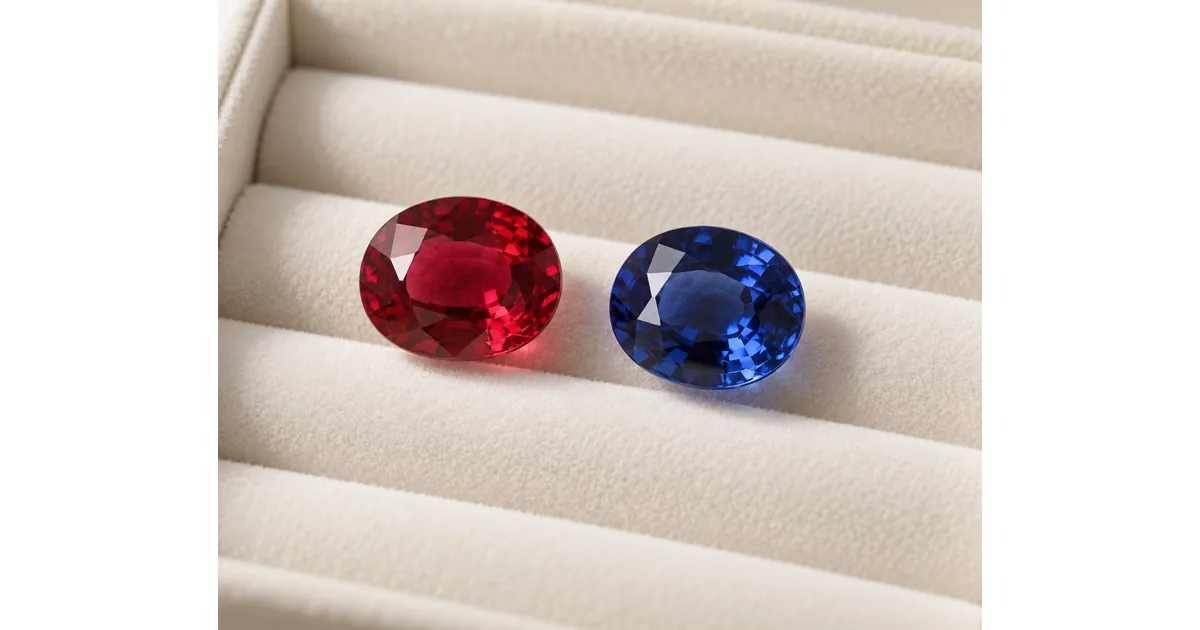
Ruby is the red variety, with its red color caused by chromium.[5] Sapphire includes gem corundum in colors other than ruby red, so a sapphire can be pink, yellow, purple, or another color as well as blue.[2]
Laboratory growth produces a crystal with the defining properties of the named gem.[1][3] It does not mean every detail matches every natural specimen: growth features, inclusions, and trace-element chemistry can differ, which helps gemologists identify origin.[10]
That distinction matters when comparing jewelry. “Lab-grown” describes origin. “Ruby” or “sapphire” identifies the material. A color name describes appearance. Ask for all three when a listing leaves the stone’s identity unclear.
Lab-grown, natural, or imitation: how do they differ?
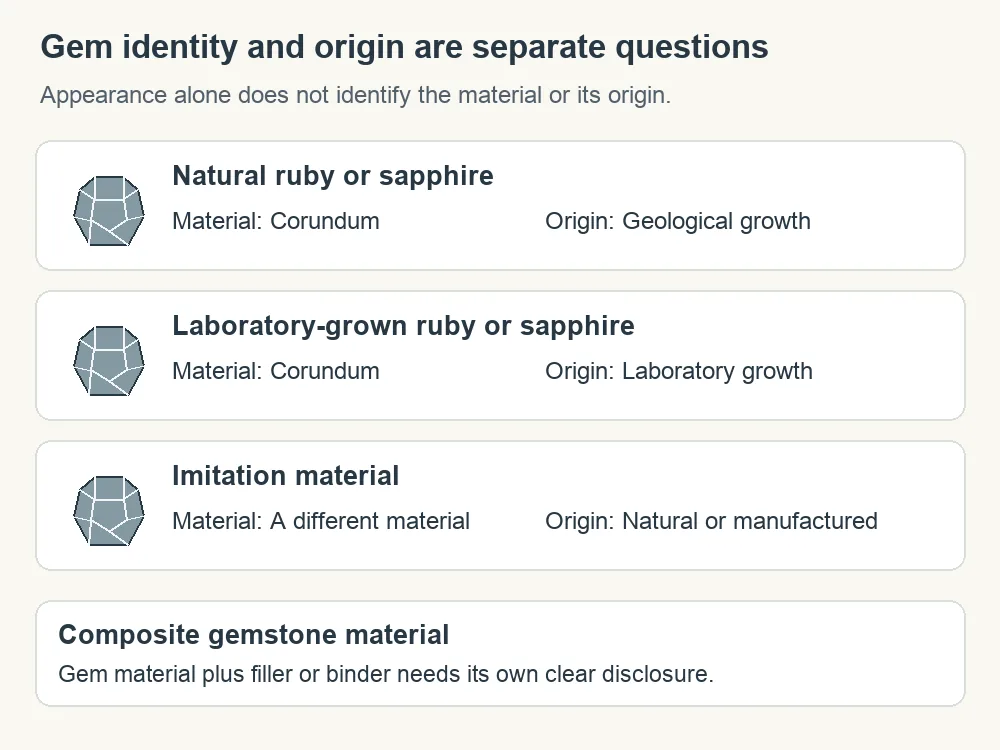
A laboratory-grown counterpart shares the defining properties of the named natural gem.[1][3] An imitation is a material used to resemble another gem, without being that gem material.[2]
| Description | What it tells you | Example |
|---|---|---|
| Natural ruby or sapphire | Corundum formed through geological processes | Natural sapphire.[2][5][10] |
| Laboratory-grown ruby or sapphire | Corundum grown by people | Laboratory-grown sapphire.[1][3] |
| Imitation or simulated stone | A material chosen to resemble a different gem | Blue synthetic spinel used to imitate sapphire.[1] |
“Synthetic” is a technical gemological term for a laboratory-made counterpart of a natural gem material, rather than an automatic description of a glass lookalike.[1][3]
For U.S. shopping, look for wording such as “laboratory-grown ruby” or “laboratory-created sapphire.” The FTC Jewelry Guides call for an origin disclosure immediately before the gem name, with equal conspicuousness.[3][4]
There is a separate wording caution: the guides describe using “real,” “genuine,” “natural,” “precious,” or similar terms for artificially produced jewelry products as unfair or deceptive. That is why the material explanation in this article should not be turned into a product claim such as “genuine natural sapphire” for a laboratory-grown stone.[8]
Glass-containing composites need a separate description. Gem material combined with filler or binder, such as lead glass, should not be presented as an unqualified ruby or as a laboratory-grown ruby. The FTC Jewelry Guides call for a clear, conspicuous explanation that the product differs from the named stone and requires special care when composite terminology is used.[3] Ask what the material contains and how it should be cleaned; a label such as “treated” alone does not explain a composite.
How are lab-grown rubies and sapphires made?
Several growth methods can produce laboratory-grown corundum. Ruby and sapphire can be grown by flame fusion, crystal pulling, flux growth, and hydrothermal growth.[1][10]
- Flame fusion, also called the Verneuil process: Powdered ingredients pass through a hot flame, melt, and crystallize into a larger crystal called a boule.[1][10]
- Crystal pulling, or the Czochralski process: A seed crystal contacts molten ingredients and is slowly withdrawn as the growing crystal forms.[1][10]
- Flux growth: Gem-forming ingredients dissolve in a molten flux, and crystals grow from that solution under controlled conditions.[1][10]
- Hydrothermal growth: Crystal growth takes place in a hot, pressurized, water-based environment.[1][10]
These are different routes to crystal growth, not a universal ranking of finished jewelry quality. Flame-fusion corundum is crystalline material, too; GIA describes the process as producing a single crystal of corundum.[10]
If a seller emphasizes a particular growth method, ask what that means for the stone you are buying. Compare the actual color, cut, visible clarity, and finish. A method name alone is not enough information to choose between two pieces.
Can you tell whether a ruby or sapphire is lab-grown?
A casual visual impression is not a reliable way for a buyer to establish origin.[10] Professional identification considers the stone’s internal features and analytical evidence together.[9][10]
For example, flame-fusion corundum can contain curved growth striae or gas bubbles, while other methods leave different clues that may resemble features in natural or treated stones.[10]
A very clear appearance does not establish laboratory origin, and visible inclusions do not establish natural origin.[10] GIA’s research describes both inclusions in synthetic materials and identification challenges where features overlap.[10]
When origin affects your purchase decision, ask for supporting documentation. For a substantial purchase, consider an independent identification report. GIA’s colored-stone reports describe the material, whether it is natural or synthetic, and any detectable treatments.[9]
Use that information to check identity and treatment. Assess the jewelry’s design, setting, and price separately, and make sure the report’s measurements and description correspond to the stone being offered.
Are lab-grown rubies and sapphires durable?
Laboratory-grown corundum shares the defining physical properties of natural corundum, including its Mohs hardness of 9.[1][6][7] GIA describes corundum as having excellent toughness and no cleavage, making it a good choice for rings and other jewelry worn daily when treatment and condition permit.[6][7]
Hardness measures resistance to scratching, toughness concerns breaking and chipping, and stability concerns exposure to conditions such as chemicals, heat, and light; each is a separate part of gemstone durability.[11]
A high hardness number does not make the whole piece damage-proof. The setting still matters: GIA recommends protecting vulnerable points and corners and keeping the prongs that hold a gem in good condition.[11]
For everyday wear, consider how exposed the stone is and how you use your hands. Remove rings for heavy lifting or rough work, and have a jeweler check a loose stone or bent prong before wearing the piece again.
For a broader comparison of scratch resistance, see WearLumi’s Mohs hardness guide.
Why do prices vary?
There is no single price for laboratory-grown ruby or sapphire. GIA notes that synthetic corundum is available at many price levels, from very affordable to very expensive.[1]
Laboratory-made gems can also be much less rare than natural gems of equal size, clarity, and color saturation.[1] That helps explain why laboratory origin changes the buying comparison, but it does not establish a universal percentage discount.
Compare actual pieces with similar dimensions and visible quality, then consider the metal, setting, craftsmanship, and seller’s terms. Avoid treating a low price as proof of imitation or a high price as proof of natural origin.
Choose jewelry for its appearance, usefulness, and personal meaning. Do not assume that buying a gemstone guarantees appreciation or a particular resale price.
Are lab-grown stones automatically more sustainable?
Laboratory origin alone does not establish an overall environmental advantage.[4] Knowing how a crystal was grown is different from having evidence about its full production and supply chain.
The FTC says marketers need a reasonable basis for environmental claims and cautions against broad claims such as “eco-friendly” or “sustainable” that imply benefits an advertiser cannot substantiate.[4]
If an environmental claim matters to you, ask for specifics: what energy was used, which manufacturing stages are covered, how inputs were sourced, and what documentation supports the comparison. A claim about one stage should be assessed within that stated scope.
Apply the same care to ethical-sourcing language. Ask what the seller has verified about its suppliers and working conditions. “Lab-grown” gives you information about gemstone origin; it is not a substitute for supply-chain documentation.
What should you ask before buying?
Start with five questions that make the purchase easier to compare:
- What is the material and origin? Ask for “laboratory-grown ruby” or “laboratory-grown sapphire” in writing, including on your purchase documentation. A color name alone is not enough.
- Has the stone been treated or filled? Ask about treatments and special care. Ruby and sapphire materials that are fracture-filled, cavity-filled, or dyed can require more cautious cleaning.[6][7]
- Can I see the actual piece? Request clear photos or video in more than one lighting condition. Compare the stone’s dimensions, color, cut, and setting.
- What supports the identification? If a laboratory report is provided, verify its number with the issuing laboratory and compare its description with the stone. GIA reports include details such as weight, measurements, color, and a photograph.[9]
- What are the care and return terms? Read the return window, warranty coverage, and instructions for the complete piece before purchasing.
Cut and appearance deserve attention alongside material identity. For related background, read WearLumi’s guide to gemstone sparkle.
How should you care for lab-grown ruby and sapphire jewelry?
Care should follow the stone’s treatment, condition, and setting. Corundum is stable under normal wearing conditions, but that does not make every treatment or finished piece equally tolerant of cleaning.[6][7]
For an untreated laboratory-grown ruby or sapphire, warm water and mild soap are a sensible starting point, provided the jeweler’s instructions also allow them for the complete piece. GIA recommends warm, soapy water for ruby and sapphire, while advising only a damp cloth for fracture-filled, cavity-filled, or dyed material.[6][7]
Follow the seller’s instructions for rinsing and drying, and consider any accompanying gemstones or delicate components. Avoid ultrasonic or steam cleaning until a jeweler has assessed the stone, treatments, and mounting.
Store pieces separately so their stones do not rub against one another. Corundum can scratch other corundum and softer gems, and diamond can scratch corundum.[11]
When choosing laboratory-grown ruby or sapphire jewelry, look for a precise material label, treatment disclosure, a well-made setting, and care instructions you can follow. Choose the piece you enjoy wearing, with documentation that makes its identity clear.
Explore everyday jewelry at WearLumi.
Sources
- An Introduction to Synthetic Gem Materials
- Sapphire Gemstone | Sapphire Stone – GIA
- 16 CFR § 23.25 – Misuse of the words “ruby,” “sapphire,” “emerald,” “topaz,” “stone,” “birthstone,” “gem,” “gemstone,” etc.
- Warning letters re-”mined” diamond sellers to describe products accurately | Federal Trade Commission
- Ruby Gemstone | Ruby Stone – GIA
- Ruby Care and Cleaning Guide
- Sapphire Care and Cleaning Guide
- 16 CFR § 23.27 – Misuse of the words “real,” “genuine,” “natural,” “precious,” etc.
- Colored Stone Reports & Services Details
- Laboratory Growth of Gem Materials and the Attempt to Replicate Nature (Gems & Gemology, Summer 2024)
- More than the Mohs Scale | Understanding Gem Durability | GIA 4Cs