Water, Chlorine, and Hot Springs: A Jewelry Care Guide
If you are asking whether waterproof jewelry is pool safe, start with the metal, finish, and water chemistry—not the label alone.
Is Waterproof Jewelry Pool Safe?
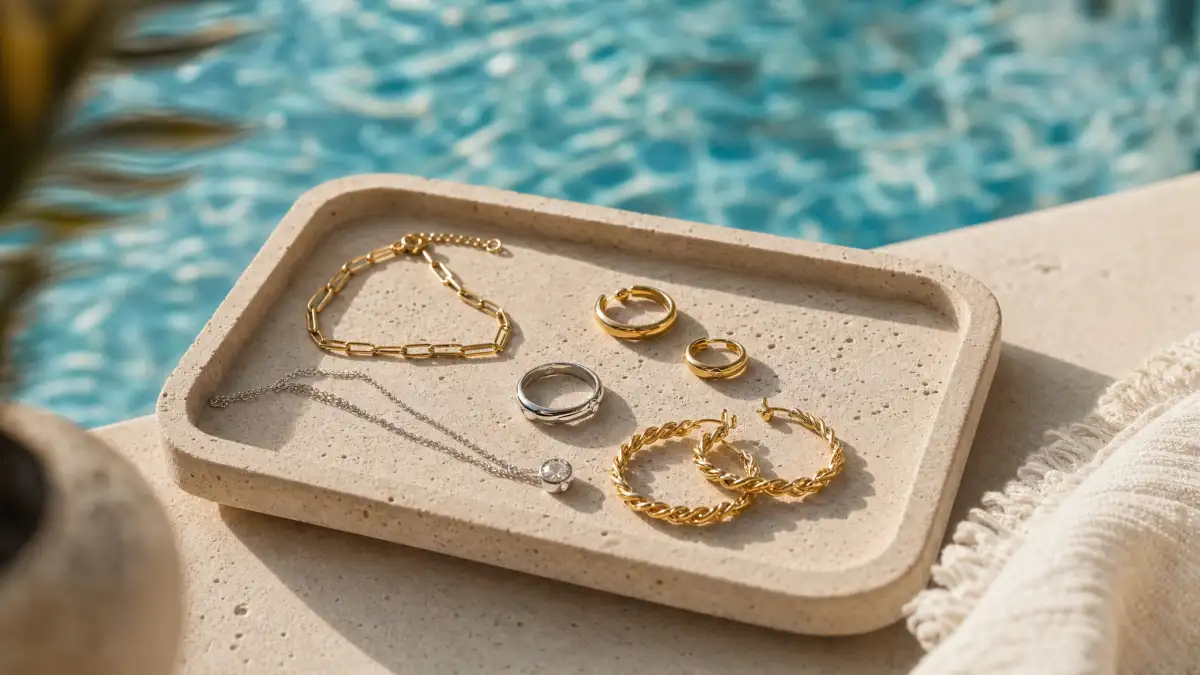
To keep your waterproof jewelry pool safe, you must understand that jewelry surface changes usually come from residue, abrasion, or chemical reactions. Tap water is not an instant corrosive, but chlorinated pools and sulfur-containing hot springs deserve more caution than clean water, especially for plated finishes, sterling silver, and silver alloys. “Waterproof” describes a product’s intended water resistance under stated conditions; it does not mean chemical-proof.
Jewelry care becomes much easier when you stop treating every water exposure as equivalent. A quick splash of tap water, a chlorinated pool, a salt-water beach day, and a hot spring create different environments at the metal surface. Temperature, pH, dissolved minerals, disinfectants, salts, and contact time all matter.
For demi-fine jewelry, the finish is only one part of the picture. The base metal, plating or PVD coating, stones, adhesives, hollow construction, and clasp all influence how a piece handles moisture and friction. An accidental splash is usually a care problem, not a reason to panic. Repeated soaking is where avoidable wear adds up.
Start With Construction, Not Color
A gold-colored piece is not necessarily solid gold. It may be gold-plated, gold vermeil, gold-filled, or a PVD-coated base metal. Missoma describes gold vermeil as gold over sterling silver and distinguishes it from typically thinner gold plating. A surface layer can lose color first at edges, scratches, clasps, and high-friction points.
Sterling silver is generally 92.5% silver and about 7.5% other metals, according to the Gemological Institute of America. Silver can tarnish when exposed to air and moisture over time. That does not mean every tap-water contact turns a piece dark immediately; it means damp storage and chemical residue create more work for your care routine.
| Material or finish | Brief fresh-water contact | Pool or hot tub | Sulfur-containing hot spring | Lower-risk habit |
|---|---|---|---|---|
| Gold plating or gold vermeil | Dry promptly; avoid repeated soaking | Avoid; chlorine, heat, and friction can accelerate change | Avoid | Remove before swimming, soaking, or showering |
| 925 sterling silver | Dry promptly | Avoid | Higher risk of darkening | Keep dry and use silver-specific care |
| 14K or higher solid gold | Usually more tolerant than plating | Long exposure is not recommended | Long exposure is not recommended | Remove for exercise and soaking |
| 316L stainless steel or titanium | Often suitable for everyday moisture | Do not assume pool-safe | Depends on alloy, coating, and testing | Rinse and dry; watch the finish |
| PVD gold-tone finish | Often more wear-resistant than thin plating | Avoid prolonged or concentrated exposure | Avoid | Treat water resistance as a boundary, not a lifetime promise |
How Chlorine, Salt, and Hot Springs Change the Risk
Chlorinated Water Is More Than Moisture
Pool and hot-tub sanitation relies on chlorine-based chemistry. The U.S. Environmental Protection Agency describes related forms in water, including chlorine, hypochlorous acid, and hypochlorite ion. That chemistry does not make household tap water equivalent to pool water, and it does not mean every item fails after one swim.
The practical risk often comes from several stresses arriving together: chemical exposure, warm water, rubbing, and repeated wet-dry cycles. Plating is a surface over a different material, so a scratch or worn edge can become the first place where uneven color or reduced shine appears. Missoma advises avoiding swimming or showering while wearing gold jewelry and lists chlorine, salt water, and fresh water among exposures that may damage precious metals. Mejuri similarly warns that plated and delicate vermeil pieces may fade or tarnish faster around moisture and chlorine.
“Chlorine melts gold” is not an accurate explanation. A more careful statement is that chlorine environments may damage some gold alloys, plated finishes, or related jewelry structures. The result depends on composition, surface condition, concentration, temperature, and exposure time.
Salt Water Adds Chemical and Physical Stress
Salt water does not automatically corrode every piece. Salt changes the conductivity of the water film, while sand and repeated rubbing can scratch a surface. Jewelry worn at the beach may also become wet and then dry with residue left behind. For a plated finish, repeated cycles can matter more than a single brief touch.
Why Sulfur Springs Can Darken Silver
The familiar “rotten egg” odor around some hot springs is associated with hydrogen sulfide. The CDC’s ATSDR public-health statement notes that hydrogen sulfide can occur naturally in sulfur springs. Conservation research published through the Journal of the American Institute for Conservation explains that reduced sulfur gases, including hydrogen sulfide and carbonyl sulfide, can form silver sulfide on silver objects and contribute to tarnish.
That makes “the hot spring turned my silver dark” a reasonable observation, but the chemistry still needs careful wording. Sulfur-containing environments may encourage silver sulfide to form on the surface, particularly when heat and moisture are present. Not every hot spring has the same composition or concentration, and there is no sound basis for promising that every silver piece will turn black within seconds.
Silver sulfide is a surface chemical change; it does not mean the silver was burned. Aggressive polishing can be the bigger problem if a piece has plating, an oxidized finish, soft stones, glued settings, or delicate links.
Waterproof Does Not Mean Chemical-Proof
“Waterproof jewelry” is not a single universal scientific grade covering every brand and material. In its water-resistant guidance, Missoma explains that jewelry is not permanently indestructible; its stated product construction uses 316L stainless steel with a PVD precious-metal finish while still recommending that prolonged chlorine exposure be avoided.
Stainless steel and titanium are often better suited to everyday sweat, humidity, and incidental water than sterling silver or thin plating. That physical water tolerance is not the same as chemical immunity. Chlorine species, salt, heat, crevices, scratches, and cleaning products can still affect a finish or surface.
Before buying, check four details: the base metal, the surface finish, whether the brand specifically covers chlorinated pools or hot tubs, and what aftercare it requires. If the information is missing, the safer default is simple: remove the piece, rinse it if exposed, and pat it dry.
What to Do After a Swim or Hot Spring: A Three-Step Rinse-and-Dry Reset
This sequence suits most metal jewelry without visible structural damage. Stop rubbing and seek brand or professional guidance if stones are loose, plating is bubbling or peeling, links are bent, or the surface is already flaking.
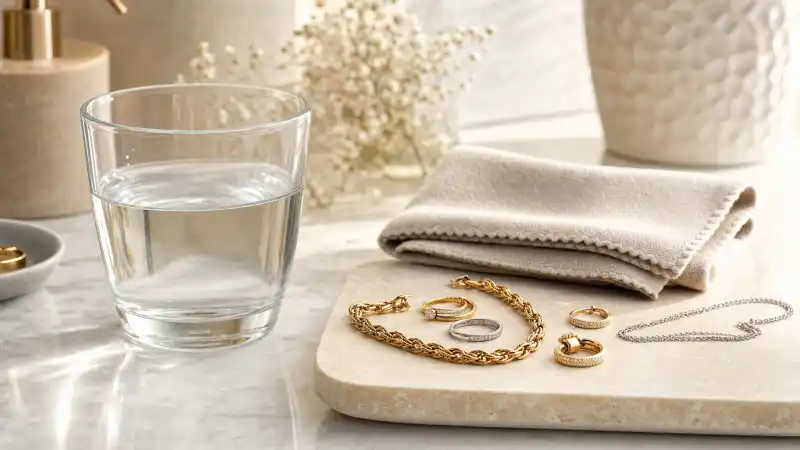
- Remove the jewelry and rinse it with clean, gentle fresh water. The goal is to lift away pool water, salt, or hot-spring residue—not to neutralize it with a stronger chemical. Do not use bleach, alcohol, toothpaste, or abrasive powder.
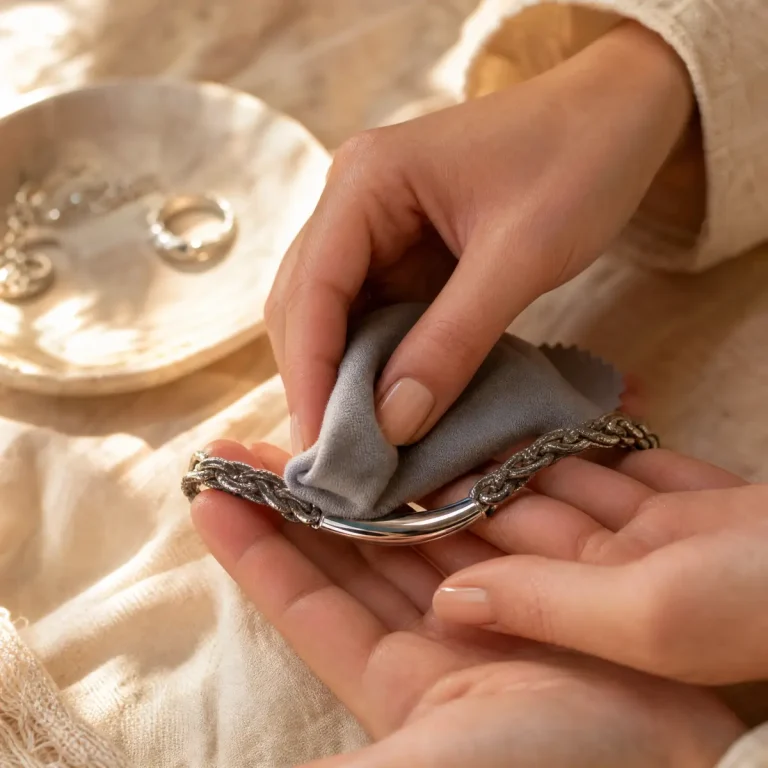
- Pat it dry with microfiber or another lint-free soft cloth. Absorb moisture instead of polishing back and forth. Do not leave the piece to air-dry. Mejuri recommends rinsing after swimming and drying with a soft cloth; Missoma also recommends a clean soft cloth for drying.
- Inspect the surface, clasp, and stone settings. If you only see water spots and the material allows it, use a barely damp soft cloth. If you see darkening, uneven color, bubbling, peeling, a loose stone, or persistent odor, stop DIY cleaning and note the material and water exposure before contacting the brand or a jeweler.
The Boundary for DIY Cleaning
For metal jewelry whose care instructions allow it, mild soap, lukewarm water, and a soft-bristle brush can clean crevices. Rinse thoroughly and pat dry. Missoma lists mild dish soap, warm water, and a soft toothbrush as options for deeper cleaning, while warning against polishing cloths that contain cleaners or polishing compounds.
Do not apply one routine to every finish. Gold plating, pearls, opals, turquoise, glued stones, hollow pieces, and specialty surface treatments need material-specific instructions. A silver-care cloth can help with light tarnish on appropriate sterling silver, but it removes a small amount of surface material. Avoid it on plating or intentional patina unless the brand says it is safe.
For a broader cleaning routine, see how to clean tarnished jewelry. For the chemistry behind why silver can darken differently in different environments, read why silver tarnishes on some people’s skin and in different conditions.
Frequently Asked Questions
Can you shower with jewelry?
An occasional splash of clean water is usually not an emergency, but long-term shower wear is not recommended for gold plating, gold vermeil, or sterling silver. Soap, shampoo, heat, humidity, and rubbing increase the care burden. Missoma advises removing gold jewelry before swimming or showering.
Does chlorine damage gold-plated jewelry?
Chlorine can increase the risk of fading, dullness, or surface damage, especially on thin plating and delicate vermeil. One swim does not guarantee failure; composition, finish, water chemistry, temperature, and contact time all affect the result. Remove it before swimming, then rinse and dry it if exposure happens.
What should you do if a hot spring tarnishes silver?
Rinse the piece with clean, gentle fresh water and pat it dry with microfiber or a lint-free soft cloth. Sulfur-containing water may encourage silver sulfide to form on the surface. Use sterling-silver care only if the brand permits it; do not aggressively polish plated, stone-set, or peeling jewelry.
Is waterproof jewelry safe for a swimming pool?
Do not treat the word waterproof as a guarantee. Check whether the brand specifically covers chlorinated pools and review the base metal, finish, and care instructions. Even 316L stainless steel, titanium, or PVD construction should not be assumed to tolerate prolonged chlorine exposure.
Are stainless steel and titanium jewelry completely safe around water and chemicals?
No. They are often more suitable for everyday moisture than silver or thin plating, but water resistance is not total chemical inertness. Chlorine, salt, heat, cleaners, scratches, and a gold-tone surface coating still have limits.
Can jewelry air-dry after getting wet?
It is better not to let it air-dry. Minerals, salts, or other residues can remain on the surface, and air-drying extends the damp contact time. Rinse with fresh water, then pat dry with microfiber or a lint-free soft cloth.
A Simple Rule for Everyday Wear
You do not need a list claiming that every drop of water is dangerous. Identify the water first, then identify the finish. Brief fresh-water contact is usually manageable; chlorine and sulfur-containing hot springs are worth actively avoiding. Even jewelry designed for everyday water exposure should follow the maker’s chemical-exposure limits.
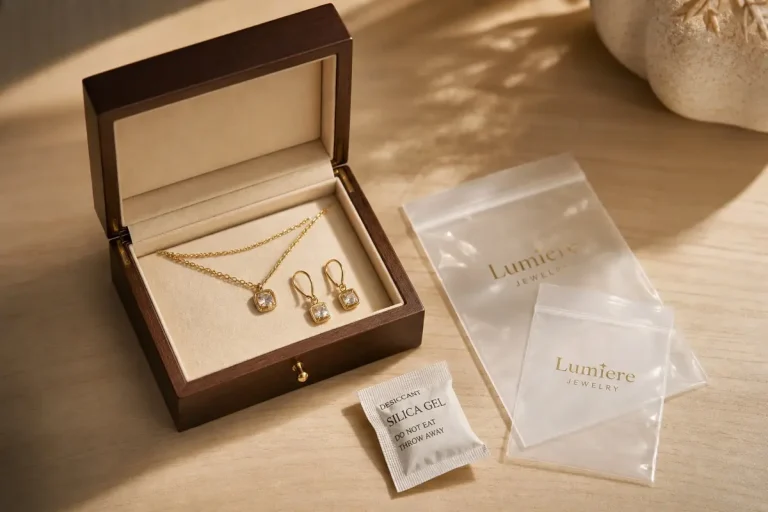
Remove jewelry before showering, swimming, exercising, or soaking, and store it somewhere dry. If an accident happens, a fresh-water rinse, a soft-cloth pat dry, and restraint around polishing are safer than reaching for a strong cleaner. For more ways to reduce moisture and oxidation during storage, see this jewelry anti-oxidation storage guide.
Choose jewelry made for your everyday story, then care for it within its real material limits.