JEWELRY CARE · STORAGE SCIENCE
Why Silver Tarnishes in Cardboard Boxes
If sterling silver darkens after a season in a shipping carton, the box may be part of the story—but it is not a chemical verdict. Paperboard composition, humidity, air exchange, time, and the alloy all matter.
Why Silver Tarnishes In Cardboard Boxes During Storage
Silver tarnish is usually a dark surface layer made largely of silver sulfide. The Canadian Conservation Institute explains that silver reacts with sulfur-containing compounds; hydrogen sulfide is one possible contributor. That chemistry explains why a piece can lose its shine while sitting untouched, but it does not mean every room—or every carton—contains a large supply of sulfur gas.
Paper and paperboard can be tested for their tendency to tarnish silver. TAPPI T 444 describes a silver-tarnishing test for paper and paperboard, while TAPPI T 406 addresses reducible sulfur. That is an important distinction. A testable material risk is not the same as a universal property. Fiber source, recycled content, sizing, coatings, adhesives, and manufacturing batches vary. Some cardboard may contribute sulfur-containing contaminants or make contact with a vulnerable piece more likely; another box may have little practical effect.
Archival specifications make the distinction visible. The U.S. National Archives and the Library of Congress set material requirements for enclosures and artifact-storage papers, including limits related to reducible sulfur and other potentially damaging components. Those specifications show that sensitive storage materials can be screened and selected carefully. They do not prove that an ordinary shipping box is automatically unsafe—or that it will continuously release hydrogen sulfide.
Cardboard Risk Is Possible, Not Automatic
A cardboard box becomes more relevant when several variables line up: the silver stays there for a long time, the material has a higher tarnish potential, moisture is present, or the jewelry touches the paperboard directly. A relatively closed container can also reduce air exchange, but a shipping carton is not necessarily an airtight enclosure. Depending on the starting conditions, less exchange can slow the arrival of polluted or humid air—or leave existing moisture and contaminants inside.
That is why “the box made my silver black” may be directionally useful but scientifically incomplete. A more careful conclusion is that the packaging may have added one risk factor to a system that also included the metal’s alloy, surface residues, temperature, humidity, contact, and elapsed time.
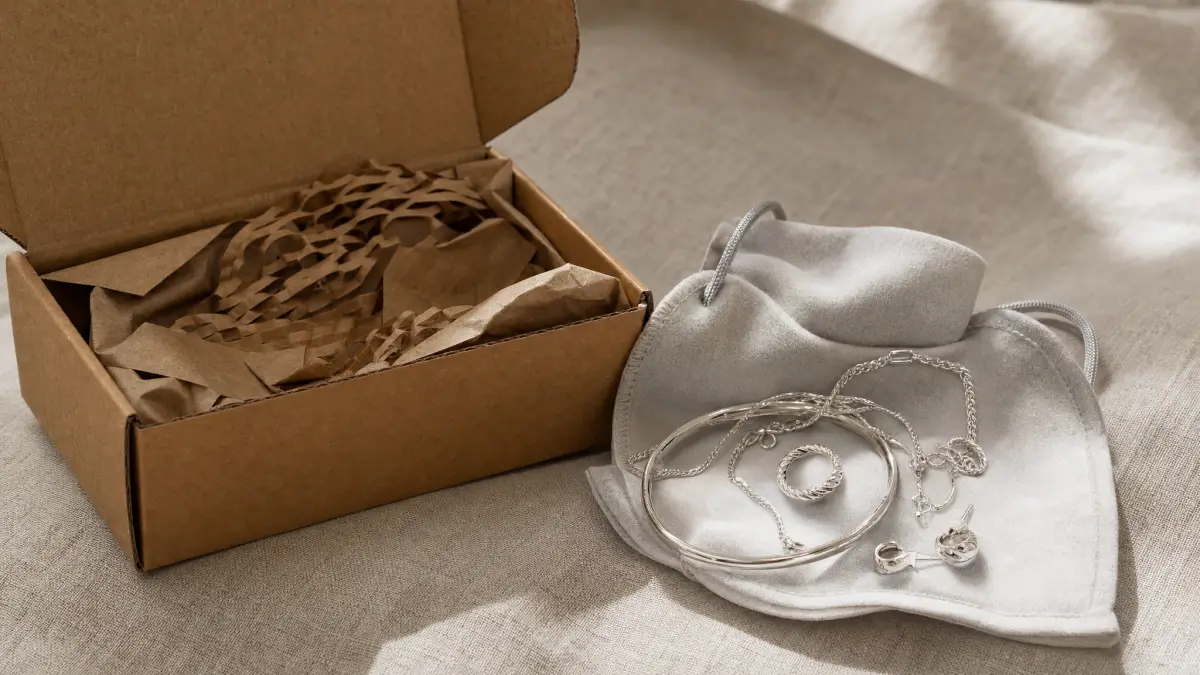
Direct contact and enclosure are also different exposure routes. A chain resting against paperboard has a local contact point; a chain inside a pouch within the same carton has an added barrier. Neither arrangement reveals the carton’s chemistry, but separating the metal from an unknown material removes one avoidable variable. Smell is not a reliable home test, either: a box that smells neutral has not been certified for metal storage, and a strong paper or adhesive odor does not identify a specific sulfur compound.
What the evidence does not support: that all ordinary boxes contain large amounts of free sulfur, that every box continuously emits H2S, or that enclosing 925 silver guarantees black tarnish.
Labels Have Different Jobs: FSC, Acid-Free, and Sulfur-Free
Packaging labels are useful only when you read them for what they actually cover. FSC labeling concerns responsible forest sourcing, recycled content, or related chain-of-custody claims. It is not an acid-free certification and not a sulfur-free performance guarantee.
“Acid-free” describes an acidity or alkalinity property of paper. It does not, by itself, certify that a board contains no sulfur-related compounds or will never contribute to silver tarnish. If a supplier claims a material is appropriate for sensitive metal storage, look for the relevant specification, reducible-sulfur data, or a silver-tarnish test—not a single reassuring phrase.
| Term | What it can tell you | What it does not prove |
|---|---|---|
| FSC | The sourcing or recycled-content claim covered by the specific FSC label | Acid-free, sulfur-free, or anti-tarnish performance |
| Acid-free | An acidity or alkalinity property under the stated specification | No reducible sulfur or no silver-tarnishing potential |
| Tested for silver tarnish | Performance under a named test and its conditions | Permanent protection in every jewelry-storage environment |
The useful purchasing question is therefore not simply “Is this box eco-friendly?” or “Is this tissue acid-free?” Ask which claim applies to which component. An outer shipping carton, a decorative jewelry box, an insert, a pouch, tissue, and adhesive can all have different specifications. Documentation for one layer should not be silently extended to every other layer.
A Practical Inner Layer for Sterling Silver
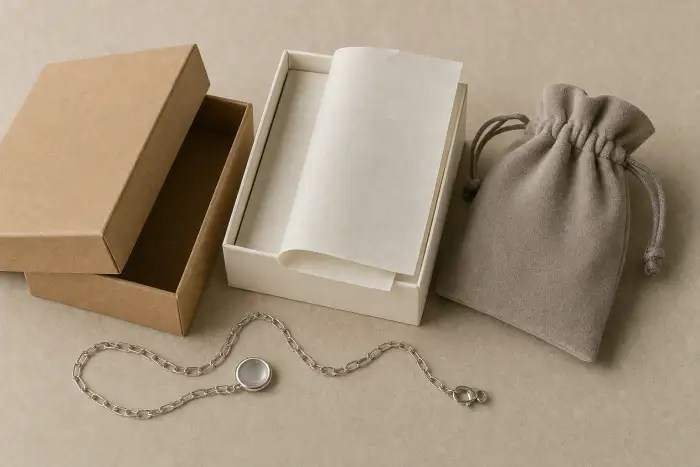
You do not need to diagnose a box to lower uncertainty. Start by separating the jewelry from direct paperboard contact. Make sure the piece is dry and free of sweat, lotion, cleaning residue, or other surface contaminants before storage. Place each item in a suitable soft pouch or separate compartment, both to reduce scratching and to prevent one piece’s residue from transferring to another.
Keep long-term storage away from bathrooms, kitchens, and sharp temperature swings. If a shipping carton is the only outer container available, treat it as an outer layer rather than the jewelry’s direct enclosure. A verified inner material creates a practical boundary without claiming that the carton is toxic or that the inner pouch is a permanent chemical shield.
For plated jewelry, pearls, opals, amber, and intentionally oxidized finishes, follow the care limits for the specific material. A strategy designed for sterling silver should not be applied indiscriminately to every piece in a jewelry box.
A five-minute storage reset
- Identify the piece before treating it. Confirm whether it is sterling silver, silver plated, finished with another coating, or set with a sensitive gem. If you are unsure, avoid aggressive cleaning and extreme storage conditions.
- Remove surface residue. Follow the maker’s care guidance, then allow the piece to become fully dry. Do not seal away jewelry that is still damp from wear or cleaning.
- Separate each item. Use a suitable soft pouch or individual compartment so chains do not knot, hard settings do not scratch softer surfaces, and residues are less likely to transfer.
- Create a controlled inner space. Put the protected piece in a reasonably well-closing container. Keep ordinary shipping cardboard outside that inner layer when practical.
- Inspect periodically. A brief check catches moisture, exhausted accessories, loose stones, or early tarnish before a forgotten storage setup becomes a long-term problem.
What Silica Gel and Anti-Tarnish Strips Can—and Cannot—Do
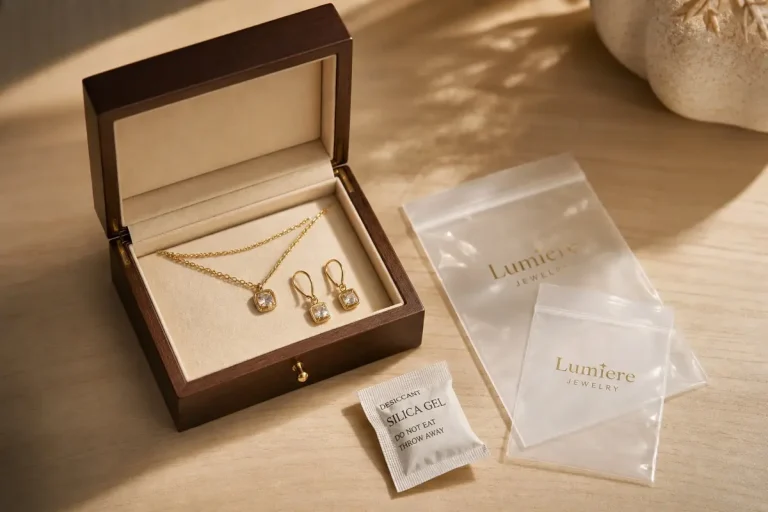
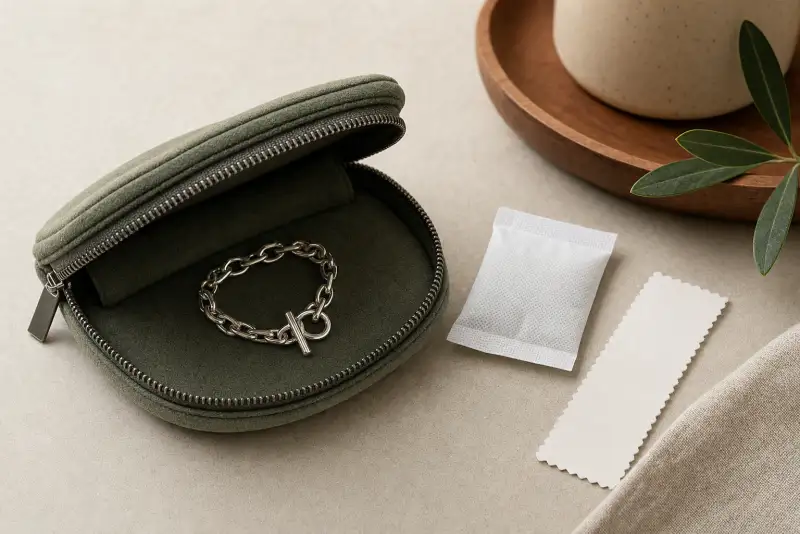
Silica gel is a desiccant: it helps control moisture. It is not a universal scavenger for sulfur-containing gases, so a packet cannot cancel out a high-risk material, damp jewelry, or constant air leakage. Use it according to the product instructions, keep it from direct contact with the jewelry, and do not treat “drier” as automatically better for every gem or finish.
An anti-tarnish strip is an auxiliary tool intended for an appropriate enclosed space. Its usefulness depends on the product, the enclosure, the pollutant load, and the strip’s remaining capacity. It is not a guarantee of permanent protection and cannot replace dry, separated storage or periodic inspection. Replacement timing belongs to the product instructions; there is no universal interval that can be safely inferred here.
For a desiccant to help, the surrounding space must be small enough and closed enough for the product’s stated capacity. A packet sitting loose in a frequently opened shipping carton has a different job from one used according to instructions in an inner storage case. The same principle applies to anti-tarnish products: match the accessory to the enclosure and follow its directions rather than assuming that one packet or strip protects any volume forever.
When to Clean Tarnish—and When to Ask a Jeweler
Light surface tarnish does not make every piece a candidate for aggressive polishing. Sterling silver, plated finishes, pearls, opals, amber, gemstones, and deliberately oxidized designs have different boundaries. For material-aware cleaning guidance, see safe ways to clean tarnished jewelry. If the surface is flaking, the finish is damaged, a stone is loose, or you are unsure what the piece is made of, pause and ask a qualified jeweler.
After cleaning, storage choices still matter. Our anti-tarnish jewelry storage guide covers general dry, separated storage. This article’s narrower point is material literacy: cardboard can be a possible risk factor, acid-free does not mean sulfur-free, and silica gel is not a universal sulfur remover.
The Bottom Line
Silver may tarnish in a cardboard box, but the box is only one variable. The evidence supports a cautious approach: reduce direct contact, keep jewelry dry and separated, choose inner materials by documented specifications when possible, and use silica gel or an anti-tarnish strip only for the job each product is designed to do. That is more useful—and more accurate—than treating every carton as a guaranteed sulfur trap.