Why a 1-Carat Gemstone Can Look Bigger—or Smaller
A 1-carat gemstone can look larger or smaller than another because carats measure mass, while the view from above depends on the material’s density, shape, and cut proportions. Gemstone carat weight vs size comes down to two different questions: how much does it weigh, and how much space does it occupy? One metric carat is exactly 0.2 grams; it is not a fixed diameter. GIA explains the carat measurement.
For shopping, keep the carat weight beside the actual millimeter measurements. Then check whether that weight describes one stone, a pair, or every stone in the piece.
In this guide
Gemstone carat weight vs size: what each number tells you
Carats tell you mass. Millimeters tell you dimensions. Neither number can substitute for the other.
A listing marked “1.00 ct” describes one carat of weight when it refers to an individual stone. A carat contains 100 points, so a 50-point gemstone weighs 0.50 ct. “Carat” also differs from “karat,” the term used for gold purity. These definitions come from GIA’s carat guide.
The distinction shows up in laboratory practice: GIA uses an electronic micro-balance to weigh diamonds, then measures their dimensions and proportions separately. Weight is not obtained by treating the top view as a standard size. See GIA’s explanation of weighing and measuring.
When reading a listing, look for the gemstone’s length, width, and depth, with the measurement order identified. For a round stone, ask for its diameter measurements and depth. Those numbers describe the actual stone more usefully than a generic “one-carat size” illustration.
Why density changes the volume of a 1-carat stone
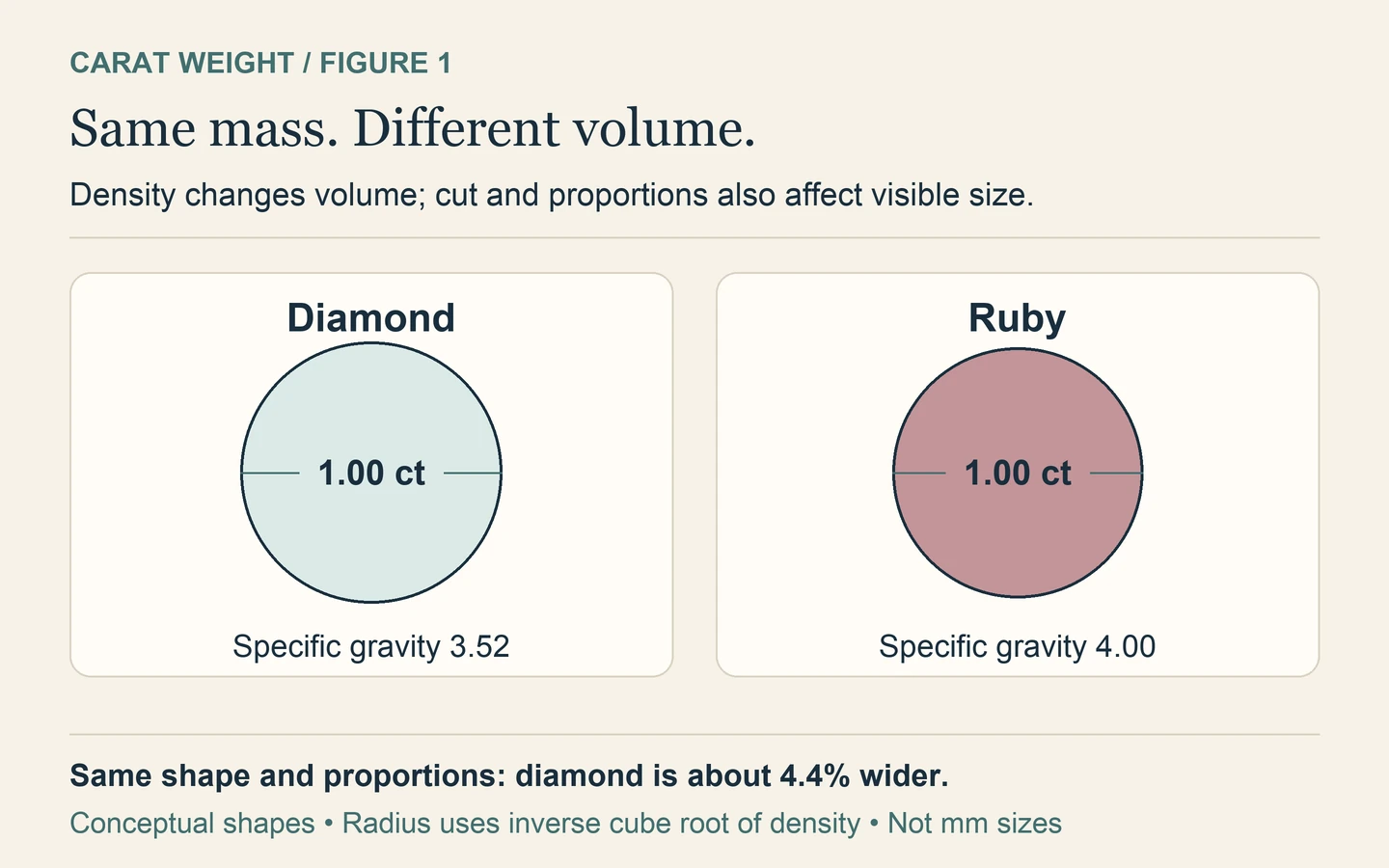
At the same mass, a denser gemstone occupies less volume. That is the first reason equal-carat stones need not have equal dimensions.
Gemologists describe this relationship using specific gravity: the ratio of a material’s density to the density of water. GIA gives diamond a specific gravity of about 3.52 and ruby about 4.0. A 1-carat ruby therefore occupies less volume than a 1-carat diamond. With comparable shapes and proportions, the diamond would have larger dimensions. GIA discusses this density comparison.
The qualification matters: volume includes the whole gemstone, including the portion below its widest edge. Density alone does not tell you the diameter, length, or width of a particular finished stone. Different cutting proportions can change how that volume is distributed.
Start by confirming the material rather than grouping everything that looks similar together. Our guide to lab-grown diamond, moissanite, and cubic zirconia explains the identity distinctions to check before comparing listings.
How cut spread and depth change the face-up view
Two stones of the same material and carat weight can show different amounts of surface from above because their proportions differ.
“Face-up” means looking at the gemstone from the top, as you usually see it in jewelry. “Spread” describes its visible footprint. The pavilion is the lower portion of a faceted stone, below the girdle, or outer edge.
A cut that places more of the available volume in depth can leave less spread at the same weight. GIA illustrates this with diamonds that carry weight below the girdle: extra weight there does not necessarily make the mounted diamond look bigger. Read GIA’s discussion of hidden weight.
That does not make maximum spread a universal goal. Jewelers of America explains that colored gemstone cutters balance color, weight, and a shape suitable for mounting. A depth measurement by itself cannot establish whether a colored gemstone is well cut. Its gemstone buying guide explains these cutting considerations.
Compare the outline you want with the stone’s appearance in ordinary viewing conditions. When evaluating gemstone carat weight vs size, treat visible spread as one key factor alongside color and light performance. For that separate question, read why gemstones sparkle differently.
Why matching millimeters do not mean matching cuts
Matching length and width establish matching outer measurements, not identical three-dimensional geometry.
Imagine two hypothetical oval gemstones both listed as 8 × 6 mm from above. One could be deeper, have a thicker girdle, or have different facet arrangements. Even with the same face-up dimensions, their volumes and weights need not match. This follows from the distinction between dimensions, proportions, and mass in GIA’s measurement explanation.
Nor does an oval and a cushion with the same maximum length and width necessarily fill that outline in the same way. A bounding measurement is not a measurement of every point around the edge.
This is why calculating gemstone carat weight vs size through a universal conversion chart can mislead. A chart’s assumptions about material, shape, and proportions may not fit the stone you are considering. Ask for actual measurements and photographs instead. For an existing mounting, have the jeweler confirm the stone’s full shape and depth compatibility; length and width alone are an incomplete fit check.
Ct vs. ctw: check whether the weight covers a pair
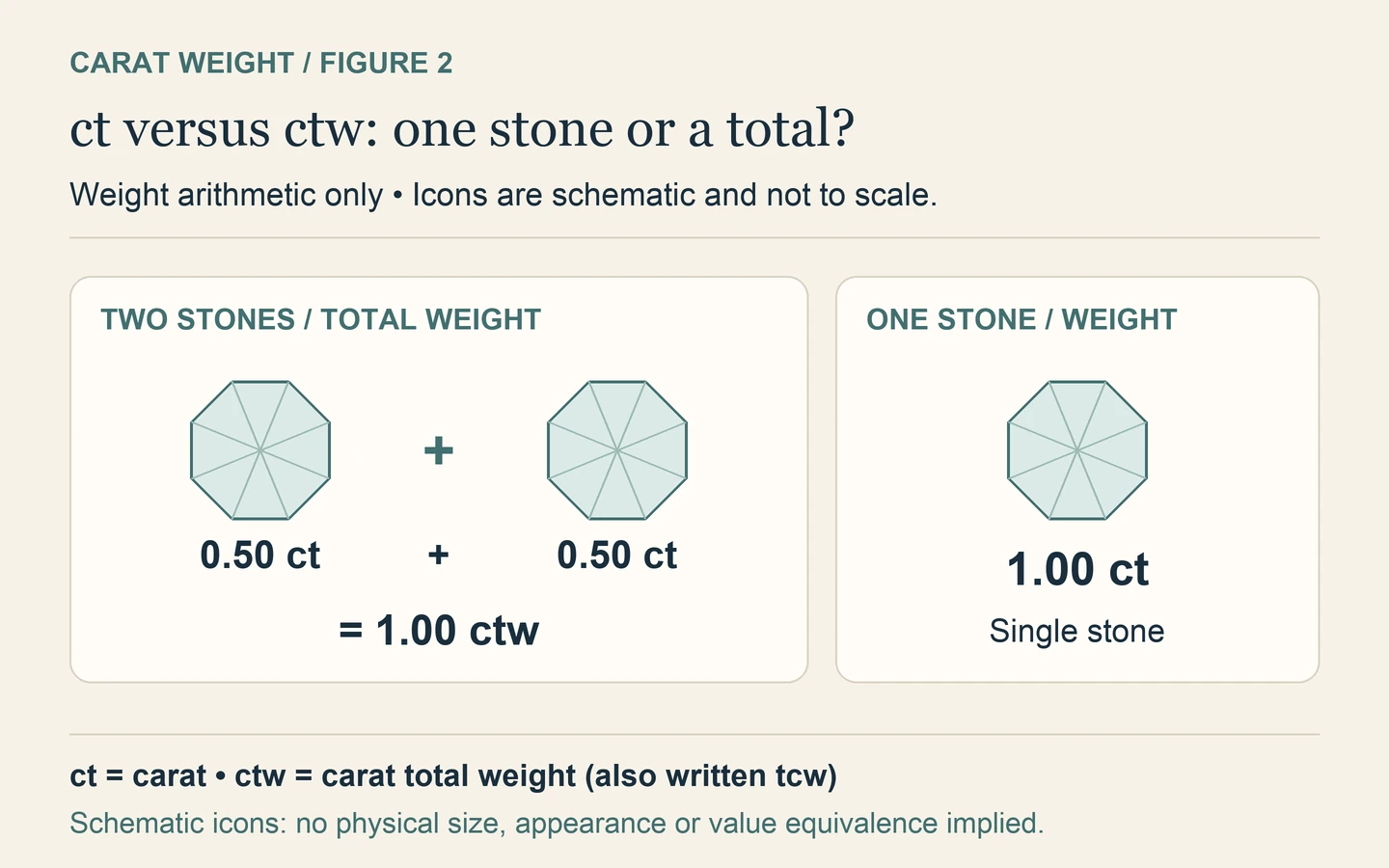
A total weight combines stones; it does not tell you how that weight is divided among them. GIA describes total carat weight as the combined weight of the diamonds in a piece. Listings may use abbreviations such as ctw or tcw, so confirm the seller’s definition. GIA explains total carat weight.
For a hypothetical pair of studs containing only two equally weighted diamonds, “1.00 ctw per pair” would mean 0.50 ct in each ear. It would not mean a 1.00 ct stone in each stud. If the pair includes accent stones, the center stones could account for only part of that total.
Ask which stones are included, whether the stated weight covers one earring or both, and what each center stone measures. Do not assume equal individual weights from the pair total alone. Jewelers of America specifically notes the importance of millimeter measurements when matching gemstones for earrings and other jewelry. See its guidance on gemstone size.
A dimensional checklist for comparing listings
Use this checklist to analyze gemstone carat weight vs size across different listings before deciding which piece fits your aesthetic:
- Material: Confirm exactly which gemstone is being described.
- Weight scope: Record the individual stone weight, pair total, and any accent-stone total separately.
- Face-up dimensions: Request actual length and width, or diameter measurements for rounds, in millimeters.
- Depth and outline: Ask for depth, the shape name, and a side view.
- Stone vs. setting: Separate gemstone measurements from the overall dimensions of a halo, bezel, or decorative surround.
- Comparable views: Request top and side photographs at a stated scale, plus a worn view when available.
- Fit: For a replacement stone, have the jeweler check the mounting against the actual stone.
If you are comparing mounting styles, our prong, bezel, and pavé setting guide provides useful context for that decision.
Choose the silhouette and proportions you enjoy wearing, with the actual mass clearly explained. Understanding the true relationship behind gemstone carat weight vs size ensures the carat label works for you rather than misleading you. Explore more at Wearlumi.