
Metal Guides · Gold Jewelry
Why Does Gold Jewelry Turn Your Skin Green? Causes, Prevention & Better Metals
You slide off your favorite ring at the end of a long day — and there it is: a green band circling your finger. It looks alarming, but it is not your skin reacting to gold. It is a simple, harmless chemical reaction you can prevent in five minutes.
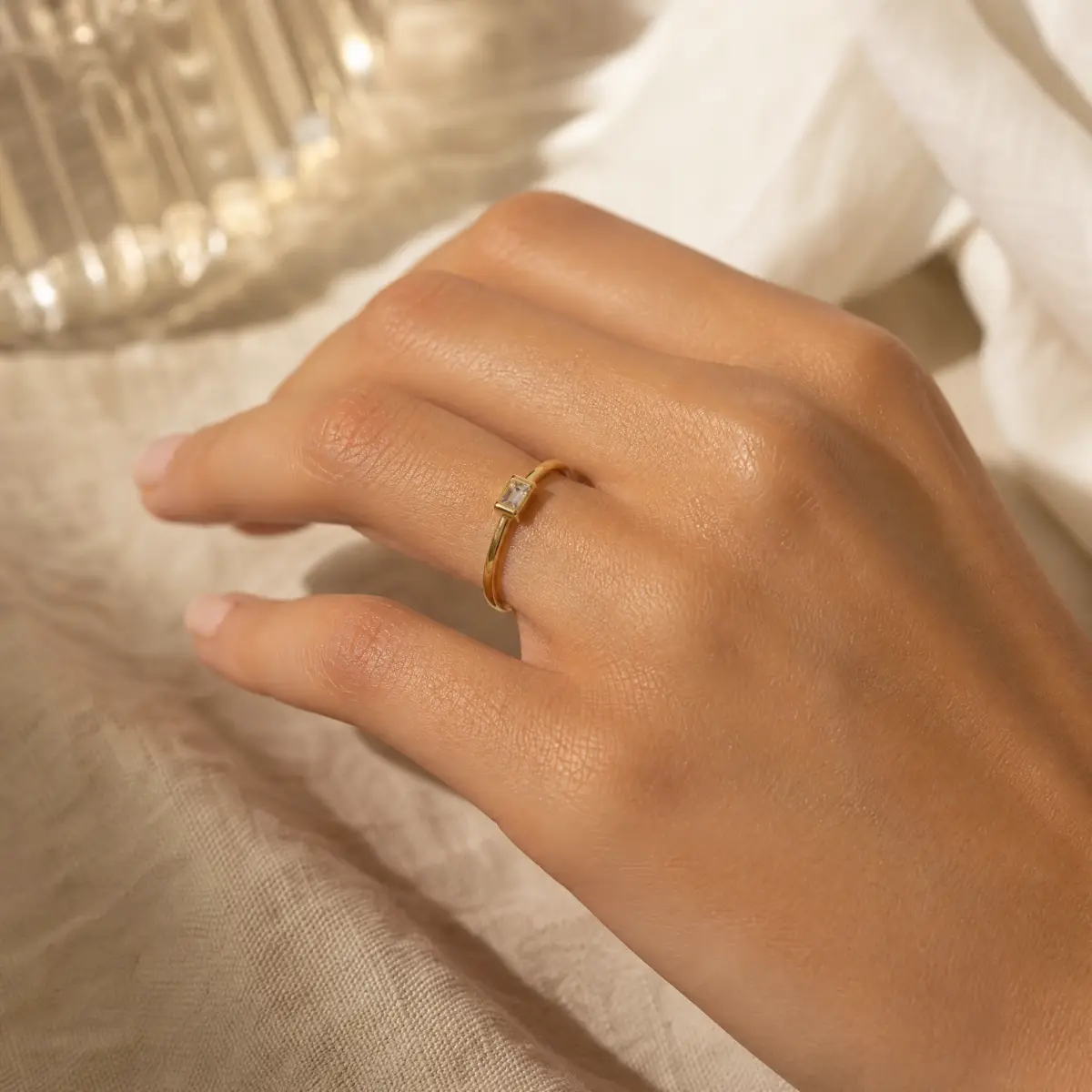
Why Does Jewelry Turn Your Skin Green
Jewelry turns skin green when copper in the metal underneath the gold surface reacts with sweat, skin acids, and moisture to form green copper salts — most often copper carbonate — that transfer onto the skin as a harmless, washable stain.
If your finger has ever turned green under a ring, you are in very good company. Green marks are one of the most common jewelry complaints, and they show up with plated pieces, costume jewelry, and occasionally even lower-karat gold. The good news: it is predictable chemistry, and once you know the culprit, it is easy to shop around it.
Here is the part that surprises most people: gold itself never stains your skin. Gold is one of the least reactive metals on the periodic table — it does not tarnish, rust, or corrode under normal conditions. The green mark always comes from copper hiding somewhere in your jewelry: either mixed into a lower-karat gold alloy or sitting as the base metal under a thin layer of gold plating.
Most affordable “gold” jewelry is gold-plated. A layer of gold just a few microns thick — far thinner than a human hair — covers a core of copper or brass. Over weeks and months of wear, that layer rubs away at contact points: the inside of a ring, the back of a pendant, the clasp of a chain. The moment bare copper touches your skin, the chemistry starts.
Quick Answer
Gold never turns skin green — copper does. When copper meets sweat, skin acids, and moisture, it oxidizes into green copper salts that rub off onto your skin. The stain is harmless, washes off with soap, and is easy to prevent: seal the metal, keep it dry, or choose higher-karat, copper-free jewelry.
The Chemistry Behind the Green Mark
The green stain on your finger is the same chemistry that turns the Statue of Liberty green. Her copper skin has been oxidizing in the salt air for over a century, slowly building a layer of green copper carbonate called patina. Your ring does in a hot afternoon what the statue does in decades, because your sweat is essentially warm salt water.
Your sweat is mostly water, salt (sodium chloride), and mild acids such as lactic acid. When that salty, acidic moisture hits copper, it drives a reaction that produces copper salts. Copper carbonate is the classic green compound, but the stain can also come from copper chloride. Either way, the color lands on the dead outer layer of your skin — which is exactly why it washes off with soap and water and is never absorbed into your body.
This also explains why the green mark shows up more in summer and during workouts. Moisture is the catalyst for the whole reaction, and heat, humidity, and sweat put more of it against the metal. Lotion or hand sanitizer trapped under a ring can do the same thing.
That is also why two people can wear the same ring with completely different results. One person’s skin chemistry — saltier sweat, a lower pH — can produce a green mark in a single hot afternoon, while another wears the same piece for years without a hint of green. The jewelry is the same; the skin is not.
One thing the green mark is not: an allergy. True metal allergies — usually to nickel — cause redness, itching, and bumps, not a green stain. If your skin is green but calm, you are looking at copper chemistry, not an allergic reaction.

Which Metals Turn Skin Green
Not all metals behave the same on skin. Here is how the most common jewelry metals stack up:
| Metal | Green stain risk | Why | The better pick |
|---|---|---|---|
| Copper & brass | Very high | Oxidize quickly in salty, acidic sweat | Avoid as a base metal |
| Gold-plated copper or brass | High | Plating wears through and exposes the copper core | Gold-plated stainless steel (PVD) |
| Sterling silver | Medium | Contains 7.5% copper; tarnish can look green-black | 14K+ gold or gold vermeil |
| 10K gold | Low to medium | Only 41.7% gold; the rest is mostly copper | 14K or 18K gold |
| 14K gold | Very rare | 58.3% gold, still alloyed with copper | 18K gold if your skin is reactive |
| 18K & 24K gold | Essentially none | 75%+ pure gold; too noble to react | Best for sensitive skin |
| Stainless steel, titanium, platinum, rhodium | None | Inert, hypoallergenic metals | Great everyday options |
The pattern is simple: the more copper in the metal, the more likely the green mark. That is also what “hypoallergenic jewelry” really means in practice — metals without reactive copper and nickel, such as medical-grade stainless steel, titanium, platinum, and high-karat gold.
Does Real Gold Turn Skin Green?
Real gold — solid, not plated — almost never turns skin green, and the reason is in the karat number. Karat measures purity: 24K gold is 99.9% pure gold, 18K is 75% gold, 14K is 58.3% gold, and 10K is 41.7% gold. The rest of the alloy is usually copper, silver, and zinc — metals added for strength, because pure gold is too soft for daily wear.
The real culprit in most green-finger stories is not the karat at all — it is plating. Gold plating on fashion jewelry is typically between 0.5 and 2.5 microns thick, and daily friction wears through it within months. That is why a gold-toned ring can stain in weeks while a solid 14K band stays clean for years: in solid gold, the copper is sealed deep inside the alloy instead of sitting a hair’s breadth under the surface.
So does 14K gold turn skin green? Almost never — but it is not impossible. That 41.7% of alloy in 14K gold usually includes copper, and in rare cases it can leave a faint mark: people with very acidic skin, people who never take their rings off, or a humid summer of constant sweating. Even then, the mark is lighter and far less common than the deep green bands left by plated copper. If your 14K pieces occasionally leave a shadow of green, stepping up to 18K — only 25% alloy — usually ends the problem.
A few other factors change your odds:
- Skin pH. More acidic sweat oxidizes copper faster.
- Humidity and sweat volume. More moisture means a faster reaction.
- Wear frequency. A ring worn 24/7 — in the shower, at the gym — wears its plating or alloy surface much faster.
- Lotions and perfumes. Trapped moisture and chemicals accelerate oxidation.
The same 14K ring can behave differently on two different people, and differently on the same person in July versus January. The chemistry is about your skin and the environment as much as the metal.

How to Prevent Green Marks
You do not have to retire a favorite piece of jewelry. Five practical fixes, from the five-minute trick to the permanent solution:
- Coat it with clear nail polish. The classic fix. Paint a thin, even layer of clear nail polish or polymer jewelry sealant over every surface that touches skin — the inside of the ring, the back of the pendant, the chain clasp. Let it dry for a full 24 hours. One coat lasts a few weeks of daily wear; reapply when it starts to rub off.
- Get it rhodium plated. A jeweler can electroplate a thin layer of rhodium — an inert platinum-family metal — over the piece. It is the same finish that makes white gold white, it is nearly invisible on yellow gold, and it forms a durable barrier that outlasts nail polish by months or years.
- Choose higher-karat or hypoallergenic metals. For new pieces, buy 14K or 18K solid gold, gold vermeil over sterling silver, or PVD gold-plated stainless steel. These either contain no copper or keep it sealed under layers that will not wear through quickly.
- Keep jewelry dry. Take rings and chains off before washing your hands, showering, swimming, or working out. Let lotion, sunscreen, and hand sanitizer dry fully before putting jewelry back on. If a piece does get wet, dry it with a microfiber cloth.
- Clean and store smart. Wash pieces weekly in lukewarm water with a few drops of mild, pH-neutral dish soap, then dry completely. Store each piece in its own airtight bag with an anti-tarnish strip or silica gel packet.
Already have a green mark? Soap, water, and a washcloth remove it in seconds — the copper salts sit on the surface of your skin. And while the mark is a sign that plating is wearing thin, it is not a safety issue: copper salts are non-toxic in the amounts involved.
One last way to think about it: nail polish and sealants are temporary fixes, perfect for a piece you love. Rhodium plating is semi-permanent. Choosing better metals is the permanent fix — it removes the copper from the equation entirely.
Frequently Asked Questions
Why does jewelry turn skin green?
Because copper in the metal reacts with sweat, skin acids, and moisture to form green copper salts — usually copper carbonate — that transfer onto your skin. Gold itself never causes the stain; the copper in the alloy or in the plated base metal does.
Why does my gold ring leave a green mark on my finger?
If the ring is gold-plated, the thin gold layer has worn through and the copper core underneath is touching your skin. If the ring is solid 10K or 14K gold, the copper in the alloy is reacting with very acidic sweat — a rare but real effect. Either way, the mark is harmless and washes off.
Does 14K gold turn skin green?
Almost never. 14K gold is 58.3% pure gold, and the copper in the remaining alloy can occasionally leave a faint green mark on people with highly acidic skin or in hot, humid conditions. It is far rarer and lighter than the deep green stains from plated copper, and stepping up to 18K gold usually eliminates it.
Is the green mark on my skin harmful?
No. Green copper salts sit on the dead outer layer of your skin and wash off with soap and water. A green stain is not an allergy — allergies cause redness, itching, and bumps. If you have those symptoms, see a dermatologist; that points to nickel or another allergen, not copper.
How do I stop my ring from turning my finger green?
Create a barrier between the metal and your skin: coat the contact surfaces with clear nail polish, have the piece rhodium plated, or switch to hypoallergenic jewelry such as 14K+ gold, gold vermeil, or PVD stainless steel. Keeping the ring dry and letting lotions dry before wearing also helps.
What jewelry never turns skin green?
High-karat gold (18K and 24K), medical-grade stainless steel, titanium, platinum, and rhodium-plated pieces are inert on skin and will not leave green marks. Gold vermeil over sterling silver is the best budget option for a gold look with minimal risk.
Tired of green rings? Shop everyday gold jewelry that stays bright — never-green metals, lifetime-friendly designs.