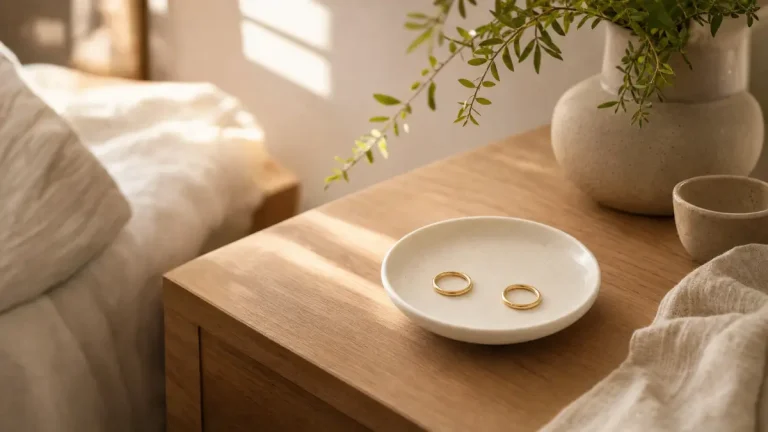
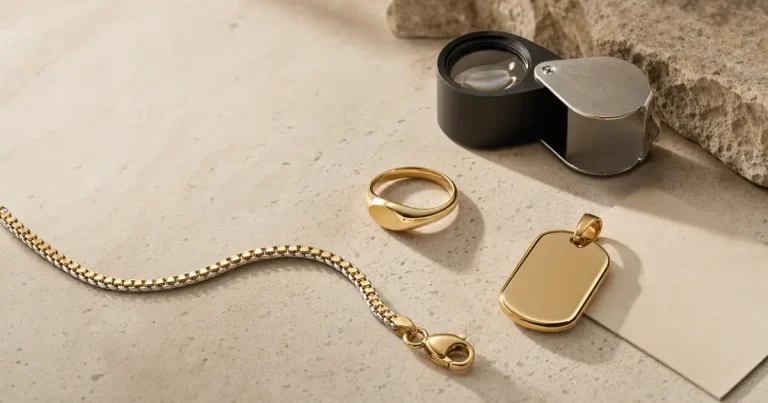
The most useful habit is simple: finish your beauty routine, let products become dry to the touch, and give your hands a quick rinse if they still feel coated before you put on your jewelry. At the end of the day, remove jewelry before showering, cleansing, or reapplying lotion. This Last On, First Off routine does not mean using less sunscreen. It creates a small buffer between skincare and the pieces you want to keep looking their best. It is also easy to adapt: put jewelry on after your morning products, and make removal the first step when you change clothes at night.
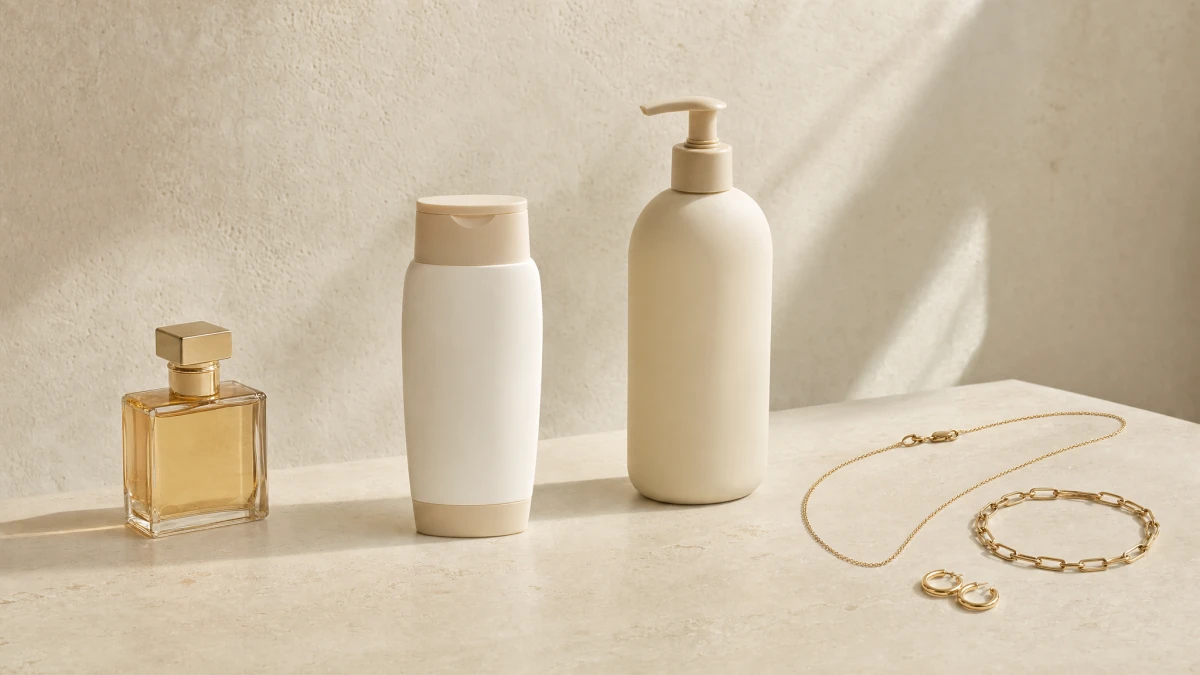
Perfume and sunscreen jewelry care: the simple rule
Apply skincare, sunscreen, fragrance, hair products, and makeup first. Give your skin time to feel dry rather than wet or tacky. Then add necklaces, earrings, bracelets, and rings. When you get home, take jewelry off before washing your hands, bathing, exercising, or beginning an evening skincare routine.
This is a practical precaution, not a claim that one spray instantly destroys a finish. Contact time, formula, moisture, material, coating, and friction all matter. Rings and bracelets deserve extra attention because they touch freshly treated hands and wrists, while chains and earrings can collect residue around links, posts, and settings.
What sunscreen can—and cannot—do to gold plating
Mineral sunscreens may use titanium dioxide (TiO2) or zinc oxide (ZnO) as inorganic UV filters. The Australian Therapeutic Goods Administration review discusses these materials in the sunscreen context. Their presence alone does not prove that sunscreen is a reliable abrasive, acts like sandpaper, or mechanically sands away 18K plating.
A more useful way to think about it is residue plus friction. A cream can leave a film; dust can cling to that film; and a ring or bracelet can then rub against skin, fabric, a bag strap, or a desk. Repeated rubbing may contribute to visible wear on a thin surface treatment. That is why letting sunscreen settle and keeping jewelry clean and dry are sensible everyday habits.
Keep applying sunscreen as directed. Where practical, let it dry before putting on jewelry. If a piece feels coated, lightly blot it with a clean, soft, lint-free cloth. Do not scrub harder to chase a perfectly bare-looking surface; extra friction can be the bigger avoidable problem.
Perfume, alcohol, and E-coating: a more precise explanation
Many fragrances contain ethanol, but “ethanol dissolves E-coating” is not a universal conclusion. E-coat is a formulated resin coating applied by an electro-deposition process; its resin, cure, film thickness, and solvent resistance vary by system. The PPG overview of industrial electrocoat is useful context, but it is not a Wearlumi-specific compatibility test.
A brief accidental touch is not the same as immediate dissolution. Repeated direct spraying, long periods of wet contact, other solvents or fragrance ingredients, and rubbing while residue is present are sensible exposures to reduce. Treat an E-coated piece as a finished surface: keep fragrance off it when possible, let any residue dry, and wipe gently instead of rubbing.
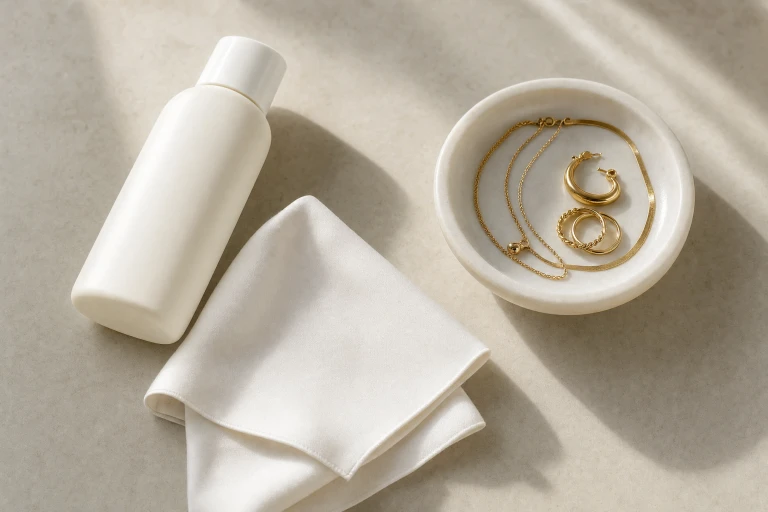
Spray fragrance onto skin or clothing rather than toward a necklace or earrings, then wait until it is dry. If fragrance lands on jewelry, gently blot it with a soft, dry cloth. Do not reach for rubbing alcohol, acetone, toothpaste, or polishing paste as a home rescue treatment. For more context on what an E-coating does, see Wearlumi’s guide to E-coating and jewelry care.
Why brightening lotion is formula-dependent
“Brightening lotion” describes a goal, not one fixed formula. Formulas vary widely, so the product name alone cannot tell you how a lotion will interact with a particular piece. Check the product maker’s care guidance, especially if the lotion is leave-on, strongly fragranced, or used several times a day.
Instead, consider three practical questions. Is the product acidic or oxidative? Will it leave a thick, wet film under a ring or bracelet? Is the piece solid gold, gold-plated, vermeil, pearl, porous, treated, or assembled with adhesive? When the formula is unknown, separation is the safer default: apply the lotion, allow it to absorb, wash and dry your hands, then put on rings.
If a product is especially rich, sticky, or frequently reapplied, leave rings and bracelets off until the routine is complete. This small change also makes cleanup easier: fewer layers collect beneath a ring, and you are less likely to rub at a film later. If you wear jewelry all day, build the pause into your morning routine rather than treating it as a special occasion step. Do not run a chemical experiment on jewelry. If you notice clouding, discoloration, lifting, or a loose stone, stop rubbing and ask a qualified jeweler to inspect the piece. Keep the product name and ingredient list available so the jeweler can understand the exposure.
Solid gold, gold-plated, vermeil, and pearls have different risk profiles
Solid gold is a gold alloy throughout the metal rather than a thin gold surface over another base. It generally tolerates everyday contact better than plating, but it is not immune to every chemical, abrasive particle, chlorine exposure, heat, gemstone sensitivity, or structural weakness. The alloy, karat, setting, and stone still determine care.
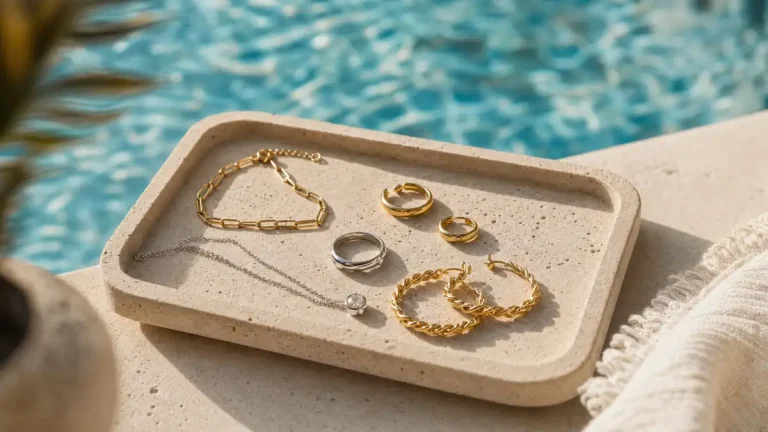
Gold-plated jewelry has a surface layer of gold over a base material. Once that layer becomes thin or worn, the underlying color can show. Reducing wet product contact and repeated rubbing is therefore especially worthwhile. Vermeil is a defined category of gold applied over sterling silver; it should not be treated as interchangeable with solid gold. For terminology, consult the U.S. Code of Federal Regulations jewelry guidance.
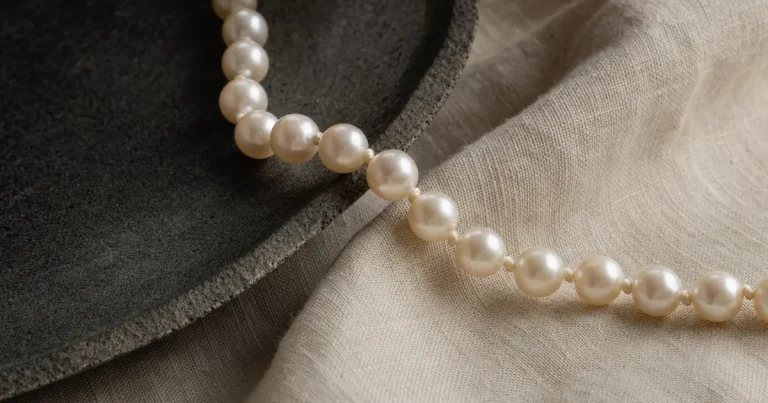
Pearls need their own rule. GIA describes pearls as relatively soft, around Mohs 2.5, and vulnerable to scratching and damage from acids, perfume, cosmetics, and perspiration. Its pearl care and cleaning guide supports gentle wiping and avoiding ultrasonic and steam cleaning. Pearls should be last on and first off, every time.
Porous or treated turquoise, coral, and opal also should not inherit a metal-only care plan. Pieces with glued stones or pearl components deserve extra caution around soaking, heat, and solvents. “The metal is fine” does not mean every component in the finished piece is fine.
A vanity-to-storage jewelry care checklist
- Complete skincare, sunscreen, body lotion, fragrance, hair products, and makeup before putting on jewelry.
- Wait until skin feels dry rather than wet or tacky. Keep rings and bracelets away from freshly treated areas when possible.
- Never spray fragrance directly toward jewelry. Remove jewelry before showers, pools, workouts, and sleep.
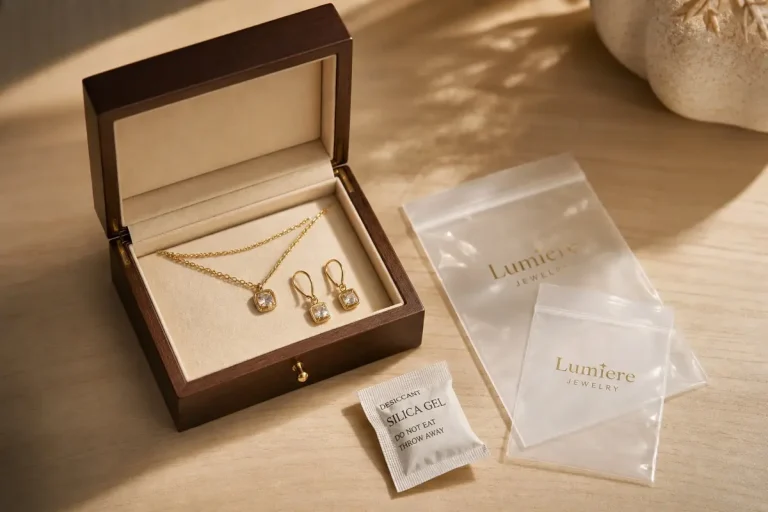
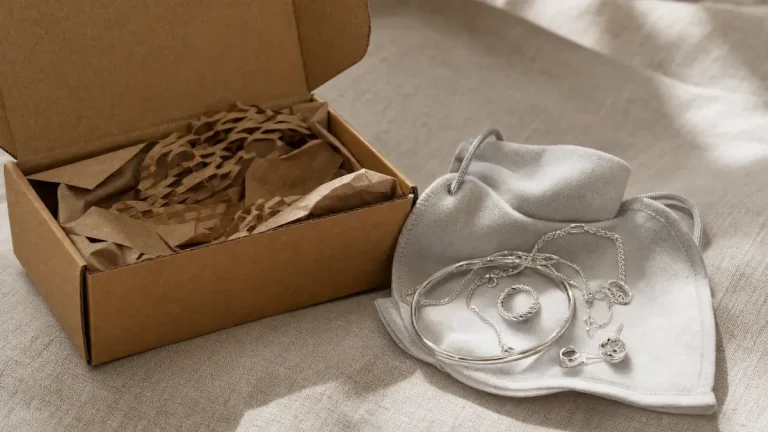
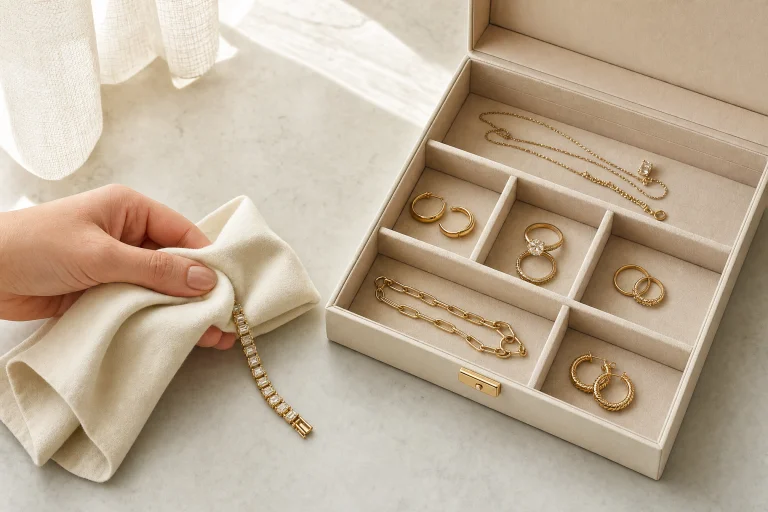
- At home, take pieces off first. Blot residue with a soft, dry cloth, then store each piece in a dry, padded space.
- For plated, vermeil, E-coated, pearl, porous, treated, or glued pieces, avoid alcohol, acetone, toothpaste, baking soda, rough polishing cloths, and unverified cleaners.
- If you see localized fading, haze, lifting, or a loose stone, stop rubbing. Note which products touched the piece and seek a professional assessment.
References
This guide keeps the advice practical: sunscreen belongs in your routine, and jewelry care is mainly about limiting wet residue, direct spray, and repeated rubbing. TiO2 and ZnO are not sandpaper; ethanol does not universally dissolve E-coat; and a brightening lotion’s name does not reveal one fixed chemistry. When in doubt, follow the jewelry maker’s care instructions and choose gentle handling.
- GIA: Pearl Care and Cleaning — pearl sensitivity, gentle cleaning, and avoiding ultrasonic or steam cleaning.
- GIA: Tips on Caring for Jewelry — general jewelry-care context.
- GIA 4Cs: Traveling in Style — care context for delicate jewelry and travel.
- Australia TGA: Sunscreen nanoparticle review — TiO2 and ZnO sunscreen context.
- U.S. eCFR, 16 CFR Part 23 — jewelry terminology, including vermeil.
- PPG: Industrial Electrocoat — formulated coating-system context.