Beyond Micro-Trends: Timeless Jewelry Style
Timeless jewelry style feels harder to build when every scroll introduces a new aesthetic with an expiration date. This episode asks a quieter question: what would we choose if we wanted to keep wearing it three years from now?
A jewelry box can become a timeline of abandoned identities: the piece for the “clean girl” month, the charm stack that belonged to one summer, the oversized shape bought for a single photo. None of those experiments is inherently wrong. The problem begins when discovery is engineered to feel like deficiency—when seeing a new look immediately makes what we already own feel obsolete.
This conversation steps outside the usual shopping language. It connects modern life, digital choice architecture, design proportion, and the emotional value of objects that stay with us. The goal is not to reject trends. It is to recover enough distance to decide which ones deserve a place in real life.
Episode promise: By the end, listeners will have a personal filter for evaluating jewelry, a three-piece capsule framework, and a simple cost-per-wear calculation for slowing down an impulse purchase.
How Micro-Trends Erode Timeless Jewelry Style
Micro-trends do not travel in a straight line from designer to customer. A visual cue is named, repeated, rewarded with engagement, reproduced at lower cost, and sold back as a shortcut to belonging. The European Commission has specifically examined how engagement-based recommender systems can amplify risks to mental well-being and create “rabbit holes.”[1]
Shopping interfaces add another layer. The OECD describes digital choice architecture that can steer or manipulate decisions through devices such as urgency, scarcity, social proof, and repeated prompts.[2] In jewelry, that pressure often sounds like: everyone is wearing this, this drop will disappear, and your current look is already behind.
The micro-trend manufacturing chain
- Label it. A loose cluster of references becomes a named aesthetic that is easy to search, copy, and perform.
- Repeat it. Recommendation systems make a niche look feel universal through concentrated exposure.
- Accelerate it. Creators and retailers translate attention into drops, countdowns, and “must-have” lists.
- Flatten it. Fast production removes material nuance and fit so the visual signal can be reproduced quickly.
- Replace it. The next label arrives before the object has had time to become part of the wearer’s life.
Conversation prompts
- When does inspiration become aesthetic anxiety?
- Why does repeated exposure make a new shape feel inevitable rather than optional?
- Can a trend introduce us to something lasting, and how do we tell before buying?
- What disappears when jewelry is optimized for a thumbnail instead of a Tuesday?
When Jewelry Becomes a Photo Prop
“Single-wear” jewelry does more than create material waste. It interrupts the slow work of personal style. A piece normally earns meaning through repetition: the earrings reached for before an important meeting, the ring turned around a finger while thinking, the necklace that gradually becomes part of how a person recognizes herself.
The broader fashion system shows what happens when production and use move in opposite directions. The Ellen MacArthur Foundation reports that fashion production doubled over a 15-year period while the amount of time clothing was worn fell by 40 percent.[3] Jewelry is a different category, but the underlying question transfers: are we designing and buying for continued use, or only for rapid visual turnover?
The episode should avoid moralizing. Experimentation is part of style. The useful distinction is between an experiment chosen with curiosity and a purchase made to quiet the fear of being left behind.
What Defines a Timeless Jewelry Style Beyond Seasonal Trends?
Achieving an authentic timeless jewelry style should never mean plain, expensive, or stripped of personality. It means the design remains coherent when its temporary trend label disappears. Architecture and restrained industrial design offer a helpful lens for a timeless jewelry style: the eye continues to accept a form when its line, mass, negative space, and ergonomic function feel resolved.
| Design lens | Question to ask | Why it matters |
|---|---|---|
| Geometry | Would the silhouette still read clearly without stones, styling, or a trend name? | A legible form does not depend on visual noise. |
| Proportion | Does the scale relate to the ear, collarbone, wrist, or hand? | Balanced volume feels intentional rather than merely loud. |
| Negative space | Is there room for skin, clothing, and movement around the piece? | Breathing room helps jewelry integrate with the wearer. |
| Material honesty | Does the finish suit how the piece will actually be handled? | A design is only lasting if its surface and construction support real use. |
| Visual edit | If one detail were removed, would the piece become stronger? | Editing protects the central idea from decorative clutter. |
Jewelry Is an Ergonomic Relationship
Jewelry is not a miniature sculpture floating in space. It meets bone, skin, hair, sleeves, keyboards, bags, headphones, and the speed of a normal morning. Its real design is revealed through that contact.
The three-body test
- Stillness: Does it sit in the intended position without constant adjustment?
- Movement: What happens when you walk, turn your head, type, hug someone, or put on a coat?
- Friction: Does it catch hair, compete with a collar, press into the body, or collide with another piece?
This reframes styling. Jewelry does not need to dominate an outfit to matter. Its most sophisticated role may be to echo the body’s structure, bring rhythm to movement, and make an ordinary uniform feel more complete.
Build a Three-Piece Jewelry Capsule
Most decluttering advice begins with removal. When curating a timeless jewelry style, try the reverse: begin with the daily life that must be served, then identify the smallest set of pieces capable of serving it. The aim is not a universal essentials list; it is establishing an enduring timeless jewelry style personal operating system.
Step 1: Audit your actual week
List the environments that occupy most of your time: desk work, caregiving, commuting, client meetings, travel, social dinners, exercise, or hands-on making. Then note your recurring clothes, necklines, metal preference, and practical friction points.
Step 2: Assign three jobs
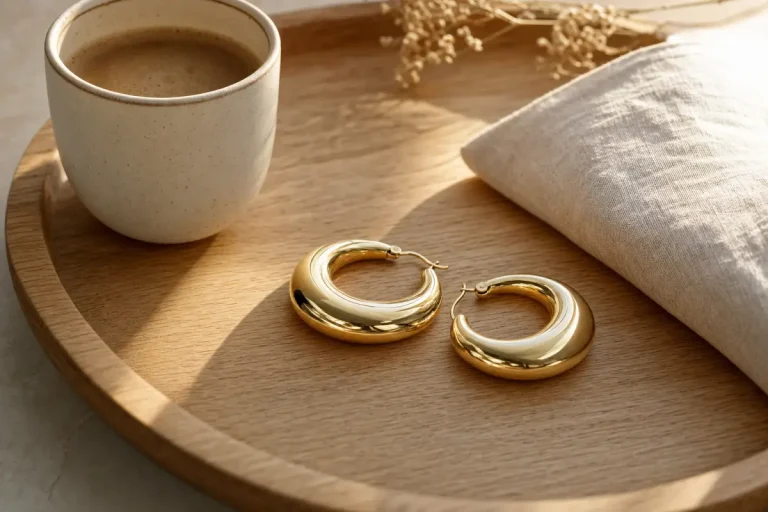
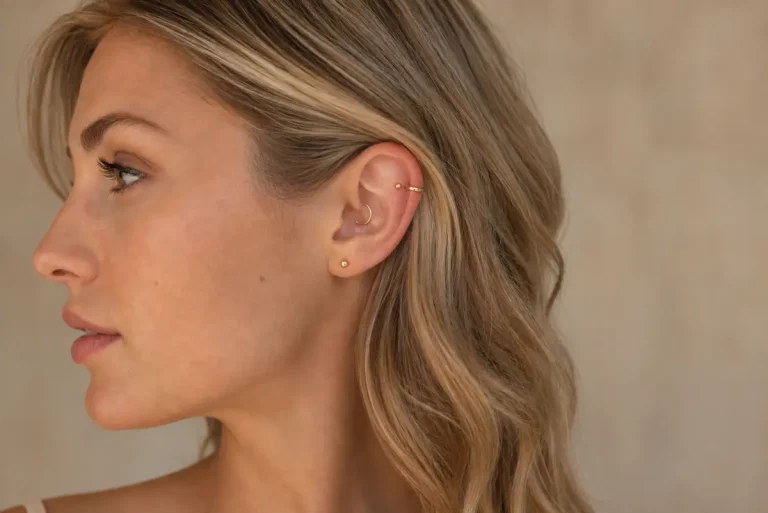
- Face-framing anchor: an earring shape that works with your hair, headphones, and most-used collars.
- Neckline bridge: a necklace that occupies the space your usual tops leave open without demanding a special outfit.
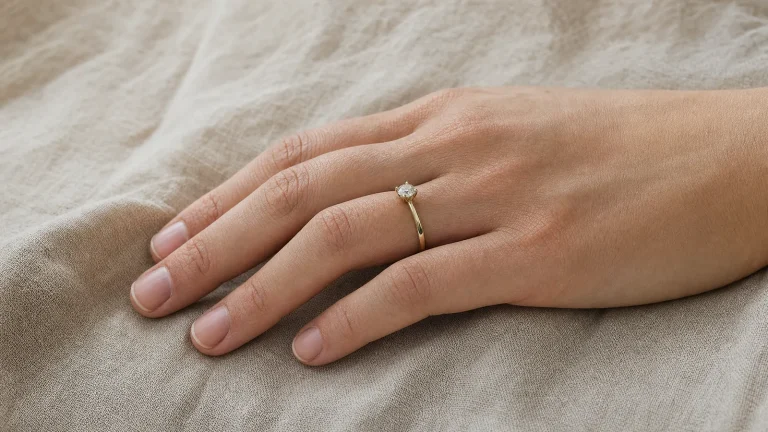
- Personal signature: a ring or bracelet whose scale and movement feel recognizably yours.
Step 3: Require cross-context compatibility
Each candidate should work in at least three recurring settings and with at least two of the other pieces. If it only works in an imagined life, it is not a foundation piece—however beautiful it may be.
Use Cost Per Wear Before You Buy
Price alone cannot tell us whether a piece fits an enduring timeless jewelry style. Cost per wear asks how much value is delivered through actual use. It rewards repeatability, comfort, durable construction, and the lasting emotional staying power central to a timeless jewelry style.
A $30 piece worn six times costs $5 per wear. A $180 piece worn 120 times costs $1.50 per wear. The calculation is not a permission slip for expensive shopping; an unworn luxury piece still performs poorly. Its purpose is to move attention from the checkout moment to the life of the object.
The 72-hour question set
- Which three outfits I already own would I wear this with?
- What part of my routine will test its comfort or durability?
- Would I want it if the trend label disappeared tomorrow?
- Am I adding a new function, or duplicating a feeling I already own?
- Can I picture at least 30 wears in the next year?
Suggested Episode Run of Show
| Time | Segment | Core beat |
|---|---|---|
| 00:00–05:00 | The three-year test | Open with the listener’s jewelry box and the pieces that never became part of life. |
| 05:00–15:00 | How a micro-trend is made | Trace label, repetition, social proof, fast reproduction, and replacement. |
| 15:00–24:00 | The photo-prop problem | Discuss identity turnover, material waste, and the loss of personal history. |
| 24:00–35:00 | Design that holds up | Use geometry, proportion, negative space, and editing to read a piece beyond trend language. |
| 35:00–43:00 | The body is the brief | Test comfort, movement, friction, and how jewelry relates to daily clothing. |
| 43:00–53:00 | The three-piece capsule | Build from real routines instead of a generic essentials checklist. |
| 53:00–58:00 | Cost per wear | Close with the formula, the 72-hour questions, and one action for the week. |
Closing thought: Personal style is not the ability to identify every new aesthetic. It is the ability to recognize what remains true about your taste after the feed has moved on.