Polished vs. Brushed Jewelry: 5 Metal Finish Secrets
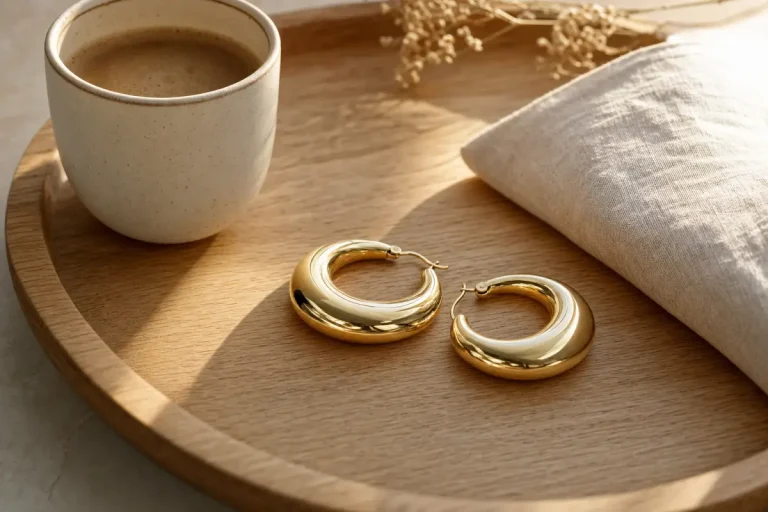
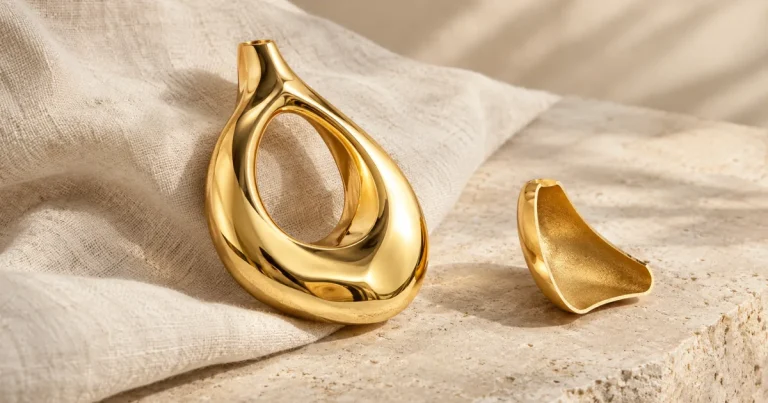
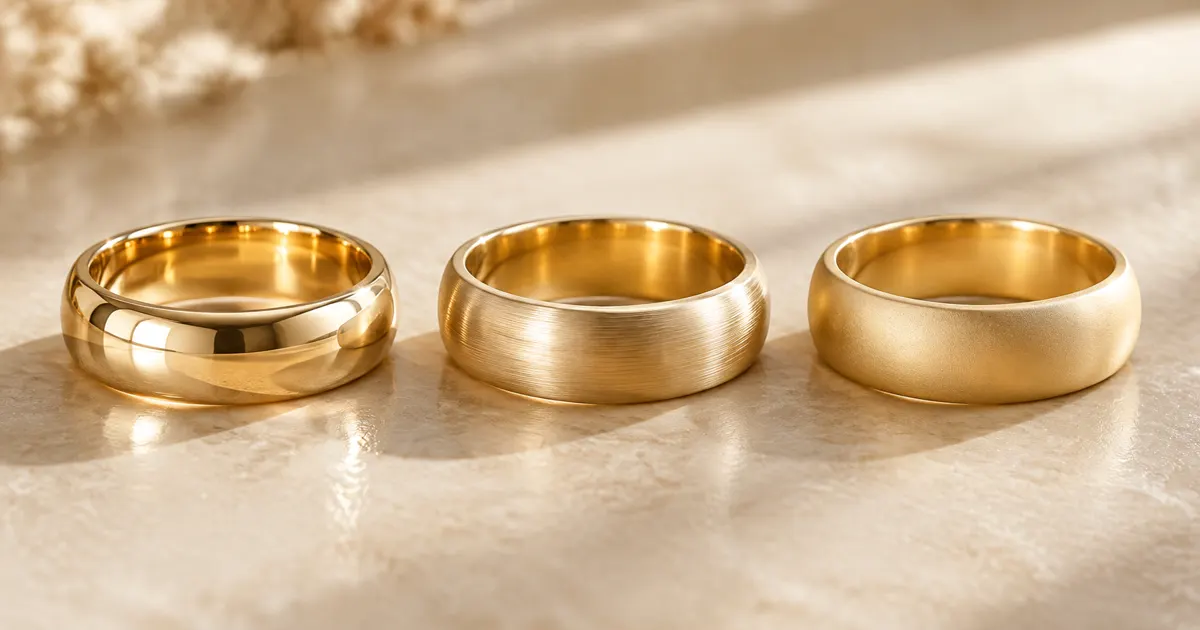
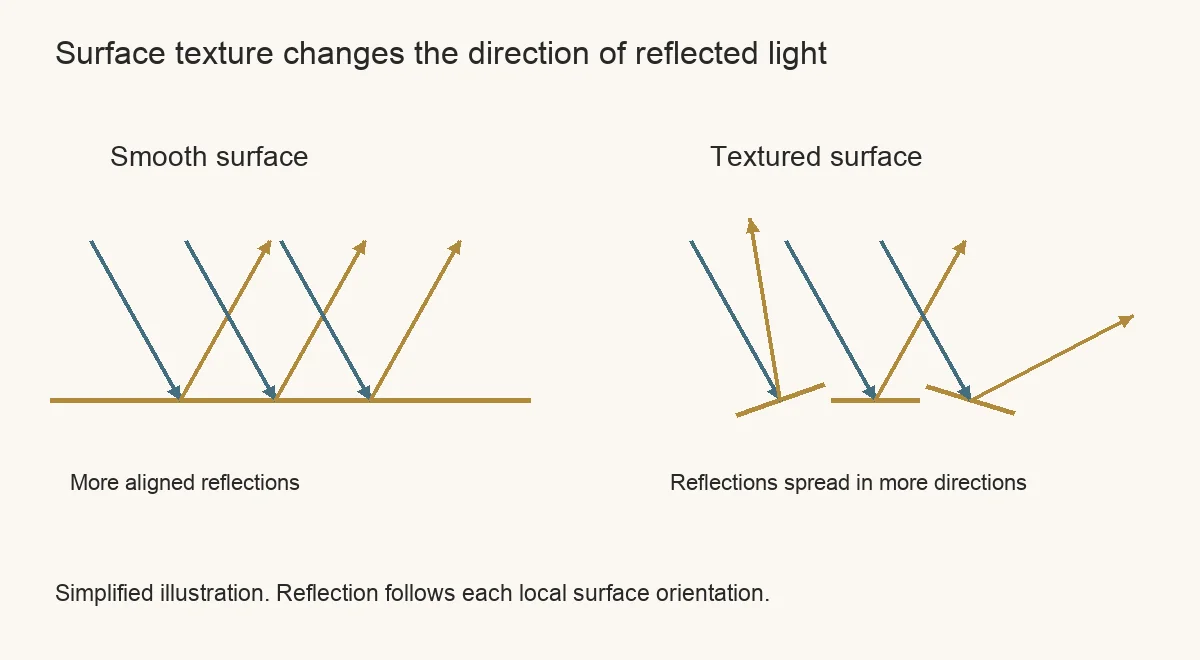
Polished vs. brushed jewelry looks different because its surface redirects light differently. A smooth, highly polished surface produces sharper, mirrorlike reflections. A brushed surface has fine texture that spreads those reflections and often gives the metal a softer glow. Two pieces made from the same alloy can therefore look strikingly different without either one containing a different metal. OpenStax explains this smooth-versus-rough reflection principle.
The practical question is which appearance you enjoy, how that surface changes with wear, and what maintenance the complete piece allows. “Brushed” does not automatically mean tougher, and “polished” does not automatically mean better made. Understanding the surface helps you read both the jewelry and its description more accurately.
In this article
Polished vs. brushed jewelry: what light is doing
A polished finish concentrates reflected light more predictably; a textured finish distributes it across more directions. Physicists call mirrorlike reflection specular reflection and broadly scattered reflection diffuse reflection. The same law applies locally in both cases: the angle at which light arrives equals the angle at which it leaves, measured from a line perpendicular to the surface. OpenStax, “The Law of Reflection.”
On a smooth surface, neighboring regions face similar directions. Light from a window can appear as a relatively clear bright shape. On a rougher surface, the tiny slopes face different directions, so the window’s reflection spreads out. You see a broader glow instead of a crisp reflected image.
“Rough” here describes the surface at a scale relevant to light. It does not necessarily mean the jewelry feels coarse to your fingertips. Nor does diffuse reflection mean that metal stops reflecting light. The reflection is distributed differently.
Real jewelry combines these effects. A curved polished band still bends and stretches reflected shapes because its larger surface curves. Brushed metal can still flash brightly at certain angles. Applying OpenStax’s explanation to jewelry, a polished piece may look dark when it reflects a dark room and bright when it catches a lamp. Brightness in one photograph is therefore a poor test of metal identity or quality.
Brush direction, satin, and matte
Brushed jewelry usually has visible fine lines, while satin often describes a subtler texture and matte describes a low-gloss appearance. These names overlap in professional usage. Ganoksin’s interviews with working jewelers distinguish brushed finishes by more apparent marks; Joseph Jewelry’s glossary also uses satin, brushed, and matte as overlapping terms. Ganoksin’s finishing guide and Joseph Jewelry’s satin definition.
A brushed finish is an intentional pattern of surface marks. Those lines may run around a ring, along a cuff, or in another chosen direction. Ganoksin describes both parallel strokes and circular patterns, with grit, pressure, and tools affecting the result. Two finishes carrying the same name may consequently look quite different.
The direction matters visually because the small surface slopes are organized rather than entirely random. Applying the reflection principle, rotating a brushed piece relative to the light can change its highlights. The effect depends on the actual texture and shape; “brushed” is not a promise of perfectly even brightness from every angle.
Think of the labels as a starting point. Satin may retain a gentle sheen. Matte may have a finer or more irregular texture with no obvious grain. Ask for a close-up and a short video in ordinary lighting. The useful comparison is the actual surface, not a supposedly universal ranking of polished, satin, brushed, and matte.
Why appearance does not establish hardness
Shine and surface texture do not, by themselves, establish hardness or scratch resistance. Aide-mémoire’s professional care guidance describes finishes as surface treatments and notes that scratching depends on the metal, care, and lifestyle. Ganoksin also documents particular finishing methods that can work-harden a surface, showing why the process matters beyond its visual label. Aide-mémoire, “Finishes and Care”; Ganoksin’s finishing guide.
That distinction prevents two common mistakes. A softly glowing ring is not necessarily softer than a shiny ring, and a shiny ring is not necessarily more resistant to scratches. Whether a scratch stands out is a separate question from whether the material resists being scratched.
The material and any coating also need their own descriptions. A gold-colored polished surface does not tell you whether the body is gold alloy or a different material beneath plating. Our guide to solid gold versus gold-plated jewelry explains that construction distinction.
When comparing durability, ask for the alloy, coating information, intended use, and evidence supporting any performance claim. Do not turn a finish adjective into a hardness specification. Even an accurately described surface needs care suited to the whole piece.
Fingerprints, scratches, and everyday wear
Texture can make some marks less conspicuous, but neither finish prevents fingerprints or scratches. Ganoksin’s interviewed jewelers describe satin texture as relatively forgiving of fingerprints and minor wear. Aide-mémoire also notes that shiny scuffs can appear on matte rings, while dull scuffs can appear on polished ones. Ganoksin’s finishing guide; Aide-mémoire’s finish-care guidance.
A fingerprint can interrupt an otherwise clear reflection on polished metal. Fine texture may make that interruption less noticeable, but oils still accumulate. GIA identifies dust and oil buildup as things a soft cloth can help remove. GIA, “How to Clean Jewelry.”
Scratches involve the same visibility question. A small mark may blend into an existing brushed pattern, especially if it follows the grain. A mark that crosses the grain, a deep gouge, or a bright rubbed patch may stand out. Those examples are visual expectations, not a guarantee that brushing hides damage.
Wear can also move the finishes toward a more intermediate appearance. Aide-mémoire describes matte rings becoming shinier and polished rings becoming more matte with use. Contact pattern matters: a ring that touches objects throughout the day is not exposed like a pendant. There is no universal timetable for either finish to change, and ordinary surface wear alone is not evidence of poor workmanship.
Cleaning and refinishing are different jobs
Cleaning removes residue; refinishing deliberately changes the surface. Start with the maker’s instructions for the metal, stones, plating, and any other components. GIA recommends gentle wiping and warns that abrasives in toothpaste or some metal polishes can erode metal and scratch gems. GIA’s cleaning guidance.
Use a clean, soft, nonabrasive cloth with light pressure for routine wiping. Check compatibility before using soap, water, soaking, or a cleaning machine. A metal-only care method may be unsuitable for a piece containing sensitive stones or other materials. For residue from everyday products, our perfume and sunscreen jewelry care guide offers additional context.
Do not try to recreate a brushed finish with toothpaste, sandpaper, scouring pads, or household abrasive powders. A cloth sold as a polishing cloth may contain abrasives: the Canadian Conservation Institute explicitly describes abrasive-impregnated silver cloths. “Soft cloth” and “polishing cloth” are not interchangeable instructions. CCI, “Silver—Care and Tarnish Removal.”
Abrasive refinishing removes material and can affect plating, edges, or detail. CCI warns that polishing removes underlying silver and can damage silver-plated objects. This is conservation evidence for silver, not a measured wear rate for every jewelry coating. Aide-mémoire likewise cautions against frequent ring refinishing because metal is removed. CCI’s silver guidance; Aide-mémoire’s refinishing guidance.
Professional methods vary. GIA describes burnishing worn platinum to move metal into depressions before light buffing, reducing unnecessary removal. That is a useful exception to “all restoration works by grinding away scratches.” Ask a jeweler whether restoring your finish is appropriate, whether plating needs renewal, and what detail can be preserved. GIA’s platinum burnishing benchmarks.
Choosing the finish you want to live with
When comparing polished vs. brushed jewelry, choose polished if you enjoy crisp reflections and stronger flashes of light, or brushed if you prefer visible texture and a softer sheen. These are aesthetic preferences; neither label settles the quality question.
Compare the pieces under the same light, rotate them, and look at both broad surfaces and small details. Then ask how the finish is maintained and whether it can safely be restored on that specific construction. A surface you enjoy as it gradually changes may be a better everyday fit than one you want returned constantly to showroom condition.
The same metal can express different moods because its surface directs light differently. Understanding that lets you choose with clearer expectations about appearance, wear, and care. Explore jewelry with those questions in mind at WearLumi.
Sources
- OpenStax — University Physics Volume 3, “The Law of Reflection.” Smooth and rough surfaces, reflection angles, and scattered light.
- Ganoksin — John Shanahan, “Tips & Techniques for Popular Finishing Touches.” Professional explanations of satin, brushed, and other textures.
- Joseph Jewelry — “Satin Finish.” Terminology overlap and retained sheen.
- Aide-mémoire Jewelry — “Finishes and Care.” Appearance changes, scuffs, and refinishing cautions.
- GIA — “Holiday Buying Guide: How to Clean Jewelry.” Residue removal, component compatibility, and abrasive risks.
- Canadian Conservation Institute — “Silver—Care and Tarnish Removal,” Notes 9/7. Material loss, abrasive cloths, and silver-plating cautions.
- GIA — “Evaluating the Quality of Platinum Jewelry that was Furbished by Burnishing.” Burnishing and preserving metal dimensions.