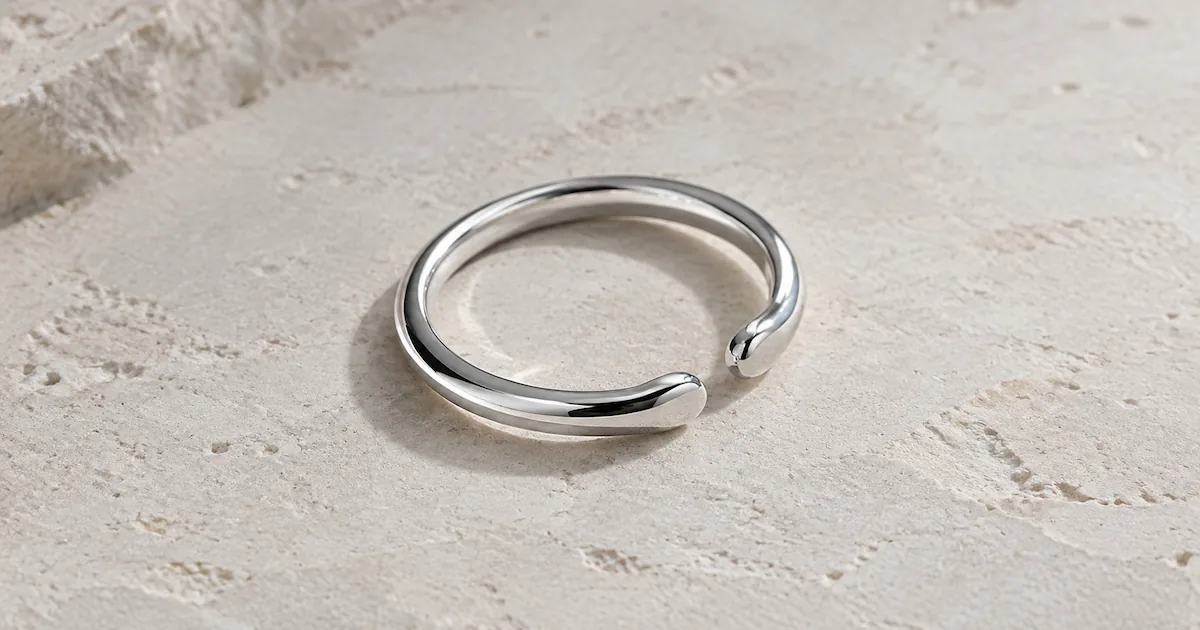
Why Adjustable Rings Break: Repeated Bending Explained
Understanding why adjustable rings break comes down to the mechanics of repeated bending and stress accumulation. Opening and closing an open metal band can create fatigue damage; repeatedly changing its shape can also work-harden it, leaving less ability to deform further.[1][3][5] Treat adjustment as a way to establish a comfortable fit, and minimize unnecessary reshaping.
That advice applies to open metal rings sized by reshaping the band. Rings with hinges, sliders, elastic cords, or engineered spring mechanisms need care instructions for their particular design. The word “adjustable” alone does not tell you how a ring should move or how much adjustment it can tolerate.
On this page
Why adjustable rings break after repeated bending
Repeated bending subjects a band to cycles of loading. Those cycles can start or enlarge cracks in a locally stressed area, eventually leaving too little intact metal to carry the load.[5] The final break may happen during a movement that feels small because damage developed earlier.[5]
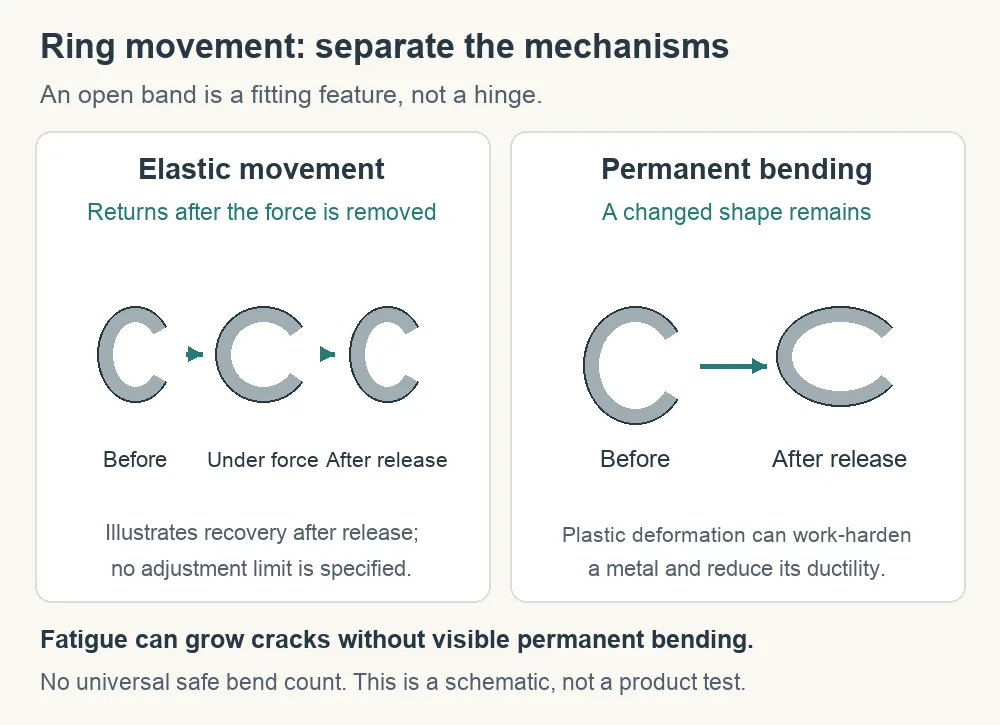
Imagine opening a ring to move it to another finger, squeezing it smaller later, and repeating that routine. Each change applies force to the band. The important question is where that force acts and how much deformation it produces. Fatigue can develop under repeated loads below the metal’s bulk yield point—the point at which it begins to take a permanent set.[2][5] Obvious permanent bending during every cycle is not required.[5]
A paper clip bent back and forth is a familiar illustration of repeated deformation ending in a break.[3] It helps explain the idea, but its bend count cannot tell you how long a jewelry ring will last. The materials, shapes, and movements differ.
Repeated adjustment is also only one possible contributor. A large one-time load or an existing flaw can be involved in failure.[2][5] A break alone does not establish whether the cause was adjustment, an accident, a manufacturing issue, or a combination.
Work hardening and fatigue are different processes
Work hardening changes how metal responds to further permanent reshaping. Fatigue describes damage that develops under repeated loading.[2][5] They can occur together during repeated resizing, but they are not interchangeable explanations.
When metal deforms plastically, defects called dislocations can multiply and obstruct one another’s movement. More force is then needed for further permanent deformation.[1][2] This is work hardening, also called strain hardening.
In jewelry metals, cold working generally increases strength and hardness while reducing ductility: the capacity to deform before breaking.[3] Controlled hardening can be useful in manufacturing. Trouble arises when further reshaping demands more deformation than the material can accommodate.[3]
| Process | What happens | What it means for a ring |
|---|---|---|
| Elastic response | The metal returns to its earlier shape after the load is removed.[2] | Springing back does not, by itself, prove immunity to fatigue.[5] |
| Work hardening | Permanent deformation makes further deformation harder and generally reduces remaining ductility.[1][3] | Repeatedly changing the fit can leave less capacity for further reshaping. |
| Fatigue | Damage accumulates under repeated loads, and cracks can grow toward failure.[5] | A modest final movement can complete a longer damage history. |
A ring becoming harder to reshape is a reason to seek guidance, not a signal to use more force. Hardness alone cannot tell you whether a particular band is sound.
Does the metal or band design matter?
Yes. Material behavior and the way a band carries force both matter.[3][5] The metal name alone cannot provide a dependable durability ranking for finished adjustable rings.
Jewelry alloys differ in how they work-harden, and working and annealing change their mechanical properties.[3] A ring’s history therefore matters alongside its material. General fatigue behavior also depends on loading conditions and the presence of flaws.[5] Claims such as “silver always outlasts brass” or “solid gold cannot break” need evidence for the actual designs being compared.
Look at where the band moves during an approved adjustment. If the movement repeatedly bends a narrow transition or creates a sharp kink, stop and request guidance. This is a practical application of the stress-concentration principle: fatigue cracks can begin where stresses concentrate around a flaw.[5] It does not establish one universal weak point shared by every open ring.
Ask the seller for the ring’s base material, intended size range, and adjustment method. Appearance and the word “adjustable” are not enough to answer those questions. If a band resists the instructed movement, do not compensate by pulling harder on its ends or decorative top.
How many times can you adjust a ring?
There is no reliable safe number that applies to every adjustable ring. Fatigue testing relates defined loading conditions to cycles until failure, and results vary between specimens.[5] A general metallurgy explanation cannot supply a tested adjustment limit for a specific piece.
A small fit correction and a large change across several finger sizes are different demands on a band. Counting both as “one adjustment” hides that difference. Repeatedly opening and closing a ring to try different fits also introduces more loading cycles than leaving an established fit alone.
Use the maker’s stated range and method. If either is missing, ask before changing the shape. Be cautious about universal promises expressed as a fixed number of bends or years of wear; those need testing tied to the ring, movement, and conditions.
For everyday care, minimize unnecessary changes. If your routine requires frequent resizing, ask whether another size or a different adjustment mechanism would be more suitable.
How to adjust an open ring with less unnecessary bending
Start with the maker’s instructions. For a ring specifically intended for gentle adjustment by hand, the following habits help you avoid unnecessary reshaping. They are precautions, not a tested lifespan guarantee.
- Confirm where adjustment belongs. Identify the intended adjustment area and size range. If the design or instructions are unclear, contact the seller or a jeweler first.
- Choose the finger you plan to use. Establish one comfortable fit and minimize switching between fingers that require different band shapes.
- Make only the change you need. Support the band as instructed. Avoid using stones, prongs, decorative leaves, or the ring’s top as handles.
- Check the fit without repeatedly reversing the bend. Stop if the ring needs force, twists, kinks, or becomes uneven. Do not use pliers or a mandrel unless the maker specifies that method and you have the necessary skill.
- Follow the intended removal method. Avoid developing a habit of prying the band wider every time you take it off. A fit that repeatedly needs substantial reshaping deserves a conversation with the maker.
As a further mechanical precaution, remove rings before tasks that put strong pressure on the band, such as lifting weights or gripping heavy tools. Keep them in a separate padded space when stored; GIA recommends padding jewelry to protect it from scratches and impact damage.[4]
When should you stop adjusting a ring?
Stop and arrange an inspection when you notice a change in the band or setting. Useful reasons to pause include:
- A line that appears to be a crack, especially near an area you reshape.
- A new kink, flattened section, or visibly uneven band.
- A rough edge or a decorative element that has shifted.
- A loose stone or a setting that no longer looks aligned.
These are prompts for inspection, not a diagnosis of fatigue. A surface scratch and a structural crack are different findings, and appearance alone may not settle which you have. Fatigue can involve internal or surface flaws and a period of crack growth before final fracture.[5]
Do not repeatedly flex the ring to “test” a suspicious line. Set it aside and ask a trained jeweler to examine it. If it breaks, keep both pieces and take clear photos for the seller or repair professional.
Can a jeweler repair a cracked adjustable ring?
A jeweler needs to assess the specific ring before advising on repair. Ask them to examine the band, joints, and settings, and to explain whether repair or replacement is the more practical option. GIA recommends choosing a jeweler with professional training and a good reputation.[4]
You may hear about annealing, a controlled heating process that can soften work-hardened metal and restore its capacity for deformation.[2][3] Softening metal is a different task from repairing a physical crack. Do not assume that annealing alone makes a cracked band ready to wear again.
Avoid heating a finished ring at home. Its metal and construction need professional assessment, and excessive heat or sudden temperature changes can damage some gemstones.[4]
When contacting the seller, describe what changed, how the ring was adjusted, and when the break occurred. Ask for an assessment before attributing the damage entirely to wear or to a defect.
Choose a fit that suits the finger and routine you actually use. Follow the intended adjustment method, minimize repeated reshaping, and treat structural changes as a reason to pause. That approach gives you practical control over avoidable bending while keeping durability expectations realistic.
For a related fit issue, read our guide to ring spinning and large knuckles. Our gold purity guide explains the material labels you may see when comparing bands.
Explore everyday jewelry at WearLumi.
Sources
- [1] University of Cambridge DoITPoMS: Work hardening in metallic polycrystals
- [2] The Open University: Manufacturing, 3.2 Properties for processing – forming
- [3] Santa Fe Symposium: Working, Annealing and Deformation Processes (2003)
- [4] Gemological Institute of America: Tips on Caring for Jewelry
- [5] David Roylance / MIT OpenCourseWare via Engineering LibreTexts: 6.5 Fatigue