
Gemology · Materials College
The Physics That Looks Like Magic: How Lab-Grown Diamonds Pass the Same 4C Grading as Mined Stones
Lab-grown diamond 4C grading uses the same four measures shoppers use for mined diamonds. Somewhere along the way, “lab-grown” picked up a reputation problem. Shoppers hear the word and picture rhinestones, drinking glasses, or the plastic gems in a party favor. The reality is stranger and more impressive: a laboratory-grown diamond is the same material as a diamond pulled from the ground, atom for atom, and it has to pass the same cold, measurable tests before a certificate gets printed.
Lab-Grown Diamond 4C Grading
A laboratory-grown diamond is a diamond: pure carbon crystallized in the same cubic structure as a mined stone, grown in weeks inside a reactor instead of over billions of years underground, and graded against the same four Cs by independent laboratories.
The chemistry is not similar. It is identical. A mined diamond and a lab-grown diamond are both 100 percent carbon arranged in the cubic crystal system, with every atom locked into four strong covalent bonds. That structure is why diamond sits at the top of the Mohs hardness scale at 10, why it resists scratching by anything a jeweler will hand you in daily life, and why it carries a refractive index of about 2.417 with a dispersion of 0.044. Change the growth method and you change the origin story, not the material.
Two reactors dominate commercial production. The HPHT method (high-pressure, high-temperature) recreates the extreme conditions of the earth’s mantle in a press, dissolving carbon into a molten metal flux that crystallizes onto a diamond seed. The CVD method (chemical vapor deposition) grows a stone layer by layer inside a vacuum chamber, feeding carbon atoms from a gas onto a seed. Both methods produce a diamond that gemologists cannot tell apart from a mined stone by eye. Differentiation requires laboratory instruments that read growth patterns, trace-element signatures, and fluorescence.
The confusion with moissanite and cubic zirconia is not a materials mix-up so much as a vocabulary problem. Moissanite is silicon carbide. Cubic zirconia is zirconium dioxide. Neither is carbon, and neither is a diamond. In 2018, the Federal Trade Commission removed the word “natural” from its definition of a diamond, recognizing that laboratory-grown stones share the same crystal structure, hardness, and optical behavior as mined ones. The FTC also stopped recommending the word “synthetic” in marketing, because consumer research showed buyers mistook it for “imitation.” That single vocabulary shift explains much of the lingering stigma: people were avoiding a word, not a material.
| Material | Chemistry | Refractive Index | Mohs Hardness | Is It a Diamond? |
|---|---|---|---|---|
| Lab-grown diamond | Carbon, cubic crystal | 2.417 | 10 | Yes |
| Mined diamond | Carbon, cubic crystal | 2.417 | 10 | Yes |
| Moissanite | Silicon carbide (SiC) | 2.65–2.69 | 9.25 | No — simulant with extra fire |
| Cubic zirconia | Zirconium dioxide (ZrO₂) | ≈2.15 | 8–8.5 | No — simulant |
| Glass | Silica-based | ≈1.5 | ≈5.5 | No — simulant |
For daily-wear jewelry, hardness matters more than most buyers realize. A stone that lives at Mohs 10 shrugs off the scratches that slowly dull a softer gem. If you want the full picture of how hardness maps across gemstones, our Mohs hardness and jewelry care guide walks through the whole scale stone by stone.
Decoding the Four Cs: How Lab-Grown Diamonds Face the Same Rigorous Grading
The four Cs — carat, cut, color, and clarity — were built by GIA in the 1940s and 1950s as a shared language for comparing diamonds. They were never a natural-diamond-only system. They grade the physical qualities of a stone, and origin is not one of those qualities. A lab-grown diamond enters the same grading workflow, sits in the same trays, and is measured by the same instruments as a mined stone of the same size.
The International Gemological Institute (IGI) has stated publicly that it will keep applying the universal 4C grading scale to all diamonds, laboratory-grown and natural alike. That means a lab-grown diamond certificate from IGI carries the familiar D-to-Z color scale, the FL-to-I3 clarity scale, cut grades for round brilliants, and carat weight measured to 0.01 carat — exactly the language used for mined diamonds. Because IGI grades the vast majority of laboratory-grown stones sold today, most lab-grown diamond certificates sellers show you will look very much like a traditional diamond certificate, with one crucial addition: the report states the stone is laboratory-grown.
GIA, the institute that invented the four Cs, also certifies lab-grown diamonds under its Laboratory-Grown Diamond Report program. Every report is tied to a laser inscription on the stone’s girdle that reads “Laboratory-Grown” alongside the report number, and the report notes whether the stone was made by HPHT or CVD, and whether it was treated after growth. In 2025 GIA simplified its lab-grown quality descriptors, because more than 95 percent of laboratory-grown stones entering the market land in a very narrow band of color and clarity, so the full natural-diamond letter scale lost its distinguishing power. The grading is still rigorous, instrument-based, and issued by an independent non-profit laboratory.
The practical takeaway is simple. Whether a certificate comes from IGI or GIA, the four Cs are applied to laboratory-grown stones with the same physical measurements, the same 10x loupe checks, and the same tolerance for error as mined diamonds. And because the report explicitly flags the stone as laboratory-grown, certification also doubles as honest labeling — which is exactly what the FTC asks of every seller.
Cut and Refractive Index: The Physics That Locks In Brilliance
Of the four Cs, cut is the one you can feel in your hands without any instruments. Cut describes the proportions, symmetry, and polish of a stone, and it decides what happens to light that enters the crown. A well-proportioned round brilliant lets light travel down through the pavilion, bounce off internal facets, and return through the crown to your eye. A stone cut too deep lets light leak out the bottom. A stone cut too shallow lets it escape through the sides. The physics of total internal reflection turns good geometry into a constant, liquid sparkle.
The refractive index is the deeper reason diamond behaves the way it does. At 2.417, diamond bends light sharply as it enters and slows inside the crystal, which is what produces its characteristic brilliance and fire. That number is identical in grown and mined stones, because it is set by the carbon crystal structure, not by the history of the crystal. Our guide to recycled gold and lab-grown diamonds explains how this material fits into sustainable jewelry choices.
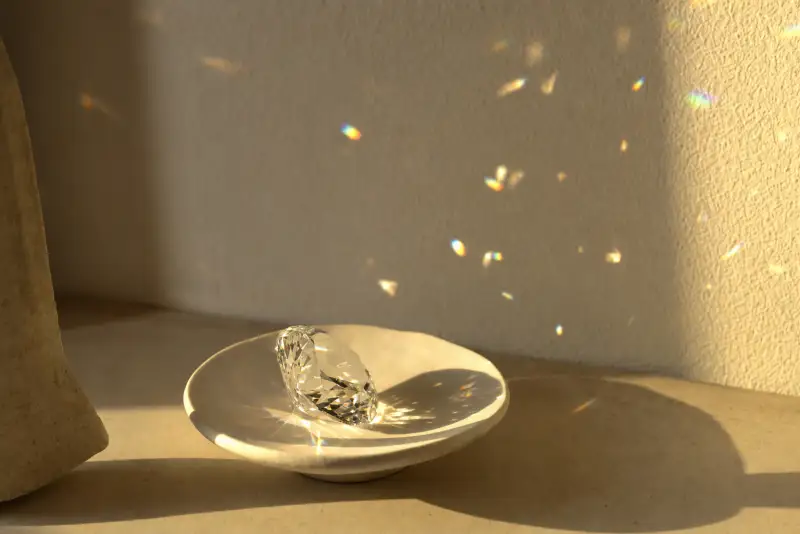
This is also where simulants give themselves away to a trained eye. Moissanite bends light more (2.65 to 2.69) and disperses it harder, so it throws noticeably more rainbow fire than diamond. Cubic zirconia sits lower than diamond at about 2.15, so it looks glassier and less crisp. Compare stones side by side in daylight and the differences become obvious, no loupe required.
Carat, Color, and Clarity: Grading at the Industry’s Ceiling
Carat is pure weight — one carat equals 0.20 grams — and laboratory scales do not care where a stone was formed. A lab-grown diamond is weighed on the same calibrated balances with the same 0.01-carat precision as a mined stone, and larger stones still command proportionally higher prices because they take longer to grow in any reactor.
Color is measured the same way too: a trained grader compares the stone against a master set under controlled lighting, moving from D (colorless) through Z (light yellow or brown). Because growth conditions can be tuned, laboratory-grown diamonds frequently land in the colorless D-to-F range, which is one reason the technical ceiling of lab-grown quality is so high.
Clarity is assessed at standard 10x magnification, from FL (flawless) down through VVS, VS, SI, and I grades. Laboratory-grown stones, grown in controlled environments, commonly grade VS to SI with clean, bright faces. On HPHT stones, a grader may spot tiny metallic flux inclusions from the growth process — an identification clue for the laboratory, and rarely something visible to the naked eye.
| 4C | What It Measures | Scale on a Certificate | Where Lab-Grown Often Lands |
|---|---|---|---|
| Carat | Weight | 1 ct = 0.20 g, graded to 0.01 ct | Any size, priced by weight |
| Cut | Proportions, symmetry, polish | Excellent to Poor (round brilliants) | Excellent and very good are common |
| Color | Whiteness of the stone | D (colorless) to Z (light yellow) | D to F common; growth can be tuned |
| Clarity | Inclusions under 10x magnification | FL (flawless) to I3 | VS to SI typical |
How to Read an IGI or GIA Certificate: Your Anti-Fraud Card for Ethical Jewelry
A certificate is the difference between trusting a sticker and trusting a measurement. When you buy a laboratory-grown diamond, the report tells you exactly what you are paying for and where the stone came from, and it gives you a way to check the seller’s story in about two minutes.
- Check the report number online. IGI and GIA both run free report-verification pages on their websites. Type in the report number from the certificate and you should see the same carat weight, cut, color, clarity, and growth method.
- Confirm the inscription on the stone. Every certified lab-grown diamond carries a laser inscription on its girdle with the report number and the words “Laboratory-Grown.” A 10x loupe is enough to read it, and it must match the certificate.
- Look for the origin disclosure. FTC rules require the words “laboratory-grown” or “laboratory-created” to appear right with the word “diamond,” in the same size and weight as the rest of the description, not hidden in a footnote.
Red flags to walk away from.
No certificate at all. A report number that does not verify on the lab’s official website. A laser inscription that does not match the report. A document printed by the seller’s own brand instead of IGI, GIA, or another independent laboratory. And marketing that calls moissanite or cubic zirconia a “diamond” — simulants are beautiful materials, but they are not diamonds, and the FTC treats that distinction as non-negotiable.
None of this is about finding a cheap diamond. It is about removing the guesswork. When a stone carries a verifiable 4C report from an independent laboratory, its quality is a documented fact, and its origin is printed on the certificate. That transparency is the backbone of ethical jewelry: traceable materials, honest labeling, and buying decisions made with information instead of marketing.
Laboratory-grown diamonds are not a substitute for the real thing. They are the real thing, made by a different route and held to the same standard. The next time someone tells you grown stones skip quality control, ask them to show you a certificate — then check the number on the lab’s website. The science holds up every time.
Keep reading
Lab-Grown Diamonds and the 4C Standard: FAQ
Are lab-grown diamonds real diamonds?
Yes. A lab-grown diamond is pure carbon crystallized in the same cubic structure as a mined diamond, with the same hardness (Mohs 10), the same refractive index (2.417), and the same optical behavior. The FTC removed “natural” from its definition of diamond in 2018, recognizing that laboratory-grown stones are diamonds. Sellers must label them “laboratory-grown,” but that label describes origin, not quality.
Are lab-grown diamonds graded with the same 4Cs as mined diamonds?
Yes. Both IGI and GIA apply the four C grading framework to laboratory-grown stones. IGI uses the same D-to-Z color scale, FL-to-I3 clarity scale, and cut grades it applies to mined diamonds, and the report states the stone is laboratory-grown. GIA issues Laboratory-Grown Diamond Reports with a laser inscription and growth-method details.
What is the difference between a lab-grown diamond, moissanite, and cubic zirconia?
Chemistry. Lab-grown diamonds are carbon, moissanite is silicon carbide, and cubic zirconia is zirconium dioxide. Moissanite has a higher refractive index and more fire; cubic zirconia sits lower and looks glassier. Only diamond — mined or grown — measures Mohs 10 with a refractive index of 2.417.
Can a lab-grown diamond pass a diamond tester?
Yes, because a diamond tester measures thermal and electrical conductivity, and laboratory-grown diamonds share those properties with mined diamonds. A good tester will read a lab-grown stone as diamond. This is also why certification matters: some simulants can fool basic testers, but a verifiable 4C report is definitive.
How do I verify an IGI or GIA lab-grown diamond certificate?
Go to the free report-verification page on the laboratory’s official website and enter the report number. Confirm the carat weight, cut, color, clarity, and growth method match, then check that the laser inscription on the stone’s girdle matches the same number.
Are lab-grown diamonds more ethical and more affordable?
They avoid the environmental and social questions that come with open-pit mining, and every certified stone carries a traceable origin. Pricing is typically lower than an equivalent mined diamond because supply is a matter of reactor time rather than geological luck. Lower price is a benefit of the process, not a signal of lower quality.
Build a jewelry box that tells the truth about its materials.

One Comment