
Jewelry Materials College · Craftsmanship
Hollow vs. Solid Gold Jewelry: Weight, Durability, and the Design Trade-Off
Hollow vs solid gold jewelry is a design choice that balances scale, weight, and durability. That “too light” moment when you unbox a pair of hoops is one of the most common doubts in jewelry — and one of the most misunderstood. Here is the honest physics behind hollow and solid construction, why the lightest oversized earrings may be the kindest to your earlobes, and how to verify 14K gold weight before you judge it.
Hollow vs Solid Gold Jewelry
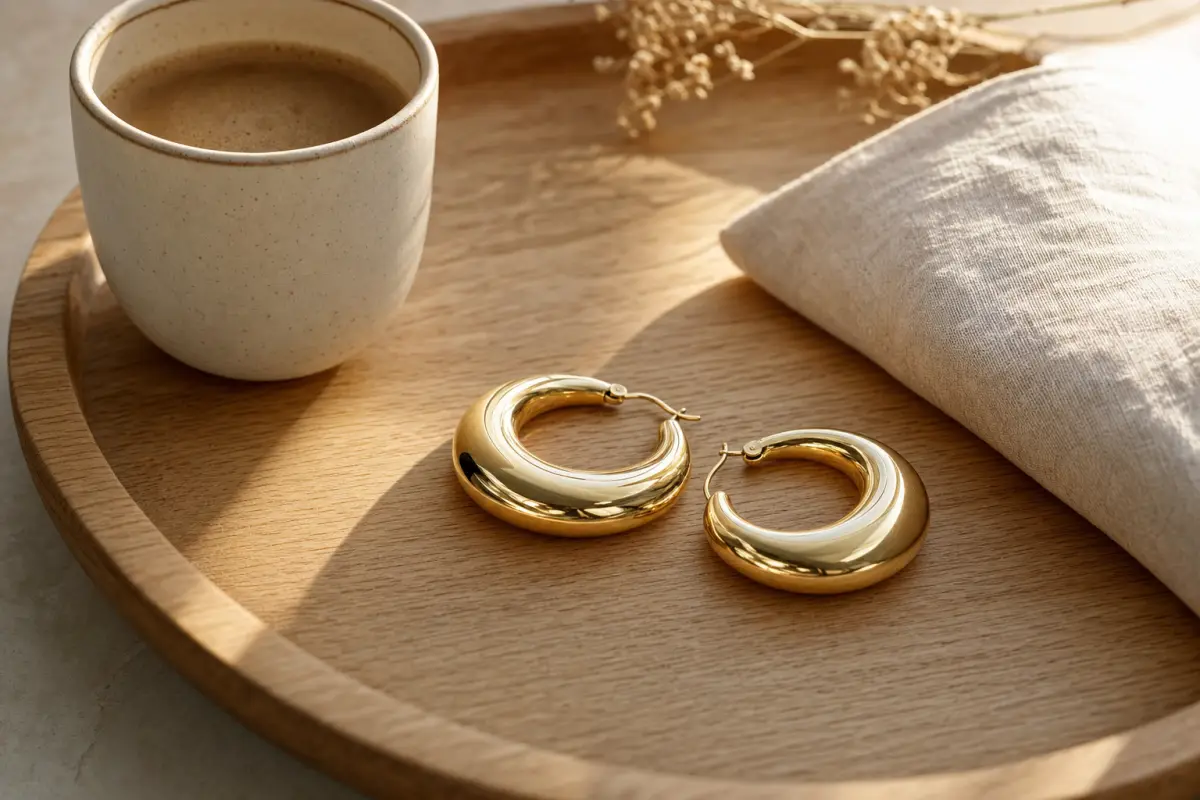
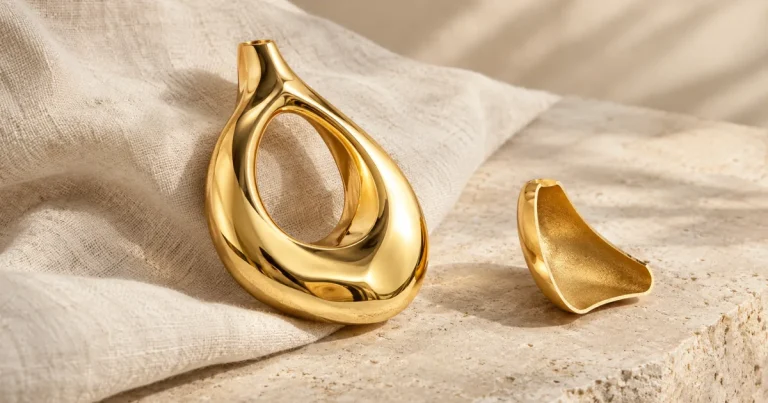
Hollow jewelry is a manufacturing approach in which the outer shape of a piece matches a solid version but the interior stays empty — a thin metal tube or electroformed shell — preserving full volume and silhouette while cutting metal weight by half or more.
Here is the first thing worth internalizing: gold is sold by the gram. That is the entire basis of “metal value,” and it is also the reason weight and size grow together in solid jewelry. The moment a design gets bigger, the metal bill explodes — and so does the load on your body. We worked through the geometry for two common hoop sizes (14K gold density is about 13 g/cm³, sterling silver about 10.5 g/cm³):
| Hoop size | Solid 14K | Hollow 14K (wall ≈ 0.5 mm) | Hollow vs. solid weight |
|---|---|---|---|
| 40 mm (1.6 in) hoop, 3 mm tube | ≈ 11 g per earring | ≈ 6 g per earring | ≈ 55% |
| 55 mm (2.2 in) bold hoop, 5 mm tube | ≈ 40 g per earring | ≈ 14 g per earring | ≈ 35% |
Look at the bottom row for a second. A pair of 55 mm solid 14K hoops weighs about 80 grams total. The same shape in solid sterling silver is about 32 grams per earring. This is not “slightly heavy” territory — it is a daily load that slowly pulls the piercing hole downward, keeps the tissue red and irritated, and in the worst cases tears an earring straight through the lobe. It is also exactly why you will not find a serious jewelry brand selling solid 14K oversized hoops: not because the design is impossible, but because nobody could actually wear them all day.
The first truth about “lightness”: for large earrings, weight is not a badge of quality — it is the enemy of comfort. Hollow construction removes more than half of it while keeping every millimeter of the silhouette, which is the reason your ears thank you after hour eight. If you are sensing a theme here, it is this: lightness can be engineering care, not corner-cutting.
One honest caveat before we move on: not all hollow pieces are equal. The quality difference lives in wall thickness, seam construction, and structural reinforcement — which is exactly what the next section unpacks.
Hollow vs Solid Gold Jewelry: Two Design Philosophies with Different Jobs
Every piece of jewelry has two independent variables: volume (the visual shape) and weight (the metal cost). Designers tune these two dials for the way you actually wear the piece. Hollow and solid are the two philosophies that result — and each one is right for a different job.
Hollow-Tube Hoops: The Lightweight Magic Behind Oversized Earrings
The classic technique behind big hollow earrings is hollow-tube construction: a metal tube (seamless or welded) formed into the hoop shape, typically with a wall just 0.4–0.8 mm thick, then sealed at the connection point. Electroforming is the other common route — metal is deposited onto a wax or resin form that is later melted away, leaving a thin, seamless shell.
Why is this technology made for hoops specifically? Because a hoop’s visual impact comes entirely from the outer frame — the diameter plus the tube thickness — not from how much metal fills the cross-section. A hollow tube keeps 100% of the shape language at one-third to one-half of the weight. You get an earring with real presence that weighs about the same as a small ring, which means it survives commuting, daycare drop-offs, and business trips without ever announcing itself on your ears.
Now the durability truth, laid out honestly:
- Hollow does not mean fragile. A round tube is one of the most bend-resistant cross-sections in engineering — think of how hard it is to kink a drinking straw compared with a solid wire of the same outer size. Normal wear (putting them on, washing, sleeping, brushing against things) will not damage a well-made hollow hoop.
- Hollow’s real enemy is extreme pressure. The genuine risk scenarios are: crushed at the bottom of an overstuffed suitcase, bent by body weight when you sit on them, or aggressive stress-test bending.
- Craftsmanship decides lifespan. A quality hollow piece has even wall thickness, secure seams, and reinforced connection points. A bad one has paper-thin walls and a seam that pops on day two. The difference is workmanship — not the hollow label.
Here is a quiet industry fact: nearly every major brand’s oversized gold and silver hoops are hollow. It is the standard solution for high-end everyday jewelry, not a sign of a low-end product.

Solid Gold and Silver: Why Small Pieces Earn Their Weight
Solid construction is the other philosophy: the piece is made from solid metal with no cavity, so weight and volume stay strictly proportional.
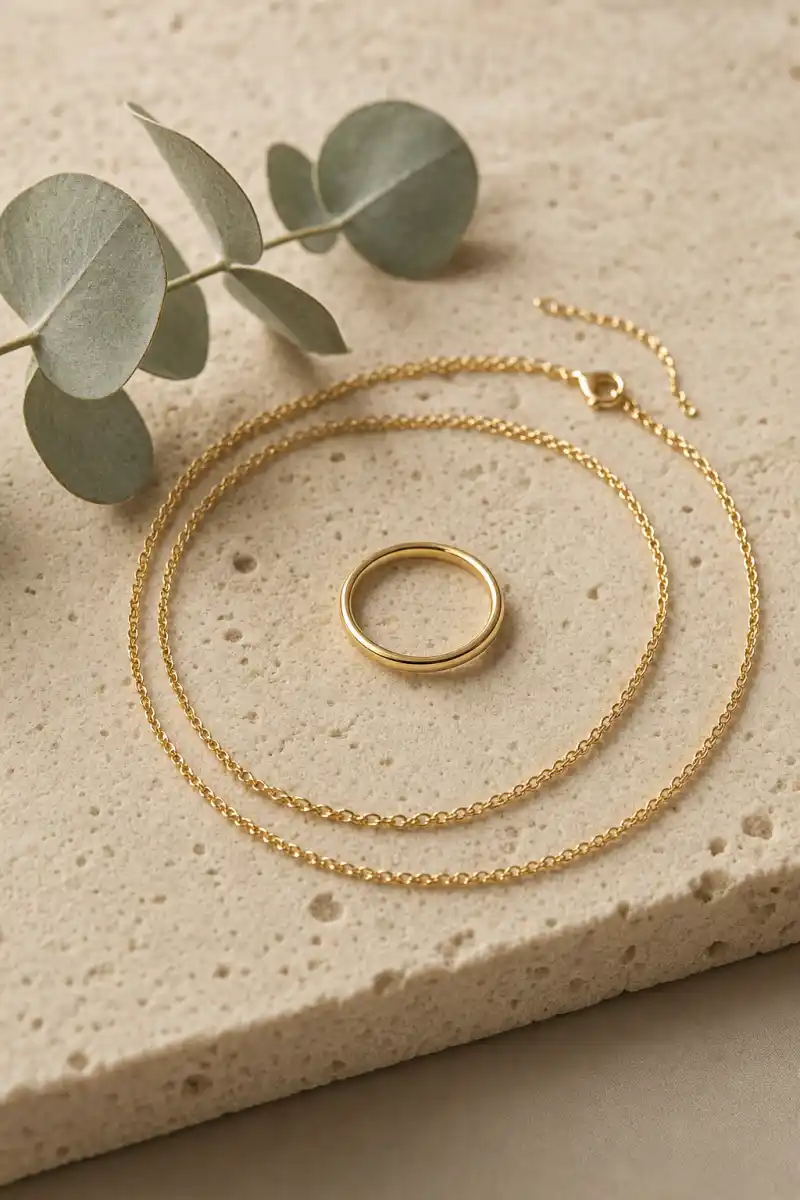
Why do small pieces actually belong in solid? Because their gram count is already tiny. An 18-inch 14K chain with a delicate 0.5 mm wire weighs about 1.5 grams; a slim 2 mm 14K band ring is around 2 grams. At this scale, solid gold is neither expensive nor heavy — and it buys three experiences that hollow cannot deliver:
- Heft and presence. “Thin, but with a satisfying weight” is the quiet luxury signature of a solid chain — it drapes close to the collarbone and feels substantial when you touch it.
- Bend resistance. The strength of a small solid piece comes from the metal itself, so it holds its shape through years of daily wear and can stay on 24/7 without worry.
- Layering anchor. A stack needs a steady base to hold the composition together — solid chains and slim bands are exactly that anchor, while hollow pieces float on top for volume.
The philosophy, in one sentence: big pieces go hollow to stay light and elegant; small pieces go solid to hold their weight and shape. When the size grows (a chunky chain, a wide cuff, a massive hoop), solid gold’s weight and price grow with it — that is physics, not a quality signal.
How to Choose: Match the Physical Weight to Your Wearing Habits
Stop asking “which is better” and start asking “when do I wear it, and for how long?” This table is a practical cheat sheet for matching construction to your life:
| Wearing scenario | Best choice | Why |
|---|---|---|
| All-day daily wear (commute, office, kids) | Hollow large pieces + solid small pieces | Comfort rules: zero earlobe strain, chain detail still reads |
| Date nights, dinners, photos | Solid or heavier pieces | That deliberate drape and ceremony — weight reads as polish |
| Gym, workouts, travel | Lightest pieces, or none | Impact can dent; sweat can corrode; suitcases can crush |
| Layered stacking | Solid base + hollow accents | Composition and depth without the total weight adding up |
| Everyday forever pieces | Solid chain or slim band | Bend-resistant, low maintenance, never needs to come off |
The one-line formula: big pieces hollow, small pieces solid, and anything that touches your skin judged by metal quality first. Earring posts and ring interiors should be hypoallergenic regardless of hollow or solid — that is a separate quality line entirely.
How to Verify 14K Gold and Karat Weight: Three Checks That Beat a Hand Scale
The “too light” doubt is, underneath it all, a fear of buying something fake or underfilled. Skip the hand-feel guessing and run three verifiable checks instead:
- Read the hallmark. In the US market, genuine 14K gold jewelry should carry a clear 14K or 585 stamp (585 means 585 parts per thousand — 14 out of 24 — i.e., 58.3% gold). Sterling silver is stamped 925 or Sterling. No hallmark on a piece labeled precious metal? Hold that thought, whatever it weighs.
- Weigh it. A 0.1 g jewelry scale costs about twenty dollars. Measure the piece and compare with the listed weight — an honest listing is normally within about 0.2 grams. The number matching is your first trust checkpoint.
- Think in grams-and-volume together. Never judge value by weight alone. A 4 g solid pendant and a 4 g pair of hollow hoops are both completely legitimate — they are just different design decisions. What deserves suspicion is a big “14K” piece with an implausibly low weight (a wall under about 0.2 mm is a red flag for thin-wall junk), and any piece that fails a density check: pure gold is 19.3 g/cm³, 14K is about 13 g/cm³, and gold-plated copper sits far below that.
Want the full picture on purity levels? Our 10K vs. 14K vs. 18K vs. 24K gold purity guide walks through every karat, what it does to color and durability, and which one fits which kind of jewelry.
Hollow vs. Solid Jewelry: Your Questions, Answered
Are hollow or solid gold earrings better?
Neither is universally better. Large pieces — hoops, wide bangles, big pendants — are usually hollow so they keep their full silhouette at roughly half the weight and a more affordable price. Small pieces — chains, slim rings, studs — are usually solid because their gold weight is already low, which gives them a satisfying heft and better resistance to bending. Choose by scenario, not by whichever option sounds more premium.
Is heavier jewelry better quality?
Gold and silver are priced by weight, so gram count is part of the cost — but design intent decides how that weight is distributed. A well-made hollow piece is often harder to produce than a plain solid one: uniform thin walls, secure seams, and reinforced connection points are genuine craftsmanship. Lightness done right is a feature, not a shortcut.
How can I tell if my 14K gold is real and the weight is accurate?
Run three checks: look for the hallmark (14K or 585 on gold, 925 or Sterling on silver), weigh the piece on a 0.1 g scale and compare it to the listed weight, then check the grams-and-volume combination — an oversized piece with an implausibly low weight points to thin-wall construction. Density is the physical hard test: gold is 19.3 g/cm³ and 14K is about 13 g/cm³. Our gold purity guide covers the whole karat system in detail.
Are hollow hoops or solid hoops more durable?
In normal everyday wear, a well-made hollow hoop is plenty durable — a round tube is one of the most bend-resistant shapes in engineering, and daily wear will not damage it. Solid hoops only show a clear advantage under extreme bending tests. Wall thickness and seam quality matter far more than the hollow-versus-solid label.
Is hollow gold jewelry cheap or low quality?
No. Hollow construction is the standard engineering answer to “large silhouette + wearable weight + reasonable price” — it is how almost every major brand makes oversized gold and silver hoops. What deserves suspicion is a badly made hollow piece with paper-thin walls and weak seams. That is a workmanship problem, not a design problem.
Will hollow hoop earrings bend or break easily?
Not in normal wear. The high-risk scenarios are extreme pressure: crushed under a packed suitcase, bent by body weight, or aggressive stress-test bending. Store hollow pieces in a dedicated compartment or soft pouch when you take them off (more storage tips in our jewelry storage guide), and a quality hollow hoop will last for years — most dents can even be reshaped and repaired by a jeweler.
Keep reading
- Helix, tragus, and daith piercings: healing, pain, and aftercare — what your earlobes and cartilage need to stay healthy
- Curated ear stacking: build a balanced ear constellation — mix solid studs with hollow hoops the right way
Jewelry that earns its place in your everyday — light where it should be, solid where it counts.

One Comment