Drop Earring Comfort: Gravity, Torque and Disc Backs
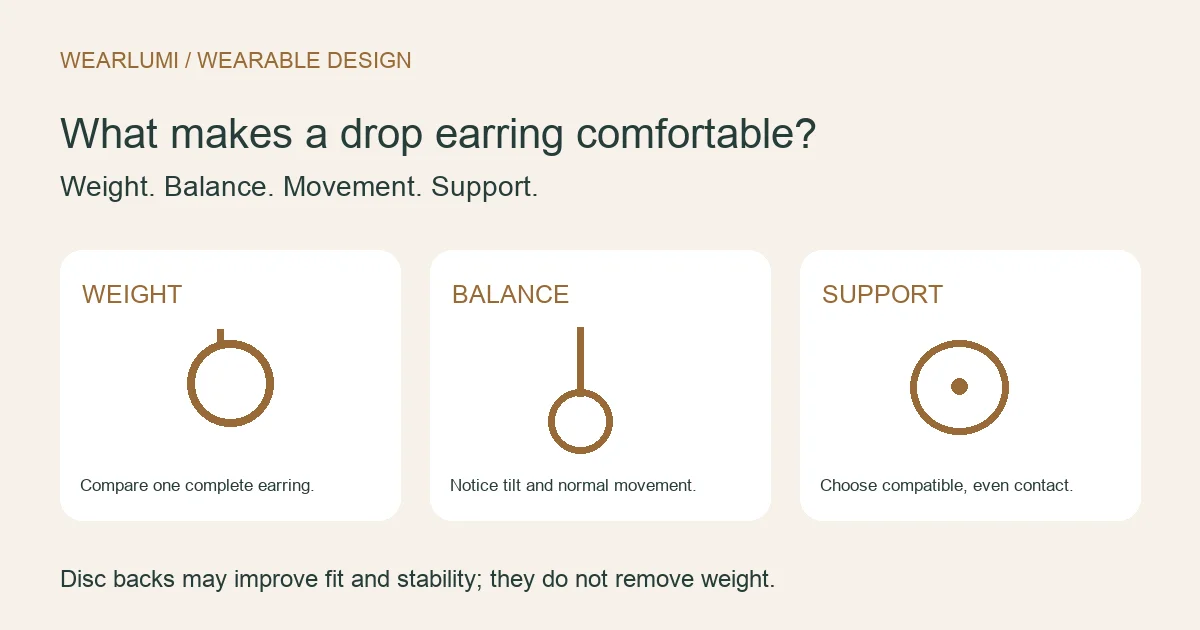
Drop earring comfort depends on weight, balance, movement, and support. At rest, a drop earring and a stud of the same mass have the same weight. A long drop may feel more noticeable because it swings or transfers changing loads through its attachment. A forward-projecting design can also create a tilting moment. Disc backs may improve stability and local contact pressure, but they do not remove the earring’s weight.
A Wearlumi podcast-style explainer and buying guide. The dialogue below is an editorial script, not a transcript of an expert interview.
In this episode
- Drop earring comfort starts with weight
- Center of gravity: where tilting begins
- Why movement changes the pulling sensation
- What disc backs can—and cannot—change
- Choose effective contact, not just a bigger diameter
- A practical drop earring buying checklist
- When better support is not enough
- Bring three questions to your next try-on
Drop earring comfort starts with weight
Length alone does not increase an earring’s static weight. The first useful comparison is the mass of one complete earring, including its back.
Host: Two earrings each weigh five grams. One sits against the lobe; the other hangs near the jaw. Why might the longer one feel more demanding?
Explainer: Because “how heavy it is” and “how it loads your ear” are different questions. Weight sets the baseline. The shape, attachment, motion, and contact points determine how that load reaches the lobe.
Weight is W = mg, where m is mass and g is gravitational acceleration. A five-gram earring has a weight of about 0.049 newtons near Earth’s surface. Turning that mass into a longer shape does not make gravity stronger. This is a calculation example, not a recommended weight or a safety limit.
If an earring is stationary and the ear is its only support, with no help from clothing or another surface, the total vertical support force must balance its weight. Local forces can still differ: a design may press, tilt, or concentrate contact around the piercing even when the total downward load is unchanged.
Host: So a stud is not automatically comfortable just because it is short?
Explainer: Correct. A bulky stud projecting forward may feel less stable than a longer, freely hanging drop. Compare complete designs, rather than treating length as a comfort score.
Center of Gravity: How Balance Affects Drop Earring Comfort
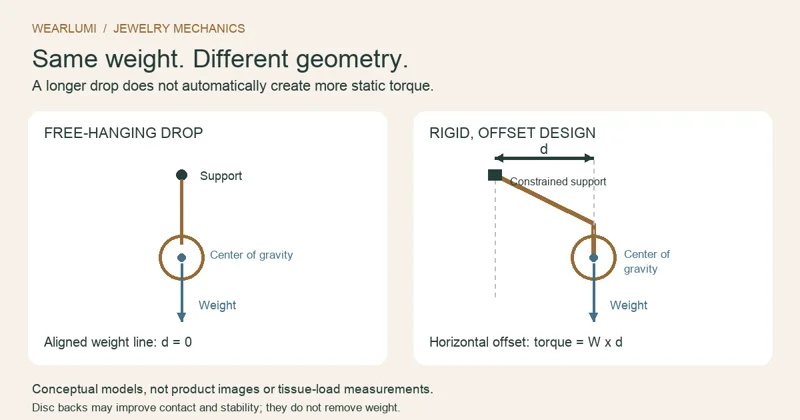
The tilting effect of gravity depends on the perpendicular distance between the support reference point and the line of action of the weight. With gravity acting downward, that distance is a horizontal offset—not simply the distance the earring hangs below the ear.
Host: Where does the lever effect fit into this?
Explainer: Imagine the weight of the whole earring acting at its center of gravity. In a nearly uniform gravitational field, that is a useful way to describe the effect of its mass distribution. The center of gravity is not the hinge or the post; it is a representative location for the weight.
For a simplified model, the magnitude of gravitational torque is τ = W × d. Here, d is the shortest distance from the chosen support point to the vertical line through the center of gravity. OpenStax’s explanation of torque calls this perpendicular distance the lever arm.
Take two rigid designs, each weighing five grams. If the weight’s line of action is two millimeters in front of a support reference point, the gravitational torque is about 0.098 millinewton-meters. At eight millimeters, it is about 0.392 millinewton-meters: four times the torque, with the same weight. These numbers illustrate geometry; they do not predict tissue damage or discomfort.
A freely hanging pendant offers a useful counterexample. When its center of gravity settles directly below the suspension point, its gravitational torque about that point can be close to zero—even if it is long. The attachment still supports its weight.
Real earlobes are flexible, and the contact geometry changes as a design tilts. A rigid earring model helps explain a tendency to rotate; it does not turn the earlobe into a fixed metal hinge.
Why movement changes the pulling sensation
A moving earring can place a changing load on its support. Swing, speed, and connection design matter; there is no universal multiplier that makes every long drop feel heavier than every stud.
Host: Some drops feel fine while I’m sitting, but I notice them as soon as I walk.
Explainer: Your head moves, and the earring responds. The support force helps change the earring’s velocity and direction as well as balancing gravity. That can make the size and direction of the load vary over time.
A hanging drop can be understood through a pendulum model, although real earrings have distributed mass, joints, and damping. In an ideal pendulum at the bottom of its swing, the tension is T = mg + mv²/L, where v is speed and L is pendulum length. The additional term shows why a moving load can exceed the resting weight at that point.
It does not show that a longer earring always produces more tension. Speed and swing amplitude also depend on the motion. Even within this ideal model, changing length alone is not enough to predict what a person will feel. OpenStax’s pendulum chapter provides the underlying model; applying it to earrings is a mechanical analogy, not a clinical comfort test.
Host: What should I notice during a try-on?
Explainer: Whether the design swings freely, settles smoothly, repeatedly changes direction, or catches on something during ordinary movement. Compare sitting, turning your head, and walking normally. Do not deliberately tug on the jewelry to test your ear.
What disc backs can—and cannot—change
A compatible disc back may help improve drop earring comfort by stabilizing a post-style earring and spreading contact forces behind the lobe. It cannot cancel gravity, and the back itself adds a little mass.
Host: Is a wider back like a little tray carrying the whole earring?
Explainer: That picture is too simple. A disc sits behind the lobe rather than underneath the entire load. The post, front of the earring, back, and tissue around the piercing all participate in transferring forces.
The useful starting principle is average pressure: P = F/A. For a given force acting perpendicular to a contact surface, increasing the effective area reduces average pressure. OpenStax’s pressure chapter explains this relationship.
But the relevant force is the force actually transmitted through that contact—not automatically the full downward weight of the earring. The actual load path may involve normal contact forces, friction, and resistance to tilting. Dividing the earring’s weight by the disc’s advertised area does not calculate the pressure inside the piercing.
Likewise, a disc four times larger does not establish a 75% reduction in injury risk. Such a claim would need specific contact measurements and clinical evidence. The practical, conditional claim is narrower: a properly fitted, compatible back may improve stability and local pressure distribution. This is a design inference from mechanics, not a proven medical benefit for a particular product.
Choose effective contact, not just a bigger diameter
A useful back must fit the post, sit comfortably against the lobe, and hold the earring without excessive squeezing. A larger nominal diameter is not necessarily a larger effective contact area.
Host: How do I choose one?
Explainer: Start with compatibility, then look at how it actually sits. A broad disc that touches only along a tilted edge may provide less useful support than its dimensions suggest.
- Check the closure. Use a back intended for the post’s diameter and fastening system. A conventional disc back for a straight post is not automatically suitable for a fishhook or a different closure.
- Look for even contact. Notice whether the disc sits against the lobe or rocks, lifts, or bears mainly on one edge. Lobe shape and piercing position affect the fit.
- Inspect the surface. Choose intact hardware with smooth edges and no obvious burrs or concentrated pressure points.
- Adjust without squeezing. Pushing a back tighter adds contact pressure. Tightness is not a substitute for appropriate weight and geometry.
- Compare the whole result. Check whether forward tilt improves and whether the ear remains comfortable during normal movement. A straighter-looking earring that feels persistently compressed is not a successful fit.
There is no single disc diameter that suits every lobe. Post length, front-piece shape, piercing position, and space behind the ear all matter. If closure security is the problem, see our guide to loose clicker hoops and earring backs; security and load distribution are related but separate questions.
A practical drop earring buying checklist
Compare weight per ear, mass placement, connection behavior, and the supplied support. These questions make shopping comparisons more useful without promising a universal comfort threshold.
Host: What should I ask before buying?
- Is the listed weight for one earring or the pair? Ask whether it includes the supplied backs.
- Where is the heavier decoration? Notice both its downward position and whether the design projects forward from the lobe.
- Is the connection rigid or articulated? A fixed design and a freely hanging drop can transfer loads differently.
- Does the back match the design? Check compatibility and practical fit, not simply the size shown in a photograph.
- How does it feel during ordinary movement? Appearance alone cannot establish comfort.
A visually large piece is not necessarily heavier than a small solid one. Our hollow versus solid jewelry guide explores how construction changes weight and other design trade-offs. That context does not replace an actual weight specification for the earring you are considering.
For a fully healed piercing with no current discomfort, begin with a brief try-on and compare stillness with normal movement. This is a shopping recommendation, not a validated safe wearing duration. Product descriptions that omit weight or support testing should not be treated as ergonomic verification.
When better support is not enough
Persistent pulling or discomfort is a reason to stop that wear session, rather than tighten the back further or try to get used to it.
Host: What if the disc back helps the earring sit upright, but my ear still hurts?
Explainer: Stop wearing it. A support accessory is not a reason to ignore symptoms. Seek medical assessment for significant pain, bleeding, ongoing elongation of the piercing, or damaged tissue. For a new or recovering piercing, follow professional aftercare guidance instead of using this try-on method to test heavy drops.
Cleveland Clinic identifies heavy earrings as a possible cause of stretched piercing holes and changes to the earlobe. That supports taking weight and visible changes seriously. It does not establish one safe gram limit or wearing time for everyone.
This guide explains mechanics and shopping considerations. It does not diagnose the cause of ear discomfort or claim that disc backs prevent stretching or tears.
Bring three questions to your next try-on
Host: How much does one complete earring weigh? Is its center of gravity offset from the support? Does the back actually fit?
Explainer: Then add what happens when you move. Ultimately, achieving lasting drop earring comfort comes from balancing mass, connection, and support. A disc back can be a great tool, but matching the earring’s physics to your ear is the true key.
Sources and scope
- OpenStax, University Physics Volume 1: Torque — perpendicular lever arms and turning effects.
- OpenStax, University Physics Volume 1: Pendulums — the idealized motion model.
- OpenStax, College Physics 2e: Pressure — force divided by effective area.
- Cleveland Clinic: Earlobe Repair — heavy earrings and stretched earlobes or piercing holes.
The numerical examples and diagram illustrate simplified mechanics. Recommendations about disc-back fit are design inferences and editorial guidance, not clinical results or Wearlumi product-test claims.